The Argentine feminist anthropologist Rita Segato describes the emerging fascist states in Abya Yala as made possible, in part, by what she calls the “para-statal sphere of control of life”. She explains that the drug trade that occurs on street corners is part of an organisational structure that allows these new forms of anti-social governance to reach every block of the city. In this context, and over the last few decades, the idea of a possible narco-state has emerged. Since the 1970s, in drug-producing countries such as Colombia, or trafficking countries such as Mexico, and even in the suburbs of European welfare states, organised cartels and syndicates have become ever more powerful and far-reaching. More than simply being a source of profit for organised criminal gangs, the drug trade also serves as a violent and efficient way of penetrating each street corner in cities to keep society under control. And, with a presence in most countries of the world, has the drug trade reached the power and reach of a state? Or have they penetrated so deeply into some states, such as Ecuador and Afghanistan, that they have turned them into narco-states?
This rapid surge in the presence of drug cartels around the world can be surprising when contrasted with the massive efforts to combat the global drug trade through the so-called War on Drugs. This war has been ongoing since Nixon planted the idea in the consciousness of the general public in 1971. There is a major contradiction between the growing problem and the increasingly harsh reality of drug abuse, from Baltimore in the US to Amed in Kurdistan, and the increasing military capacity of capitalist modernity and its supposed efforts to eliminate the drug problem through military means.
During these years of the surge and development of the international drug trade, the enigmatic idea of the narco-state has emerged in our political imagination. In relation to Öcalan’s analysis of the history and reality of the state, it seems important at this moment, when cartels are becoming increasingly powerful and hegemonic states develop initiatives such as the Shield of the Americas, initiating a new “War on Drugs”, to understand clearly what the narco-state is. This is particularly relevant with recent developments such as the increased dominance of right-wing states, first in Europe, and, more recently, in Abya Yala, all of which align completely with the new strategy of world domination developed by the US and the priority they are giving to the new War on Drugs as a means of achieving this.
Is the narco-state an evolution of the nation-state, or even a type of state, or is this a fabricated concept to label and attack dissident states? Is the drug trade’s rapid accumulation of profits, its growing reign of terror over societies, and the increased presence of cartel members, from official positions in municipalities to even presidential posts, a real basis for a new kind of state directed by cartels? Through the paradigm of democratic modernity and its panoramic analysis of the state, we will attempt to understand the origins and current reality of the so-called narco-state.
A brief reconsideration of the “state”
One of the most comprehensive contemporary descriptions of the essence of the state was developed under conditions of imprisonment by Abdullah Öcalan, the leader of the Kurdistan Freedom Movement. Transcending the description of the state as a mere apparatus for the administration of resources and laws and reaching into the psychological and sociological dimensions of what the state is and the human factors that enabled its emergence, he explains coherently the importance of patriarchal mentality and the permanent exploitation of society at its foundation. We will review some of the main theses in Öcalan’s explanation of the state in order to explore what a possible “narco-state” could actually entail.
A history of the state – hunter gangs to patriarchy and Sumerian priest states
Any explanation of the history of a social phenomenon (such as the state) that is not able to connect the development of a phenomenon to what happened at the societal, individual, and mentality levels during its emergence risks remaining an abstract and incomplete description of that history. The state, in its current immensity, as a sociological expression of the world system, has a very “human” and social origin.
Öcalan explains the origin of the social problem and the first repressive social structures: “It is not unrealistic to assume that the initial effort to establish authority over social nature to oppress and exploit people was the result of the analytical thought and action of a “crafty strongman” from a hunting tradition.” He locates the origin of repression in a group of strong men and how they developed analytical thought and used it to break with a tradition of morality to manipulate and dominate the very society that had nurtured them. “Essentially, he attempted to establish his authority over two key groups: the hunters at his side and the women he was trying to confine to the home.” This is not far from what the state continues to do today;: gather men to dominate the rest of society through military force and enslave the most precious commodities for the capitalist system – women and children – to guarantee the state’s production capacity.1
Öcalan clarifies the importance of patriarchy in the emergence of the social problem throughout his writings, and, drawing on the discovery of new archaeological evidence, shows that patriarchy predates class structures and even the state itself, by thousands of years. This emphasises the importance of patriarchy in the possibility of the state even being imagined and conceived of. “Lowering the woman’s position to that of sexual object while raising his own to that of father-or rather, master-of the children, with the right to control all the material and immaterial cultural accumulation, whetted the strong man’s appetite. The organisation of his power, acquired through hunting, enabled to establish the initial social hierarchy.”2. The gradual development over time of hierarchy and the growing reach of that hierarchy created an increased need for a way to administer the accumulated resources and the slaves. This need for administration was, over time, systematised into the so-called “Ziggurat model”. The Ziggurat was a pyramidal temple that emerged during the Sumerian civilisation, which encapsulated this new power administration. Öcalan states: “…the Ziggurat functioned—to a greater or lesser degree—as a model for later civilisations. This initial model led to an urban society that now exceeds millions of people. It is in fact the womb of all state-like organisations. Ziggurats, at the time, were not only the centre of the city but the city itself. Today’s cities too are divided into three main parts: the temple (the house of the god) where legitimacy is derived, a larger section for urban administration and the largest section—dwellings for the workers.” The city inherited this structure from the temple building itself, with its three levels; the lower one was for the functionaries, while the slaves or workers were housed around the outside. On the second level were the privileged priests who had emerged from the hunter gangs. These priests were now in anexclusive relationship with the third and highest level, which represented the gods; thus, they were the only ones who could interpret and deliver the commands of the gods.
It was necessary for the exploiting class of priests to lay their hands on divinity and divine knowledge to convince society that these horrible conditions under which they were enslaved were the only true way to exist. Öcalan explains: “…throughout history, the rulers and the exploitative monopolies have first and foremost constructed ‘hegemony over mentality’ to attain their goals, for example, the way the Sumerian priests first built the temple (ziggurat) to increase the productivity of Sumerian society, i.e., opened it up to exploitation.”3
These power structures started with a group of hunting men dominating their own tribe and then moved on to use their accumulated power to colonise other tribes. With time, the system grew into cities and city-states, and after a while it was reaching such a scale that it was no longer possible to keep the power within the family structure or the dynastic system. The reach of power was so great that something larger than the family was needed to transfer and perpetuate power – the class structure was born and it gave way to the most recent and contemporary form of the state – the nation-state.
Nation-state, the last form of the state
This condensed description of the history of the state brings us to the most recent and powerful form of the state. In the manifestos, Öcalan describes the nation-state in these words: “This is a state consisting of a single nation, and all the members of the nation are integrated with the state on the basis of the religion of nationalism. The nation and the state have almost become one. It is capitalist civilisation’s main mode of state. The fascist state is the counter-revolutionary form, or a continuous regime of crisis, that the nation-state becomes in capitalism. Therefore, it is difficult to differentiate between the nation-state and the fascist state.”4. Since the state has basically been formed to administer the ever-increasing exploitation of society, there is an impossibility built into its very existence, like a snake eating its own tail. This is why the state’s tendency toward fascism is so great.
In summary, Öcalan defines the state as such: “…state is the sum of surplus product and value together with ideological tools, instruments of coercion, and the art of administration”5. With regard to this, how can we understand the concept of narco-state?
Common definitions of “narco-state”
To begin our attempt at a definition, it might be helpful to gather some commonly accepted versions of the concept of “narco-state”. The infamous International Monetary Fund has attempted this and concluded that the narco-state is ‘where all legitimate institutions become penetrated by the power and wealth of traffickers’, where we can understand the presence of persons or resources involved in or influenced by the drug trade in all areas of the state as a key factor. In Matt Weiner’s definition, it is not just about presence, but there is also a factor of drug-trading forces putting the state apparatus at the service of their own business, stating that a narco-state is “a state where drug networks are able to control and regulate the coercive instruments of the state, financial apparatus and government executive and policy to facilitate narcotics production, refining and trafficking”. Paoli, Greenfield & Reuter take it even a step further when they describe the narco-state as “a country that is economically dependent on the illicit drug economy”, basically making the narco-state into a state that exists upon the funds generated by the drug trade.
It might be said that a common trait of the narco-state in these definitions is a kind of total penetration of drug cartel power into the different spheres of the state. So when we look at some of the states most commonly classified as narco-states, do these definitions add up? In the examples of Colombia, Mexico and, most recently, Ecuador, is it true that almost all the spheres of the state apparatus are connected to or under the control of the narcotics industries? One important way of evaluating this is capital. For instance, in the countries mentioned, is the drug market such a large market that it can be said to be dominating the economy?
In Colombia, the illicit drug market generated roughly USD 5 billion in 2022, and the legal pharmaceutical market in that same country generated about USD 7.2 billion in 2024. So it is safe to say that the illicit drug market is not generating more than its legal counterpart, and if we look at the total economy of Colombia (GDP in 2022 was 345.6 billion USD), it is far from being a dominating market in that sense.
Taking our starting point in an important thesis in Öcalan’s paradigm of democratic modernity, “capitalism is not economy but power”, which is probably a more realistic measure of the importance of the drug trade in a country, we can ask: Is, for instance, the drug trade in Colombia or Mexico more powerful than that of legal industries? If we look at the influence generated by pharmaceuticals or even weapons industries to steer political decision-making, they might still be comparable to the influence the drug trade has over political decision-making in any of these states. An even more important aspect of power is the influence the narco industry has over the everyday life of the general population, and this is probably the most interesting factor.
With the drug trade being present in every village and every neighbourhood of Bogota, CDMX or Quito, and the risks this poses for the people living there, it must be admitted that it is a life-defining aspect in these places. Everything from the risk of being robbed by desperate drug addicts, the violence generated between gangs, the risk of political persecution you face as a socially active person from cartels in these areas, and the militarisation it creates in neighbourhoods and rural areas is very real. In this sense, the pharmaceuticals industry is not as present or powerful as the drug market… but the impact of the weapons industry could be discussed. But then again, the proximity achieved by smartphones and the damage they cause to the cognitive capacity of entire populations could also be put to this kind of scrutiny. In the end, it is a difficult effect to measure, and it poses the question: if we categorise a state by the market that has the most influence and causes the most damage to society, then which industry do we choose? Is the US a “saturated fats state”?
Deeper analysis of the narco-state
We want to avoid falling into a positivist trap when evaluating sociological truths such as the importance of the impact of the drug industry in any given country. As with any other sociological analysis, we have to be more holistic in our approach and search for the meaning of the phenomena we are examining to understand their true impact on society. One of the important contributions of the paradigm of democratic modernity is the scientific approach of analysing social issues in this way.
Is the narco-state a new kind of state?
In the five-volume series “Manifesto for a Democratic Civilization”, Öcalan puts a lot of effort into describing the history and typology of the state, dissecting it via, for instance, social class that derives surplus: the slave-owning state, the feudal state or the capitalist state – or through the administrative elite: priest state or nation-state (bourgeois) – but also criticising concepts like “fascist state”, since this would mean that some states are fascist and some are not, while actually, the deep tendency toward fascism lies in the concept of the state itself. Or even criticising ideas such as “socialist state”, since an anti-social organ like the state can never be socialist. So is the categorisation of states into “narco-state” meaningful? Is it, for instance, distinctly different from the nation-state? Does the term hide or expose something about the labelled states?
There are, of course, some countries or regions that suffer more from the impact of the drug trade and the violence and chaos that it creates – in this sense, it is important to expose these realities in order to take steps towards solutions. But there are also many states that benefit from classifying other states as more corrupt than them, and in today’s political context the term “narco-state” seems to be serving their purposes more than those of liberating any society from the terror of a narco-dominated state. It also creates the idea that some capitalist organisations, such as criminal gangs, solely focus on a certain industry, in this case the narco industry – but this hides the opportunistic nature of capitalism, which tends to turn towards whatever industry is serving its purposes at the moment. In, for instance, Mexico, there are indications that the cartels are now gaining more profit from human trafficking than from illicit drugs, and their ventures into the avocado industry and real estate are now some of their most important sectors. What characterises a capitalist organisation is not necessarily the industry it is involved in at the moment but rather the profit motive and the level of risk it is willing to take.
The capitalist state also tries to hide the fact that law or legitimacy has never been a precondition for its existence. In the competition with other capitalist entities and states, the one who gets away with cheating the most will always have an advantage, which is why we find them working at the margins of their own laws consistently. So to discard some states as “criminal” can also be misleading. Even criminal gangs work in both the legal and the illegal spheres as a fundamental means of running their business. What can they do with all the millions that they gain from the illegal market if they cannot buy anything on the legal market? Capital also tends to divest or invest in new markets in order to keep growing. And the risk factor in the illegal market and the mere size factor are all obstacles to free capital growth.
The competitive and opportunistic mentality and the profit motive are the same for criminal organisations as they are for legal capitalist enterprises and the state that serves as their administration.
The War on Drugs enables intervention and control
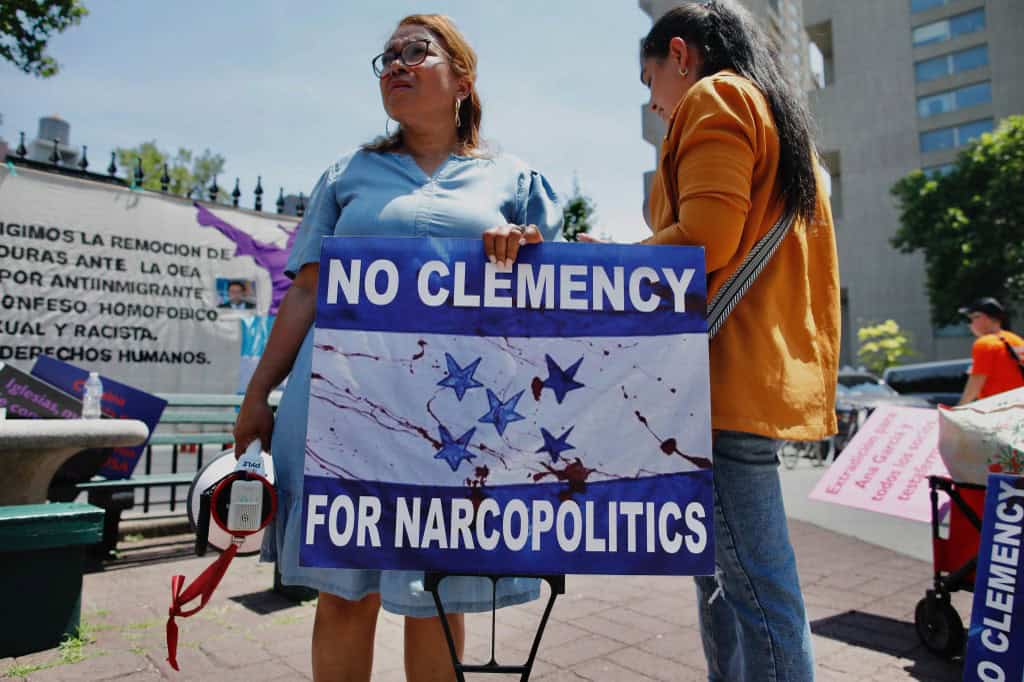
There is a strong element of creating a perceived enemy underlying the concept of the “narco-state”, so the initiation of the War on Drugs by Richard Nixon in the 1970s has mainly served this purpose for capitalist hegemony. Recently, we have seen the Shield of the Americas being formed, where most right-wing governments of the Americas, led by the Trump administration, have formed a new military alliance against the cartels. This follows the bombings against small boats off the coast of Venezuela and the accumulation of marine military power in support that were part of the build-up to the kidnapping of the then-president of Venezuela, Nicolas Maduro. There, the narrative of a war on drugs created the normalisation of military presence to remove an opposing political leader under the pretext of counter-cartel operations. This happened shortly after Trump pardoned Juan Orlando Hernandez, the former president of Honduras, who was convicted and was serving a prison term for conspiring to import 400 tons of cocaine into the US. This puts the US government’s and the Shield of the Americas’ real intentions into question. But what is clear and without a doubt is that the War on Drugs has not succeeded in fighting the drug problem; rather, it has become worse over the years. It has served, though, as an important tool for the US-led hegemony to intervene militarily in other countries of the world over the decades.
Some wars are not initiated with the aim of actually winning them,; sometimes it is more important to have the war continue in order to serve other interests. It can mean blocking an enemy’s movement, creating a sense of urgency in society to create control and impose change, or stimulating the weapons industry. It is also a powerful way of directing what will happen in a country or on a market, which can be an advantage for a capitalist entity, since predicting what will happen can create great profit on the speculative market.
The War on Drugs opens up several important doors for capitalist interests in Abya Yala. One is the possibility for military presence that it enables, most recently, in countries like Ecuador with new US military bases, in Colombia with new political programmes that will increase military cooperation, and in Mexico, where it has been proven that the DEA operates with or without the approval of the Mexican government. In line with these acts, the US designated two of the largest cartels in Brazil as terrorist narco-organisations, all in preparation for the elections that will happen there in October 2026, where the US will want to ensure that its right-wing candidate, Flavio Bolsonaro, wins and opens up the giant country to its interests.
Historically, it has been proven that the US military has been involved in actually transporting opium (Vietnam War)6 and spreading substances on the streets of poor neighbourhoods7, in direct contradiction to the alleged objectives of the War on Drugs. This war has, in fact, served as a way of increasing the presence of narco and paramilitary forces in ghettos and poor rural areas, with the direct effect of causing many social activists and leaders who try to defend their communities from the drug problem to be assassinated, systematically serving as a war to benefit the interests of capitalism.
Is the nation-state the legitimate counterpart of the narco-state?
The labelling of the narco-state has certainly served a purpose as a pretext for war or to create the threat of military intervention against states such as Sheinbaum’s Mexico, Petro’s Colombia and Maduro’s Venezuela. This labelling positions the accusing state, most often the US, as a non-narco-state or as a state that operates within the limits of national and international law. Even if that were true, what does it mean to actually have a state that operates within the borders of what the law dictates? Do not all nation-states have a history and present of robbing and looting?
To examine these questions, we can consider why it is that most criminal gangs actually seek to expand increasingly into the legal sphere as their capital and influence increase. What good is all that money if they cannot buy things on the legal market with it? As the enterprise becomes large, so does the need to place capital on a legal market because that is where the long-term and large-scale investment opportunities lie, such as real estate and company shares. Not just in terms of money, but also in terms of official political influence, taking municipal posts or even government positions opens up a lot of possibilities for any organisation, not least for a criminal one. There are examples of municipal governors with open ties to cartels in Mexico and, as we have mentioned, in Honduras the cartel influence has even reached the presidency.
In dialectical relation to that, the legal enterprises and even the state all play at the margin of what is legal. The lobbying industry accounts for a big amount of money, since it can be very profitable to steer law-making in your favour, and sometimes companies consciously act outside of the law, taking into account the penalty they might have to pay if they are caught as a part of the business risk. If one cheats and gets away with it, that can be a great advantage on the capitalist market. It can even be a great business opportunity to decide what is legal and when. If we look at the prohibition of alcohol in the US during the 1920s, this created a huge and profitable new illegal market. To have the power to decide on obstacles, or the removal of obstacles, for a certain business sector, can mean great profit for whoever holds that power.
The internal competition between capitalist forces is constant, and the means to win are only decided by opportunity. This is true for criminal gangs, legal enterprises or even states. The factor that decides whether or not that activity is legal is who holds the monopoly of power in that area and therefore has the capacity to set the legal framework.
In its essence every organisation has its own set of principles or laws, even the criminal gang has its own code of conduct: “In December 1908 there existed an Italian Secret Society in Fort Frances composed of 15 or 16 members. Frank Tino was leader, Frank Muro was 2nd in authority. I was forced to join the Society. The fee was $35.00 but I only paid $10.00. In joining the Society we took a solemn oath that we would obey our leader’s orders; would rob, burn or kill as he directed; that we would protect one another from the hands of the law; to disobey these orders we would expect to be punished by death or otherwise as decided upon by the Society.” – as witnessed by a member of the early formations of an Italian mafia-type organisation in the US8. Every gang has its own law. This is just the seed of the legal order of what might later become a hegemonic state. And these laws are often used, as in this example, as a way of imposing loyalty towards the organisation, which reminds us of the Epstein files and how they created a secret network where business favours were traded for complicity in widespread sexual abuse against women and children. This is the operational basis of the state.
So are legal states then in a position to stigmatise criminal gangs when their history and inner workings are based on immoral acts – not as exceptions but as part of their very essence? The genocide in Gaza is “legal”, and the companies profiting from the weapons trade, and now the construction companies that will build tourist attractions on the ruins of Gaza, are all legal. Is the impact of the drug market more or less than that of the market of genocide on the societies of the world? Is it meaningful to talk about narco-states while we don’t talk about genocide-states?
A statalist DNA: mafia-type organisations and gangs
The term ‘mafia’ is known throughout the world. Organisations described as ‘mafia-type’ are those involved in international trafficking and wielding local power. But where do they originate, and what is their relationship with the state?
Mafia-type organisations do not necessarily arise ‘where the state is weakest’ – often, where state structures are weaker, moral and political society has more scope to flourish; rather, they are already forms of the state, of a feudal nature, which arose even before the nation-state became established and have remained capable of maintaining territorial and economic control even after the establishment of the nation-state.
If we trace their origins, we can find them in the 9th century, during the disintegration of the Carolingian Empire, when vassalage relationships took shape in Central Europe and Italy.
These relationships between the king and the local lords, and between the local lords and their knights, were formalised through a public and solemn oath of allegiance. This re-established a clientelistic system of protection that had emerged in ancient Rome. Those who took the oath were called ‘vassus’, vassals; those who received it were called ‘senior’, lords. The vassals constituted the lord’s clientele and served two main purposes: to compete with the owners of neighbouring fiefs and, above all, to maintain order within the lord’s domain and to collect taxes, oppressing and dominating the peasants. The lifestyle of the knights, with whom the lord lived and who accompanied him on all occasions, was characterised by violence, a taste for plunder and oppression, and a desire to command. The nicknames that some of these figures gave themselves clearly reveal this mindset: for example, Pelavicino (‘he cuts the neighbour’s hair’), Guastavillani (‘he ruins the peasants’), Maltolti (‘he takes unjustly’).
These structures of oppression took particularly deep root in southern Italy, forming proto-feudal states and managing to survive eight centuries of monarchical states and the establishment of the nation-state in its various forms: constitutional monarchy, the Fascist regime, and the democratic republic.
Obviously, transformations have taken place over the years, and if they have managed to survive, it is also thanks to a dialectical relationship with the state.
Some, such as Ferdinand I, King of Naples, in the 14th century, even explicitly attempted to counter feudal privileges. However, Ferdinand I failed to dismantle the overwhelming power of the feudal lords, who, in fact, for two years (1485–1486), plotted to depose him and restore the throne to the Angevins in what has gone down in history as the ‘Conspiracy of the Barons’. Although the conspiracy was quashed, following that episode the feudal power of the barons was consolidated through new royal concessions designed to prevent further conspiracies.
If they have managed to survive, it is also because, just as in the feudal system, they often perform the functions of a local state. They can enforce their own (unwritten) laws and are based on a patriarchal and hierarchical structure. They involve initiation ceremonies for new members and clearly defined territorial boundaries. If the unitary state and the nation-state have not eliminated them, it is because they share the same DNA.
At the local level, these organisations also offer the state something it does not itself possess: proximity to society, the street corner or the village. This is not seldom used as a kind of leverage against the state, as a kind of bargaining chip. “After World War II the Calabrian clans—Honored Societies—began to grow rich on Italian reconstruction contracts and black marketeering. For the bosses of the ’ndrangheta the flow of government money into the region increased their power: their control over the workforce, their influence in land transactions, their control of votes, and the traditional fear they engendered in the populace.”9. In other words, this proximity to society gives the gangs political power, which they can offer the state, since the state tends to become increasingly distant from society when the area it administers grows over time. This exposes one of the main factors in how a gang tends to become closer to the state as its influence over society grows and why the state has an important interest in the growth of the gangs. What is also exposed is the myth about the social gang leader, such as in the example of Pablo Escobar, the drug lord from Medellin. He deliberately grew an image of himself as a friend of the poor by donating things and money while at the same time trying to hide the real effect of his business on the destruction of that same society. This is an image that many cartels foster both to gain local support and to increase their leverage toward the state and capitalist forces, since society is a decisive force.
Is this not the same dual relationship that the state has with society? While it offers protection to society in the form of “national security”, it is at the same time the source and cause of the dangers that society faces, such as war, unemployment, poverty and gender inequality. In exchange for loyalty to the nation-state, the citizen is offered “protection” in a world system where the nation-state itself is the cause of the dangers of that world. This sounds almost like a gang taking protection money from a small shop owner to protect the owner from “dangers” while they themselves are the cause of many of those dangers.
Most modern cartels have developed in this way, evolving into proto-states as they transition from small gangs to increasingly formal and bureaucratic institutions. In this sense, the line between a narco-gang and a narco-state is blurred. It is therefore impossible to distinguish these forms from the state, given their shared origins and the matryoshka-like structure they adopt.
Is the concept of “narco-state” meaningful?
The classification of the “narco-state” is meaningful in the sense that it is telling us about a state system that is becoming increasingly aggressive and fascistic as it faces a crisis which it does not know how to solve in any other way. There is a reality throughout the world in which neighbourhoods are becoming more insecure, and working as a social activist for the interests of society and against the interests of the drug gangs is becoming a mortal risk. The narco-state is, in a sense, a nation-state in an accelerated phase where its destructive characteristics are intensified.
But without a doubt, it is also a term instrumentalised by hegemonic states to classify certain states as villains while portraying themselves as a moral norm, free from sin, often in preparation for war against those very “narco-states”.
Possibly the most serious consequence is the veil that this classification puts on the origins of the nation-states in looting and robbery. The most dangerous thing the devil has done is to convince everyone that it doesn’t exist.
1Sociology of Freedom, Abdullah Öcalan
2Capitalist Civilization, Abdullah Öcalan
3Sociology of Freedom, Abdullah Öcalan
4Ibid.
5Capitalist Civilization, Abdullah Öcalan
6Alfred W. McCoy, The Politics of Heroin in Southeast Asia (1972)
71989 Kerry Committee report
8 Angels, mobsters and narco-terrorists, Antonio Nicaso, Lee Lamothe
9 Ibid.