
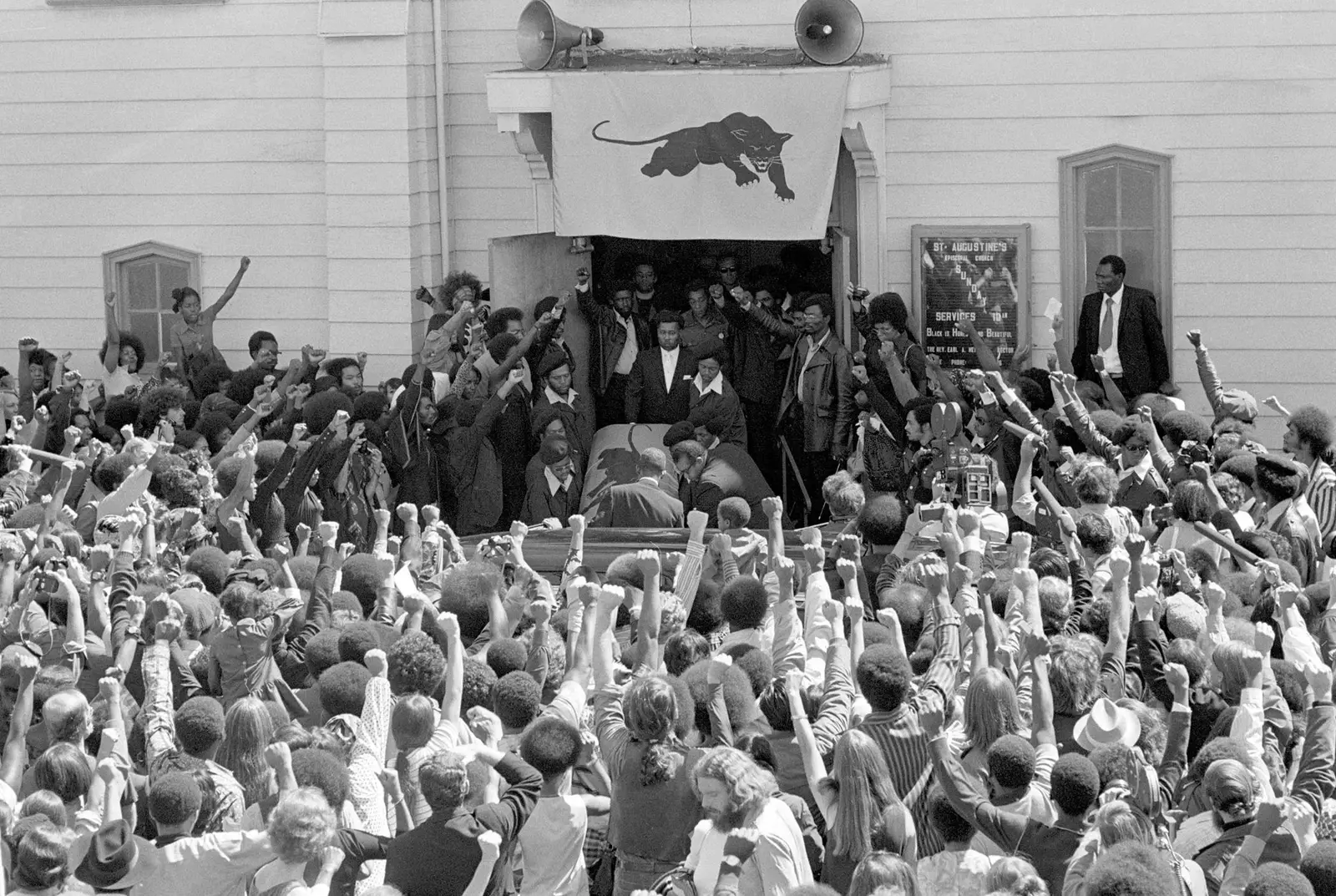
Communal organization is a form of organization that socialist movements around the world have debated for a long time and, in some cases, attempted to put into practice. Abdullah Öcalan defines the commune as a form of organization that exists entirely outside the structure of the state, has no connection to it, and in which society organizes every aspect of its own life without needing the state.
One of the most successful—though short-lived—examples of communal organization in modern history took place in the United States during the 1960s.
The history of the Black Panther Party for Self-Defense, which emerged in the United States during the years when Black people organized themselves and intensified their struggle against racism and oppression, demonstrates how a communal form of organization could rapidly become successful in every respect—and how it ultimately collapsed because its shortcomings were not overcome.
Shortly after the assassination of the Black Muslim leader Malcolm X in 1965, the Black Panther Party for Self-Defense was founded on October 15, 1966. While describing itself as an organization fighting for the freedom of Black people, it defined its ideology with the following statement:
“The ideology of the Black Panther Party is the adaptation of the historical experience of Black people in accordance with Marxism-Leninism.”
Although the Black Panther Party identified itself as Marxist-Leninist, it adapted socialism to the struggle and historical conditions of Black people. In a sense, it sought to create its own form of Black socialism.
Founding Years
The Black Panther Party emerged during the 1960s, a period in which attacks against Black people in the United States were increasing, police violence and torture had become commonplace in the streets, and paramilitary organizations such as the Ku Klux Klan were gaining strength.
Unlike other organizations active in the struggle for Black liberation—which defended only Black people while portraying all white people as enemies—the Black Panthers argued that alliances could be formed with other peoples who opposed racism.
The organization’s most significant difference from other Black movements was that it rejected Black bourgeois nationalism and instead focused on the participation of Black people in cultural and political life.
In 1960, following the struggle of Black Americans, civil rights legislation had been adopted in the United States. However, these legal reforms failed to stop the attacks against Black people. During this period, these attacks led to major uprisings in many states and to increasing police violence.
Following Malcolm X’s assassination, and driven especially by the conviction that a self-defense organization was necessary, Huey P. Newton and Bobby Seale founded the Black Panther Party for Self-Defense on October 15, 1966. The organization later shortened its name to the Black Panther Party.
The organization was fundamentally based on Malcolm X’s strategy of integration and self-defense. At the same time, the struggle of Black people was increasingly developing in a socialist direction.
One of the organization’s leaders, Huey P. Newton, explained the meaning of the party’s name in a speech:
“The reason we chose the panther is that panthers are never the aggressors. As is well known, when a panther is attacked, it first assumes a defensive position and retreats; but if the attack continues, it responds as necessary.”
When describing its founding, the organization published a declaration known as the Ten-Point Program, explaining both its organizational philosophy and the reasons for its establishment:
- Freedom: The right of Black people and other oppressed communities to self-determination.
- Employment: Employment and guaranteed income for everyone.
- End of Exploitation: The exploitation of Black people must end. The promises made to formerly enslaved people during Reconstruction after the abolition of slavery must finally be fulfilled.
- Right to Housing: Cooperatives should be established to meet housing needs.
- Right to Health Care: Free health care should be provided.
- End to Violence: Violence and killings directed against Black people and other oppressed peoples of color must cease.
- Federal Government Policies: The policies of the U.S. federal government that are the source of these attacks must be ended.
- Education for the People: Black history and the role of Black people in society should be taught.
- Freedom for Political Prisoners: Trials should reflect the will of the people.
- Community Control: Land, food, housing, education, justice, peace, and industry should be under the control of our community.
The Strategy of Self-Defense
The most important factor behind the Black Panther Party’s rapid growth among Black communities was that it had been founded as a self-defense organization.
Inspired by Malcolm X’s principle—”Respond to attacks against yourselves, but never become the aggressor”—the party first armed its members and established self-defense patrols in Black neighborhoods.
These patrol units patrolled the streets. Whenever police officers arrested someone, they would stand at a legally permissible distance, openly carrying their firearms while observing whether the police used violence against Black citizens.
As a law school graduate, Huey P. Newton had an extensive knowledge of the law. He trained the self-defense patrols to operate strictly within legal boundaries and ensured that they acted accordingly.
The Black Panther Party’s self-defense units never initiated armed confrontations or attacks as long as neither they nor Black people were under attack. Instead, by patrolling the streets and openly carrying their weapons, they sought to deter potential acts of violence.
At that time, several U.S. states permitted the public carrying of firearms, and many of these states had large Black populations. The Black Panthers acted in accordance with these laws, using legal loopholes to organize their self-defense units.
After the establishment of these patrols and their success in preventing numerous attacks, support for the Black Panthers among Black youth increased rapidly.
Founded in October 1966, the organization had grown to several thousand members before 1970 and had become an organization exerting significant social influence in the communities where it operated.
Communal Organization and an Alternative to State Power
The Black Panther Party’s most remarkable activities were not its armed actions but the steps it took to enable Black people to organize their own lives. Among the most notable of these initiatives were the Black Panther Liberation Schools.
The Black Panther Liberation Schools were established to provide an alternative model of education to the colonial-minded curriculum and inadequate public education system of the U.S. federal government. Rather than being based on centralized authority or state power, the schools adopted an educational program shaped by the needs and demands of the community from the ground up.
The curriculum emphasized Black history, literacy, and the development of political consciousness. In this way, the schools sought to prevent children from being confined to a system of rote memorization. Hundreds of Black children received their education through the Liberation Schools.
The foundations of the Liberation Schools were laid through a solidarity initiative aimed at the children of Black families living in extreme poverty. Under the Free Breakfast for Children Program, the Black Panthers began providing hundreds of children with free breakfast every morning before they went to school.
This program became one of the Black Panther Party’s best-known and most influential initiatives. By 1970, it had expanded to the point where approximately 20,000 children were receiving free breakfasts every month.
Another major initiative of the Party was the establishment of free medical clinics. These clinics were created primarily for Black communities that faced barriers to healthcare and were denied equal and adequate treatment because of racist practices within hospitals. Staffed by volunteer doctors and nurses, the Free Medical Clinics provided healthcare at no cost to the community.
In addition, the Party successfully organized numerous community support programs aimed at improving everyday life. These included regular clothing drives, educational assistance for young people preparing for school, rehabilitation centers for people struggling with drug addiction, free transportation for families whose children were imprisoned in distant prisons, and ambulance services for emergencies.
The Party’s decision to prioritize these social programs played a major role in its growing support among Black communities.
Another important aspect of the Party’s work was the regular publication of The Black Panther newspaper. The newspaper published the Party’s ideology, official statements, and organizational directives. Shortly after its launch, its circulation reached 250,000 copies. Distribution was carried out directly by Party members on the streets.
One of the Black Panthers’ most striking practices was their adoption of the natural hairstyle now widely known as the Afro as a political symbol.
Rather than attempting to resemble the colonizer, the Black Panthers sought to develop a way of life rooted in their own identity and culture. In clothing as well, they rejected the “modern” appearance imposed by colonial standards and instead chose to dress according to their own preferences.
This rejection of European and American colonial standards of beauty—and of their imposition on other peoples—became one of the Party’s defining symbols.
At a time when Black Americans were pressured to straighten their hair in order to be accepted by American society, the Black Panthers responded with the slogan:
“Black Is Beautiful.”
By proudly wearing their natural hair, they rejected these racist beauty standards.
Another highly recognizable feature of the Black Panthers was their uniform. The Afro hairstyle, black leather jacket, and black beret became the Party’s most distinctive symbols and made it one of the most recognizable socialist organizations of its time. To this day, the black leather jacket and black beret remain enduring symbols of the Black freedom struggle.
The fact that both women and men wore the same uniform reflected the Party’s theoretical commitment to gender equality. Women also carried weapons, participated directly in the struggle, and were considered entitled to equal participation and an equal voice alongside men.
Women in the Black Panther Party and the Emergence of Anti-Colonial Feminism
Although the Black Panthers developed important practical examples of communal organization, one of the greatest weaknesses that later contributed to the Party’s decline became apparent from its earliest years.
Shortly after its founding, more than 60 percent of the Party’s membership consisted of women. Yet from the beginning, women were unable to establish fully equal and genuinely comradely relations with male members.
Despite this contradiction, one of the Party’s significant characteristics was its theoretical commitment to equality between women and men. Women were referred to within the organization as “sisters” and were, in theory, recognized as possessing equal rights with men. However, this theoretical commitment was never fully implemented in practice.
The first major turning point for women within the Party came in 1966.
The first issue of The Black Panther newspaper presented the organization as “the party of distinguished Black men.” However, as a result of women’s persistent struggle against sexism within the Party and their insistence on achieving equality, the Party issued a statement in 1969 declaring sexism and sexist attitudes to be counterrevolutionary.
This marked the first major victory for women inside the organization. From that point onward, women’s work within the Party also began to receive greater recognition.
One of the most significant outcomes of women’s struggle to participate fully in political activity was the creation of childcare and educational programs.
Many Party members who were mothers demanded childcare facilities, leading to the establishment of programs that enabled children to be raised collectively while allowing women to participate more actively in organizational work.
Over time, as many male members withdrew from the struggle, leadership positions increasingly came to be filled by women.
Despite these developments, incidents of sexual harassment and sexist attitudes continued to exist within many Party structures.
The struggle of women in the Black Panther Party extended beyond the organization itself.
Women criticized what they described as “white feminism,” arguing that it lacked a revolutionary perspective. While acknowledging its opposition to sexism, they criticized white feminism for failing to adequately address questions of race and class.
Based on this critique, they became pioneers of what would later be known as Black feminism, an anti-colonial feminist current.
Women members of the Black Panther Party argued that white feminism remained confined within the limits of white hegemony. Black feminism, by contrast, held that Black women were oppressed not only because they were women but also because of their race and class position.
For this reason, they advocated an organizational perspective that examined gender, race, and class together as integral components of both patriarchal and colonial systems and made the struggle against these forms of domination one of its central goals.
In particular, women in the Black Panther Party emphasized the forms of oppression experienced because of national identity and argued that white feminism had failed to make these experiences sufficiently visible.
In this respect, they made an important contribution to defining the theoretical boundaries of anti-colonial feminism, whose ideas had previously been discussed but not yet fully developed as a coherent ideology.
This ideological current, which became known as Black feminism, introduced anti-colonial struggle as one of the essential components of feminist politics and laid the foundations for anti-colonial feminist theory.
Even after the dissolution of the Black Panther Party, its women members continued developing discussions on Black feminism and made significant theoretical contributions to the field.
Attacks on the Black Panthers and the Dissolution of the Party
From the day it was founded, the Black Panther Party attracted the attention of the U.S. federal government. As its influence within Black communities continued to grow, the government intensified its repression of the organization.
During this period, repression was carried out less through direct physical assaults than through the infiltration of the Party by government agents. One of the weaknesses that contributed to the Party’s relatively rapid decline was that, from its inception, it applied no consistent screening criteria for new members.
Experiencing rapid growth, the Black Panther Party accepted virtually anyone who wished to join and did not subject prospective members to any formal vetting process. This made it considerably easier for the FBI to infiltrate the organization.
In 1967, the FBI launched COINTELPRO, a program targeting what it described as “Black nationalist groups” as well as other opposition movements. The program became particularly notorious for its operations against the Black Panther Party.
One of the first major developments during this period was the arrest of Party leader Huey P. Newton, who was charged with killing a police officer. Newton remained imprisoned for three years before being released after an appellate court overturned his conviction.
Despite his release, FBI operations against the Black Panthers continued.
On April 6, 1968, Black Panther member Bobby Hutton was shot and killed by police, despite being unarmed. He was struck by twelve bullets.
As government operations intensified, leading Party figures Eldridge Cleaver and Huey P. Newton were eventually forced into exile.
One of the greatest blows suffered by the Black Panthers was the killing of Fred Hampton, who had served as the Party’s deputy chairman after 1968.
Considered highly dangerous by the FBI, Hampton was killed during a police raid on his home only days before he was due to begin serving a prison sentence. Official reports acknowledged that FBI agents fired hundreds of rounds during the raid, while Black Panther members managed to fire only a single shot in response.
While Newton was imprisoned, Hampton had become one of the Party’s most prominent leaders through both his speeches and his organizing work. He is remembered as one of the last major leaders to embody the Black Panther Party’s socialist orientation. In November 1969, he delivered a famous speech at Northern Illinois University, in which he calls the crowd to fight and resist fascism despite the repression the organization was facing :
“Because we said it before we left and we said it today. That you can jail a revolutionary, but you can’t jail the revolution. You can lock up a freedom fighter like Huey P. Newton, but you can’t lock up freedom fighting. You might hire some pork chops like Mamalama to murder Alprentice Bunchy Carter, a liberator, but you can’t murder liberation, because if you do, you come up with answers that don’t answer, explanations that don’t explain, conclusions that don’t conclude.
We say that if you dare to struggle, than you dare to win. If you dare not to struggle you don’t deserve to win. We wouldn’t go into the ring with Muhammad Ali and not fight and wonder why we lost, would we? If you don’t fight, then you don’t deserve to win. If you don’t move on these fascists, then you’re crazy. We say it’s no longer a question of violence or non-violence. We say it’s a question of resistance to fascism or non-existence within fascism. We say let’s stop the war in Vietnam. Let’s stop it by acquiring victory for the spirit of Ho Chi Minh. We say let’s stop the war in Babylon. Let’s initiate the decentralization of the police.'”1
Following Hampton’s assassination, together with Newton’s attitude toward male dominance within the organization, the departure of many women members who went on to establish their own organizations, and the sustained repression carried out by the U.S. federal government, the Black Panther Party effectively disintegrated during the mid-1970s.
Its formal dissolution did not occur until 1982.
Nevertheless, the Black Panther Party for Self-Defense’s understanding of self-defense and its experience of communal organization continue to be regarded as politically relevant today.
1 Fred Hampton, “It’s a Class Struggle, Goddammit!,” Hampton Institute, https://www.hamptonthink.org/read/its-a-class-struggle-goddammit-fred-hampton