
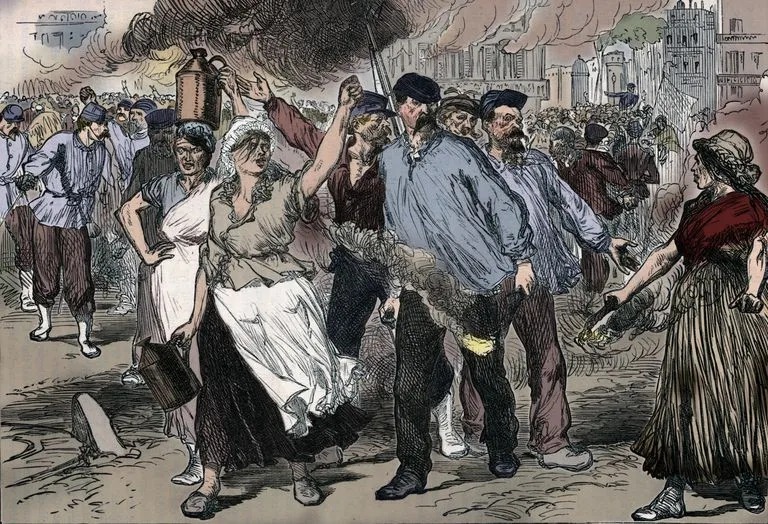
The 18th of march marked the 155th anniversary of the declaration of the Paris Commune. In those days the commune came to the forefront in its country of origin as a symbol and program that paved the way for the left prior to the municipal elections. The campaign of ‘The unsubmissive France’ (La France insoumise – LFI) defines the struggle for the municipal administration. Also in the context of perspectives of a ‘program of rupture’, ‘communalism’ and the ‘civil revolution’. Apparently the LFI does not refer to the commune as a form of municipal politics, but rather in the context of a more general political vision of rupture.
The commune is one thing, the ‘communal socialism’ another
As part of the goals of the LFI, the Paris Commune is associated with the sovereignty of the people, civil control and the revocability of representatives. The commune returns back to the field of social struggle and by that it gains its true meaning in the tension between local and central politics as well as in the discussion about sovereignty and counter hegemony. In other words: The very fact that the name appears in the local election campaign only in connection with political issues that extend beyond the city shows that the practices of 1871 cannot be reduced to the local level.
If the Communards of Paris could rise from their ‘eternal resting places’ and view our present world, they would likely be most concerned with protecting all their listeners from a misunderstanding: ‘‘Do not remember the commune as ‘communal socialism’.’’ Because the commune was not just a progressive municipal administration, a people-oriented city council or a social welfare package for the poor: It was the bravery of a city to take its fate into its hands and at the same time it was an attempt to people’s power that failed because it remained limited to a city. The true lesson of the commune was not that “The march to socialism begins when we take over a city council,” but rather that, just as the 27th and 28th of May 1871 taught us in a tragic way, the counterrevolution will inevitably pick up momentum if socialism is limited to a country, a city, a city council, or a local administration.
New York, Istanbul, Diyarbakır
If Istanbul, the westernmost city of Turkey, and Diyarbakır, the heart of Northern Kurdistan, are considered regarding the lessons of the commune and taking into account the municipal elections in New York, it becomes clear that these lessons are not limited to France.
When regarding Diyarbakır, we need to focus on another side of contradictions. Here the city council cannot only remain a service institution, even if it wanted to: Starting from the moment that it comes into contact with the people, it becomes a space in which the locally voted will, the language, memory, cultural visibility and democratic legitimacy becomes manifested – and it enters into an irreconcilable conflict with the center. For this reason the paternalism through the central state does not only have impact as administrative control. Through the limitation of authority, budget cuts, the undermining of the representation and lastly through mechanisms like appointing state trustees it turns into a direct political usurpation. Beyond that all of this is already long written and established within the constitution: While Article 127 of the constitution defines the local administrations according to the principle of decentralization, it grants the central administration the right to ‘administrative authority’ over these administrations as a part of the policies and and procedures established by law.
The fact that the Kurdish municipalities Mardin, Van, Hakkari, Batman, Halfeti, Dersim, Ovacik, and many more are still being governed by appointed state trustees, and that this practice is spreading to the municipalities governed by the CHP as well, can serve as a cautionary example that it is by no means beneficial to dream of a ‘local service municipalism’ within a reality of municipal administrations in the chokehold of the central state, similar to a bed of nails.
The example of Diyarbakır reveals another dimension of the commune that should not be lost out of sight: Local democracy is never only a local matter, it always entails a problem or topic of power and of the counter center – a form of hidden dual power. The commune it is not just about distribution, it is also a battle field in which the right of the people to self administration clashes with the supervisory power of the state.
Istanbul however lies on the point of intersection between New York and Diyarbakır: On the one hand, as a giant metropolis it is the main stage for speculation, the regime of construction as well as logistical and financial growth. On the other hand it is a political and economical field of struggle, in which the central government intervenes constantly through financial dependency, fragmentation of authority, parallel institutionalization, judicial pressure and the regime of major projects in order to limit the scope of action on the local level. When the city council is seized it is not just about taking over the city council itself but rather about establishing a fragile position against a central, bureaucratic, profit-orientied mechanism which crushes the city.
Nowadays however it is not just about this structural siege in Istanbul. The fact that the city council and district administration are under fire, the imprisonment of the IBB President and the CHP’s presidential candidate Ekrem İmamoğlu., as well as dozens of district mayors and other elected representatives due to staged trials, the plundering of communal resources and the dismantling of the oppositions organizational foundation in Istanbul – all of this is clear proof that the problem of the judicial attacks that shift from the communes to the party, escalated directly into a political-legal siege. That is why Istanbul should not only be regarded as a metropolis narrowed by the regime of profit driven growth, but as a non-bloody civil war that is being lead through the criminalization of the locally voted will and the undermining of its societal foundation.
At exactly this point the Communards will remind of the hand that let go of Versailles. The Commune was not just any other local self-administration, it was a popular power that was besieged by the counter revolution deployed in Versailles, the main quarter of the Bonapartist regime. Versailles was not just a place outside of the administration of the commune, it was the centralized counter revolution of the landowners, the army, the bureaucracy, the conservative provincialism and the international order. When Paris was liberated, France was not liberated. When Paris rose up, the province, finance, army and the European order remained untouched. In the end the Commune was pushed from a 72-day spring of local freedom into a winter of central power that lasted an entire era. Because Paris was not able to spread out far enough to Lyon, Marseilles, into the countryside and towards the European workers movement, it did not succeed in finding an international response to the global capital and system of states that rushed to help maintain the order in France.
Still today the ‘Versailles’ of Diyarbakır is a combination of reason of state, security apparatus, financial system and official nationalism in Ankara. The ‘Versailles’ of Istanbul is the central political block, that restricts the city council’s elected will through court, financial supervision, media and property rights. The Versailles of New York however does not speak with gunfire, but with bond interest, real estate capital, federal and state law as well as institutionalized financial discipline. Although the forms of power and resistance change, the logic remains the same.
The horizon of Degrowth
The Communards of today do not need to be content with only smashing the repressive apparatus, they need to have the vision to dismantle the city itself. Because the problem does not just lie in whether the municipalities are more participatory or not, but rather in which regime of growth the cities are subjected to. In Istanbul more streets, more concrete, more cars and more profit are being produced, but more new life is not being created. More exhaustion, inequality and more ecological destruction are being created. As long as the regime of consumption and property is not questioned, the communal socialism in New York will at best try to make an extremely expensive metropolis a little bit more worth living. In Diyarbakır however, in the face of habitats restricted by central guardianship and a dependent development model, it’s all about strengthening care, commons and local social capacities. That is why criticism of growth through local democracy can only gain importance when connected with a new imagination of public power that spreads from the local level to the center, just as in the context of the ‘Degrowth’-approach – a criticism to the economical and urban expansion that does not promote life but suffocates it through its tumor-like growth.
The real lesson of the Commune of which the impact lasts on till today is that neither municipalism nor statism alone will work. What is really needed is a general political struggle, that connects the direct participation and control of the people on a local level with a more wide democratic counter hegemony, that changes the property regime, financial regulation and planning regulation on a central level.
If the Communards could speak, they would probably say the following: ‘The freedom of a city suffocates, if it does not spread out to the country and the rest of the world. If you are victim of the illusion that you have achieved victory by taking over the city, you have made the first step towards defeat. Our legacy is: ‘The commune everywhere – in the neighborhoods, the city, on the countryside, in the entire country and beyond its borders. It is about much more then just a city council.’
The price that was payed for learning the lessons of the commune was very high. We must not ignore: ‘The city council alone is not a salvation. But it is one of the most concrete starting points of counter hegemony. Either you reduce it to public service and lastly hand it over to the limitations of the system, or you make it to a position for a more extensive democratic, social and internationalist transformation.’
The warning that the defeat of Paris concedes for today’s New York, Diyarbakır and Istanbul is still the same: If you do not go beyond the local, Versailles will inevitably return.
The article was first published on 20 March 2026 in the Kurdish daily newspaper Yeni Yaşam.