
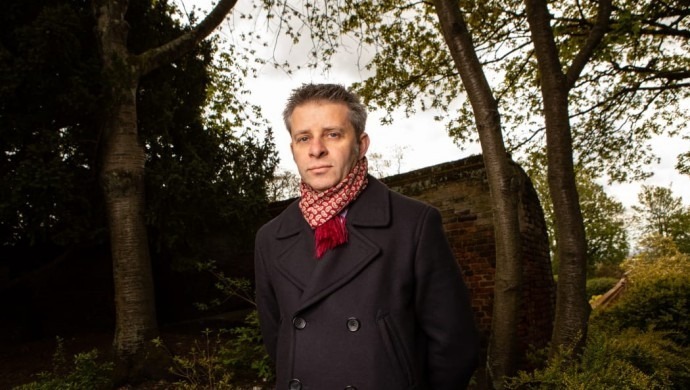
Archaeology Professor David Wengrow has written a statement expressing his support for the Peace and Democratic Society Process in Turkey.
The international repercussions of Kurdish leader Abdullah Öcalan’s February 27, 2025, call for “Peace and a Democratic Society” continue to grow. As part of an ongoing international campaign in support of the call, 90 leading thinkers, writers, and academics from around the world have so far declared their support for the process.
Among those supporting the campaign is Archaeology Professor David Wengrow, who is internationally known for The Dawn of Everything, co-authored with anthropologist David Graeber. Graeber also wrote the foreword to Abdullah Öcalan’s Manifesto for a Democratic Civilization: The Age of Masked Gods and Veiled Kings. As part of the international campaign, Wengrow has written the following statement in support of the Peace and Democratic Society Process.
The following is the text written by Prof. David Wengrow:
Thank you for asking me to reflect on this important moment in world history.
On March 7th, 2014, the late anthropologist David Graeber emailed me a draft of the preface he was writing to Abdullah Öcalan’s Manifesto for a democratic civilisation: the age of masked gods and disguised kings. I was in Kurdistan at the time, in the foothills of the Zagros Mountains, near the border between Iran and Iraq, conducting archaeological fieldwork close to the town of Halabja.
It was the right place to read Graeber’s reflections on ‘the historical tragedy of a region whose women once made unprecedented contributions to human civilization, but which has ever since been reduced to a bloody plaything of empire.’ My own research there was devoted to the Neolithic past, where Öcalan’s writings seek the root of alternatives to patriarchal civilisation.
To the west, in the Darband i-Gawr range of the Qara Dagh Mountains, is an ancient footprint of that later civilisation. It is the monumental figure of a king, carved into the rock, trampling the people of the hill country underfoot in the manner of a terrible Leviathan.
The carving dates to over four thousand years ago, which is a long time for anyone to be under the foot of someone else. These systems of oppression, which first appeared in the Middle East almost five millennia ago, have reappeared in one guise or another ever since. For many people, this what ‘civilisation’ has come to mean (to borrow George Orwells phrase, a ‘boot stamping on a human face—for ever.’).
But each new incarnation of human society is also unique. Social forms devised under one set of technological circumstances may reappear under others. It’s now commonplace, for instance, to refer to ours as an age of ‘managerial feudalism,’ or sometimes ‘techno-feudalism.’
It seems to me that one of Öcalan’s key intellectual and political contributions has been to suggest that this logic doesn’t just apply to systems of domination. It can also apply to forms of human freedom.
This is often viewed as a utopian or idealist position. For a university academic, such as myself, to even entertain such ideas is immediately to invite ridicule from one’s peers. For Öcalan, the Neolithic is where mother goddesses are born. Universities are where they go to die.
Why so? No serious scholar would deny that the Neolithic period in the Middle East is the source of material innovations that have shaped the modern world: everything from plant cultivation and animal husbandry to techniques of weaving, metallurgy, cuisine, and architecture, which are the foundations of urban life.
Such innovations spread across regions far larger than the kingdoms, empires, and nation-states that came after them, with no apparatus of coercion to direct them, and little in the way of material infrastructure to push them along.
What world of ideas was this, where ‘social relations’ could mean something other than the logic of market relations or ‘growth,’ but where societies could also span continents? Why have we forgotten it so completely?
This critical moment in the Middle East, which you have asked me to reflect on, has a tragic salience. Because this part of the world is both where humanity’s most enduring cultural revolutions took place, but also where they were first harnessed to an apparatus of coercion and extraction, which for the majority of its people has meant the longest continuous experience in history of incursion, annexation, and exploitation: for more than four thousand years, ‘a bloody plaything of empire.’
Today, it is also the place where masked gods are revealed, the king is no longer disguised, and our present world order reveals its true, shocking face.
It seems hard, then, to dispute the thrust of Öcalan’s argument that there, in that same place, we may discover once and for all if this way of being in the world really is the only one available to us.
Thank you once again, for inviting me to reflect.
David Wengrow, 20.08.26
Who Is Prof. David Wengrow?
Prof. David Wengrow, born on July 25, 1972, in the United Kingdom, is a British archaeologist and scholar specializing in comparative archaeology. He studied archaeology and anthropology at the University of Oxford, completing a master’s degree in world archaeology in 1998 and a doctorate in archaeology in 2001. Following his doctoral studies, he served as a Junior Research Fellow at Christ Church, Oxford, and as a Henri Frankfort Fellow at the Warburg Institute.
In 2004, Wengrow joined the Institute of Archaeology at University College London (UCL), where he became Professor of Comparative Archaeology in 2011 and continued his academic work. He has conducted archaeological fieldwork in various parts of Africa and the Middle East, focusing particularly on social inequality, early cities and states, ancient art and writing systems, Neolithic societies, and long-term forms of social organization.
Wengrow gained international recognition particularly through The Dawn of Everything: A New History of Humanity (2021), which he co-authored with anthropologist David Graeber. The book challenges conventional narratives that portray human history as an inevitable progression from hunter-gatherer societies to agriculture, settled life, hierarchy, and the state. Drawing on archaeological and anthropological evidence, Wengrow and Graeber argue that human communities have historically developed a wide range of political and social forms, and that institutions such as inequality, property, cities, democracy, slavery, and the state cannot be reduced to a single model of historical development. The book was a finalist for the 2022 Orwell Prize for Political Writing and won the Wenjin Book Award in 2025.
At the center of Wengrow’s thinking is a critical examination of the idea that human history inevitably progresses toward hierarchy, inequality, and centralized state power. He approaches archaeology not merely as a means of understanding past societies, but also as a way of examining how contemporary societies came into being and whether alternative forms of social organization are possible. In particular, he has emphasized the historical possibilities of human freedom.
Together with Graeber, he sought to demonstrate that people in the past were capable of moving between different forms of social organization and of experimenting, under different circumstances and at different times, with egalitarian, hierarchical, centralized, and decentralized forms of social life. In this respect, Wengrow stands out among contemporary archaeologists for bringing archaeology and anthropology into dialogue with present-day debates over freedom, inequality, democracy, and social organization.
This article was originally written by Prof. David Wengrow for Mezopotamya Ajansı and published in Turkish at https://mezopotamyaajansi35.com/GENCLIK/content/view/321440. The English version is published here with the permission of the editorial board of Mezopotamya Ajansı.