
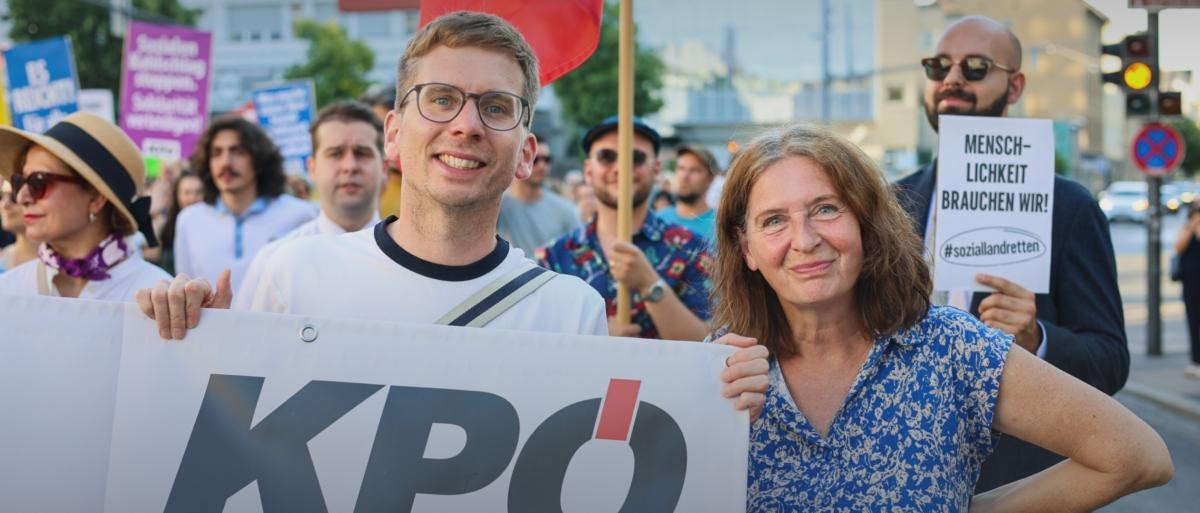
The following interview was originally published in German by the Lower Class Magazine and is reproduced here in English with their kind permission. Robert Krotzer has served as a city councillor for the Communist Party of Austria (Kommunistische Partei Österreichs, KPÖ) in Graz since 2017, where he is responsible for health, care, integration and employment. Before joining the Graz city government, he worked as a secondary-school teacher, served as a KPÖ municipal councillor and was national chair of the Communist Youth of Austria (KJÖ). The interview discusses the KPÖ’s experiences in municipal politics, the question of participation in government, the need to rethink and reorient socialist politics in the 21st century, and the role of cadre politics.
After the KPÖ to the surprise of many – emerged as the strongest force in the 2021 Graz municipal council election and has since held the mayoral office with Elke Kahr, the party achieved an outstanding victory in the most recent election on June 28, securing over 35% of the vote. Did this victory surprise you, or did you go into the election feeling confident anyway?
Well, we live in times when it’s more likely that communist parties will get 0.35 percent rather than over 35 percent in elections. So, of course, it would have been presumptuous to go into the election campaign with an exaggerated sense of certainty of victory. Our success in 2021 was already a sensation. Even we were a little speechless at first. But fortunately, that speechlessness didn’t last long. We said to ourselves: Why should bourgeois forces, which govern a city in the interests of a limited few, manage a city better than a Communist Party rooted in the tradition of—and as part of—the worker’s movement? We strive to organise a city in the interests of the broad majority of the population and in this sense, we have indeed been able to implement many initiatives and achieve numerous social gains over the past five years.
Of course, we’ve maintained a great deal of contact with the people, but even so, you can never be sure whether this work is actually seen or whether you’ll actually receive the support of the broader population at the ballot box. That’s why election night, with this enormous gain, was definitely a great success for us, and we’re very glad about the strong support from so many residents of Graz. But even though we can look back on a term in office during which we’ve accomplished a great deal, we wouldn’t be the Communist Party if we were satisfied with everything we’ve managed to achieve under these circumstances. At the same time, it must be said that this surprisingly strong vote from the public didn’t come out of nowhere. It wasn’t as if Elke Kahr, as mayor, or the KPÖ had been prayed court to by the media, or as if there hadn’t also been massive political resistance. One can say that the election victory was also the result of a campaign that largely came from the grassroots and was driven by people who are convinced by our work and sympathise with our ideas. We owe this electoral success to them as well.
You just mentioned it. It is, of course, truly a rarity for a party that bears the stigmatised label “communist” in its name to win over more than a third of the voters in the second-largest city of a European country. Mayor Elke Kahr has repeatedly spoken of how it is “earned trust” that sets the KPÖ apart from the other parties. But that trust had to be earned in the first place. How did you manage that?
For us, there are two central guidelines. First, we operate on the assumption that we must earn the trust of the population—of working people—from anew every single day. It’s not as if you gain support once and then can simply do whatever you want. That means a great deal of work, a great deal of engagement, and a great deal of concrete support, which we strive to provide to people. On the other hand, we need to take a brief historical look back at the early 1990s. In light of the very deep, global crisis facing the communist movement at that time, we—the KPÖ Graz and the KPÖ in Styria—developed the slogan that we wanted to be a “useful party for everyday life and for the big goals of the worker’s movement.” With this, we began to focus on the issues of housing and rent, and in particular on municipal housing in Graz. The aim was to be there for tenants in very concrete ways, to help them find solutions to problems together and to push through their interests. This has since become an integral part of the KPÖ’s approach in Graz, and we are constantly striving to expand it further into other fields. Elke Kahr expressed this in her statement upon being elected mayor. She said that we want to approach our tasks with a perspective from the bottom. After all, we are, of course, a party of working people and place their interests at the centre of our politics. That is why we must maintain daily contact with the working class and with people who find themselves in precarious living situations and are struggling with many concerns.
This is nothing new to us; rather, it’s something we experience every day in our consultations and office hours. We view our offices as open city council offices where anyone can come with their concerns, and we take the time to address these issues and talk with people about their situations. The range of concerns certainly is very broad. They range from very common issues, such as rent arrears or high subsequent payments for utilities and heating. In the area where I work, many questions revolve around health or care, as well as working conditions. We deal with people suffering from addiction, as well as those facing harassment in the workplace, and we provide advice on labour law issues. In a sense, this is the bread and butter of our work at the KPÖ, and it also shapes our perspective. In all of this, we are always a party that is learning. It is only through this work that we learn where people’s real struggles lie, and we then try to translate that into our politics. The content of our newspapers, campaigns, and social media posts is also often drawn from people’s concrete experiences and our interactions with them.
We also have a salary cap in place. This means that all our elected officials keep only the average income of a skilled worker for themselves and pass on about two-thirds of their income to people in need. Of course, this makes a difference when it comes to the issue of trust, but also when you look at the traps set by bourgeois parliamentarism. How many parties on the socialist and even communist left have fallen into that trap? Suddenly they have high salaries, company cars, chauffeurs, and are all of a sudden incredibly far removed from the everyday lives of working people. Our salary policy naturally influences the public’s perception of the KPÖ, because people can see very clearly, by comparison, just how far removed all the other political representatives of the established parties are from their everyday concerns—and where the KPÖ stands. And in the end the salary cap also ensures that no one joins the KPÖ for career reasons.
That means the rent caps and social counselling services were already part of your plan even before 2021?
The consultation hours and direct contact with residents have been in place for a very long time. Even back when Ernest Kaltenegger himself was still a city council member, he would visit municipal housing units, talk to the tenants, and the party—which was still very small at the time—developed broad campaigns. For example, a campaign to limit rent in municipal housing to one-third of tenants’ income. When the KPÖ’s request was rejected by all parties in the early 1990s, the party swarmed into the municipal housing complexes and presented the mayor with 20,000 signatures. When the request was put to a vote again, there was suddenly a unanimous decision—and the rent subsidy we fought for back then still exists today!
The salary cap has also been in place for a very long time. As the KPÖ, we have always spoken out against high politicians’ salaries, and when Ernest Kaltenegger became a city councilor in 1998, he suddenly found himself in the position of receiving a very high politician’s salary. In keeping with the tradition of the Paris Commune, it was clear that one should retain only an average skilled worker’s income and use the rest to provide concrete help to people in need.
So how does the money get from you to the people?
For Elke Kahr and me, for example, we discuss with people during our office hours where we can help. In my case, that amounts to about 4,500 euros a month that I can pass on. Since 2017, that’s amounted to over 560,000 euros that I’ve been able to use to support people. At first glance, that looks like a lot of money, but of course there are also many people who depend on support. Often, it’s a matter of organizing quick help, for example, when someone is behind on rent. We then transfer a partial payment to the rent account and contact the company of the facility management. We tell them, “Look, Mrs. Müller is here with us right now, and I’m sending a partial payment for now, but we’ll also explore other options,” such as applying for assistance from Volkshilfe or the municipal social services office. Sometimes this allows us to prevent hiring lawyer and the resulting spiral of costs. In other cases, the issues involve medical aids, medications, or copayments for school field trips.
Providing concrete assistance when needed is one thing, but ideally, those in government should be able to improve the overall situation to the point where people no longer find themselves in such precarious circumstances. What successes have you achieved in recent years, and where have you encountered obstacles?
Municipal housing is a very important issue in this regard. The city of Graz owns approximately 4,500 apartments. In addition, there is a roughly equal number of housing units transferred from cooperatives, for which the city holds the right of allocation. The city has introduced a rent cap for its municipally owned housing. This means that rents have not increased by more than 4 percent over the five-year period from 2021 to 2026. By comparison: On the private housing market, rents have in some cases increased by more than 4 percent twice a year. At the same time, we were able to build 420 new municipal apartments during this period. In total, just under 1,500 municipal apartments were built under the KPÖ’s responsibility. With municipal housing—an important form of public ownership—the municipality has significant scope to shape policy. On the one hand, you can provide people with affordable public housing in a very concrete way; on the other hand, you compete with the private housing market. Ideally, this allows you to ensure that people in precarious housing situations do not have to settle for overpriced, poor-quality housing. At the same time, we’ve been running the KPÖ’s Tenant Hotline since the 1990s. In the private housing market, of course, disputes between tenants and their landlords or real estate companies arise time and again, and the latter usually have well-paid lawyers on their side. We try to provide legal assistance, inform people, and encourage them to assert their rights. That’s what I can say about the issue of housing. At the same time, here in Graz we have what’s known as the “Sozialcard”—another achievement that was preceded by long lasting campaign by the KPÖ. The Sozialcard is a program for people with low incomes. With it, for example, you’re entitled to the “Sozialcard-Mobility”—an annual pass for public transportation for just 60 euros. This is unprecedented in its form throughout all of Austria. There are also various other forms of support, such as Christmas bonuses, heating cost assistance, or, for example, a back-to-school allowance for families. During our first term in office, we were also able to expand eligibility to include people with low earned incomes. Until then, working people were excluded, and only those living on meagre pensions or welfare benefits were eligible for the Social Card. That has always been a toxic policy. When people who work for low wages feel excluded from something, while those who have even less are entitled to it, that can be extremely harmful to the development of class consciousness and class solidarity. Now we’ve been able to expand that.
From the very beginning, it has been a strategic priority for us to reshape the city so that it stands alongside its residents. Of course, we realise that—whether with 29 percent or now 35 percent of the vote—we cannot build socialism at the local level. The broader power structures remain in place, but it is still important whose side people are on. That is why we wanted to create institutions that people can turn to—whether these are the “Health and Care Hubs” for nursing and healthcare issues, neighbourhood outreach programs, the newly established initial counselling service at the Social Services Office, housing counselling, or a housing information centre. I believe it is a very important cornerstone of a city built on solidarity that, against the backdrop of so many crises and their impact on people’s lives, people have places to turn to and are not left alone with their problems. When people cannot find appropriate medical care, when caregiving issues arise, when a spouse or parent is suffering from dementia, or when someone is at a loss regarding housing issues—these are very concrete problems. Of course, as Marxist leftists, or as the Communist Party, you can offer explanations for many of the major issues of our time, clarify the underlying causes, and provide analyses. That, too, is obviously important. But there are also real-life situations in which people say: “I have this problem; I need help here.” It’s very important that this help is tangible and accessible in everyday life. After all, we’re also fighting against neoliberal and right-wing thinking on these issues, against the erosion of solidarity, and against the feeling of powerlessness. In doing so, it’s crucial that as few people as possible feel forgotten or left out in the cold. As the Communist Party, this is a vital tool for us at the local level. People’s trust can be earned not only on an abstract level, but also through concrete help in everyday life. One might object that all of this is merely “welfare politics.” But the question is whether people can develop self-confidence from the bottom up and a class consciousness—in other words, whether they can come to understand that society can be different from what neoliberal and right-wing propaganda hammers into our heads day in and day out. Those in power tell us that, in the end, no one will help you anyway. Through our work, however, many people have experienced that we have built strong networks and a stable safety net here. Ultimately, this is always an ideological struggle against neoliberal and capitalist hegemony, which aims to dismantle all existing social safety nets and solidarity networks and hand them over to the free market. The perception is being created that public administration is inefficient, lazy, and incompetent. When people then experience that public administration doesn’t function well, that naturally plays right into the hands of precisely these forces.
Therefore, by implication, a fundamental prerequisite for revolutionary realpolitik is that you can offer solutions to people’s everyday lives. Only then can people’s confidence grow that things—on both a small and a large scale—can indeed change and, above all, improve. That is why we say that one of our greatest political opponents is resignation and the sense of powerlessness. In 2021, we took on the major task of breaking through this, and we have now been entrusted with this task once again. Ultimately it will be history judging whether we succeeded or not.
You mentioned the private housing market. When people fall behind on their rent, evictions quickly become a reality and pose a major problem. Others have their electricity or heat shut off when they can no longer pay. As a municipality, do you have any means of intervening in such situations?
Unfortunately, as a municipality, we have no authority to prevent evictions in the private sector. However, when eviction is pending, we discuss with those affected whether it can be averted, whether a new form of housing would be better, and how to find it. We’ve also newly established a housing counselling service through the city’s social services office for this purpose. It helps people find housing and is also intended to prevent people from losing their homes in the first place. With the municipal energy provider, it’s out of the question that electricity or heat would be cut off during the winter months—that would simply be inhumane. At the same time, we offer assistance with electricity and heating costs. We have a redistribution mechanism that uses a portion of the municipal energy provider’s revenue to assist people facing energy hardship.
Let’s talk about the KPÖ’s style of governance. How do you ensure the highest possible level of transparency, citizen engagement and public participation in city policy?
We have ensured that all political factions are represented in every committee appointed by the city council. That wasn’t always the case. Until 2021, for example, the KPÖ was excluded from all supervisory boards, despite the fact that we had long been the second-strongest party. They were obviously afraid of our supervision. We’ve now changed that to enable greater transparency and supervision, because we have nothing to hide. At the same time, we’ve also made the appointment of positions in the City of Graz objective and transparent. In the past, it was common practice to engage in political patronage and place one’s own favorites in good positions. We’ve got rid of that, and the public really appreciates it.
At the same time, as mayor or city council member, we work with our teams to ensure that we respond to every email we receive. When residents of Graz write to us with concerns, questions, or even criticism, they get a response. Some people are very surprised when the mayor replies at 11 p.m. on a Sunday night with, “Thank you very much for your message.” Some people say they can’t believe it. But that also says a lot about the governing style of the conservative parties that came before us. We are also an active part of city life ourselves. You can speak to the mayor in person at street festivals, on the bus or in the tram. For us, this also has the benefit of allowing us to quickly identify the issues that are most pressing for people. There are also municipal participation forums, such as the Citizens’ Advisory Board, but our experience is that these municipal forums often only reach a small part of the population. That’s why what people tell us on the street or while shopping is so incredibly important.
In the Federal Republic of Germany, many municipalities are struggling with ever-tightening budgets, while more and more burdens are being shifted onto them. What is the situation like in Austria?
The situation is similar in Austria. Municipalities are always the last link in the chain; they are given more and more responsibilities while remaining underfunded. On top of that, we’ve had to deal with two major financial burdens from the previous term. On the one hand, there’s the unfunded tax reform of the Black-Green federal government, and on the other, a long-term care financing law at the level of Styria—both of which cost the City of Graz’s budget many millions annually. This has led to enormous challenges. At the same time, Austria is continuing its neoliberal budget policy and is even tightening it further. Even an adjustment to the property tax—which would directly benefit the municipalities—is vehemently rejected and blocked by the ÖVP. One gets the impression that the ÖVP would rather let its own mayors literally starve and close outdoor swimming pools, for example, than allow even a minimal reform of the property tax, which has remained unchanged since the 1970s. This is class war from above that protects the wealthy and leaves public purses empty. Accordingly, we are facing major challenges. We were able to invest heavily during the previous term—and we had to do so, because there was a huge neet to catch up. This ranges from sewer system renovations and the construction of a new wastewater treatment plant to the purchase of new trams and buses. In Graz, for example, trams from the 1970s are still in service, even though they have long since reached the end of their useful life. We have therefore invested a great deal of money in expanding public transportation, as well as in greening city streets and much more.
Now we find ourselves in a phase of fighting to defend our budget. Our primary concern is securing the social infrastructure and our cities public property. This was also a major issue during the election campaign. Public property is currently being sold off in many cities in Styria, particularly municipal housing. We view the KPÖ’s gains in the Graz elections as a clear mandate from the public that the privatisation of municipal housing is not up for discussion here. We made this clear during the election campaign, and this was also the main point of conflicts with the bourgeois and right-wing parties. Overall, however, we know that we are now transitioning from the proactive course we have been able to pursue in recent years to a different phase, one in which the primary focus will be on securing what we have achieved. But we will not be satisfied with that: As the Communist Party, we will continue to focus on extra-parliamentary protest and social movements—for example, advocating for a tax on the wealthy instead of austerity measures, or an end to military buildup costing billions, which in Austria, too, comes at the expense of affordable housing, healthcare, and education.
However, the question of whether socialist and communist parties should participate in government—whether at the municipal, state, or federal level—is not entirely uncontroversial even within the own ranks of the socialists. One example is the challenge that the party Die Linke will very likely face in September of this year following the election to the Berlin House of Representatives. If a left-wing party decides to govern, what do you think, based on your experience, should it watch out for to avoid falling into any traps?
It’s difficult to offer advice from a Graz and Austrian perspective. Graz, like most other Austrian cities, has a proportional representation government. This means that the KPÖ has served as both a governing and an opposition party since 1998. With around 10 percent of the vote, a party automatically secures a seat in the city government. As a result, we’ve been both members of the government and the leading opposition party. This means you can gain a lot of experience and implement achievements without facing the major dilemma of governing coalitions—namely, that you’re, in a sense, tied to the decisions made. In other words, regarding all the setbacks that occurred under the Black-Blue city government before our term in office, we not only voted against them but also organised numerous mobilizations and educated the public. In 2021, we suddenly found ourselves in a position to nominate the mayor and form a progressive coalition. The big difference was that we, as the Communist Party, had 28 percent of the vote; the Greens, with 17 percent, were the second-strongest party in the coalition; and the Social Democrats had nine percent. This balance of power was crucial for a policy of social progress. On the other hand, I can say that prior to that, we had repeatedly rejected the opportunity to participate in government as a minor partner.
As early as 2003, the KPÖ would have had a majority with the SPÖ—which was still powerful at the time—and the Greens, while the ÖVP was the strongest party. However, our comrades decided against joining the government because the Social Democrats, for example, were unwilling to categorically rule out privatization. From 2015 to 2016, we had a two-year budget partnership with the ÖVP and the SPÖ, during which we, as the KPÖ, entered the negotiations with a clear plan. In the interest of the population, we established ten points as red lines and set them as conditions. We publicly announced these conditions and made it clear: Either they are met, or we won’t approve the budget. This approach worked well over the course of two years. For example, the price of the annual public transit pass was cut in half, new municipal housing units were built, and green spaces were created. In 2017, there was a major grassroots movement against the construction of a hydroelectric power plant on the Mur River on the southern outskirts of Graz. A project for which, in the end, thousands of trees were cut down within the city limits. As the KPÖ, we supported the protest movement from the very beginning. At the time, the ÖVP wanted to demand our approval and would have offered us generous concessions in other areas in exchange. For us, however, that was out of the question, and the budget partnership failed. In a constellation with bourgeois parties, there will always be sticking points where you must be able to clearly define what defines a Communist Party, what the people elected us for, and which positions we must never compromise on. That is why these red lines exist for us, and they will continue to exist in the future: Our positions and principles are more important to us than positions and offices. Because if we were to go along with certain decisions that harm people, we would no longer be able to look the people who have placed their trust in us in the eye.
You said earlier that socialism certainly cannot be achieved at the municipal level alone. What role does municipal politics play in your party’s long-term strategy, and what is your stance on the issue of participating in government in general? After all, there is also vehement opposition and sharp criticism from parts of the extra-parliamentary left toward any form of left-wing politics within the bourgeois state apparatus.
I think we need to distinguish here between participating in government at the federal level—where, as part of a bourgeois coalition, one would also become part of the bourgeois apparatus of rule and the state—and the municipal level. At the municipal level, the nature of governance is much more indirect; conversely, there is potential for resistance as well as a certain degree of flexibility to shape the politics in line with solidarity and the common good. There is, after all, a wealth of experience from European municipalities and cities that have been and continue to be governed by Communist parties—for example, in Portugal, Greece, or France.
We say we want to shape a city alongside the people, strengthening a focus on the common good and solidarity. There is a difference, however, between being in charge of a local public health department and heading a ministry at the federal level. At the municipal level, you are in much more direct contact with the people. As the KPÖ, we have made it clear that our goal with this project is to strengthen self-confidence from below and class consciousness. This has also drawn criticism from the local elites. They couldn’t believe it back in 2021, and now this supposed “nightmare” for them continues. Namely, that they no longer have access to municipal funds and resources, and that there are no longer just one or two bourgeois parties that, in collusion with the Economic Chamber, the industrial association, real estate conglomerates, and a few wealthy upper-class families, can call all the shots among themselves. This definitely makes a difference, and a great deal is possible at the local level.
What role does municipal work play in a broader communist strategy? Here I’d like to return to the struggle against powerlessness and resignation that I mentioned earlier. It’s about making it clear that things can indeed be done differently. This can become tangible right here in the municipality, and our example is already having an impact far beyond Graz. In Austria, many progressive-minded people—as well as many who are frustrated and disillusioned with the ruling political caste—view our project positively. It offers a glimmer of hope for many people. Anti-communism is, after all, present in Austria as well, and it hasn’t been overcome in Graz either. But this is precisely where it’s important for people to see a communist mayor who is, in fact, completely different from all the other politicians. We make people’s problems our own concerns, and that simply doesn’t exist anymore in the entire technocratic political and media bubble. A nurse plays just as little a role there as an assembly-line worker or a janitor. As a result, people no longer feel represented there at all. And it is a fact that they aren’t represented. But through our work, people even outside of Graz are beginning to realise that there is a political force that articulates the interests of the working class. And it shows that the many so-called “ordinary people” can be stronger when united than the representatives of big money.
This opens new intellectual space to discuss what the Communist Party stands for and what is actually meant with “this communism”. We understand party-building in such a way that it can only take place from the bottom up, and in recent years, this approach has worked quite well. In addition to Graz, we have been firmly established for decades in many industrial cities in Upper Styria and were able to hold our ground even during the difficult periods of the 1990s and 2000s. At the same time, we have succeeded in making the KPÖ the second-strongest political force in Salzburg and in winning seats on the municipal councils in Innsbruck and St. Pölten.
We are now represented in more than half of Austria’s provincial capitals, and in the last election in Vienna, the KPÖ achieved a strong four percent and is now represented in all district councils. Why is building the party from the bottom up and establishing a strong local presence so important? Because we, as a party, can learn an enormous amount from this process. Of course, there’s the knowledge we gain from books—from the classics, from Marx, Engels, and Lenin, and the writings that build upon them. The period of social isolation in the 1990s and 2000s, the niche existence we were forced to lead, shaped many parts of the Left in both theory and practice. In other periods of the worker’s movement, things were different. Back then, daily contact with the people was the lifeblood of the parties—whether we look at the KPD in the Weimar Republic, the Communist Party in France after World War II, or even at places where communist mass parties still exist, such as the PCP in Portugal, AKEL in Cyprus, or the KKE in Greece. We can hardly find a Communist Party in the German-speaking world that is as deeply rooted in the population as the one in Graz. That is why it has been and remains important for us to find ways and means to play a role in people’s everyday lives—so that, ideally, people can see us as representatives of their interests and become active themselves. It’s no longer just about occupying a niche, building a trendy hangout for the left-wing scene, or organising an alternative neighbourhood. Take my neighbourhood, for example: It’s a classic working-class district in a small Austrian city. You don’t see any red flags here, or hardly any left-wing graffiti, but the Communist Party received 54 percent of the vote here. You wouldn’t know it at first glance, but it means that here—and in many other neighbourhoods—we’ve been able to reach the minds and hearts of many people. This is the lifeblood for the party’s continued growth. If we want to expand this from the local level to all of Austria, however, we definitely still have a long way to go. To do that, for example, we need to further develop our work in workplaces and with worker’s unions. Even though we’ve achieved initial successes in some areas and have been able to establish a foothold, that’s not yet the case in other areas. Sometimes, from an outside left-wing perspective, the KPÖ Graz is viewed as a kind of finished, complete product. But we certainly don’t see it that way ourselves. We continue to grow every day, and you have to make sure every day that you don’t fall back. Even though we’re well-positioned at the local level, we still have an incredible amount to do, learn, and develop in the workplace and union sectors, for example.
How have you tried so far to establish yourselves within workplace activities and beyond municipal politics?
We have the Trade Union Left Bloc (GLB-KPÖ) as our representation in workplaces and the Chamber of Labor, as well as a KPÖ working group on health and care, where we’re organizing specifically within certain occupational groups. The large care workers’ protest movement earlier this year in Graz and Styria against the announced reduction in staffing ratios in nursing homes was very important to us. In general, we try to reach people specifically based on their particular life circumstances—including, for example, high school students, college students, and young workers. We do this in collaboration with our comrades from the youth association. It’s important to emphasize here that the KPÖ doesn’t work alone; rather, we also try to reach different segments of society through our partner organizations. Naturally, youth organizations play a major and decisive role in this. Above all, the Communist Youth of Austria (KJÖ), but also the Communist Students’ Association (KSV) and the Young Left, played an important supporting role in the election campaign. A result of 35 percent would not have been possible if we hadn’t had the support of all generations.
We’re noticing that, especially among young people, there’s a breath of fresh air and an openness toward anti-capitalist and Marxist ideas. I believe there’s such momentum in Germany as well. A significant portion of young people know that capitalism cannot offer them a future worth living. They’re searching for something new, and as the Communist Party and communist youth organizations, we have a responsibility toward this generation. After all, the search for a better world can also be co-opted by neo-fascist or religious-fundamentalist forces that try to lure young people with their promises of meaning and salvation. That is why youth work plays such an important and decisive role.
It’s clear from what you’ve said that the precondition for today’s success was the process of reorientation and renewal of the KPÖ following the historic defeat of the socialist and communist movement in the 1990s. I don’t think it’s wrong to say that the discussion about a reorientation of socialist politics in the 21st century is still ongoing. Can you tell us a little about how this process of reorientation unfolded within the KPÖ?
In the 1990s, there were various factions within the KPÖ. Some openly called for the dissolution or renaming of the KPÖ and its transformation into a social democratic party. Fortunately, this faction was unable to prevail. But the conflicts persisted between this tendency and those who argued that we wanted to renew ourselves while remaining a Communist Party—that is, that Marxism would continue to serve as our compass and tool. The core of this line was the KPÖ in Graz and the KPÖ in Styria. We rejected the course toward a “transformatory left,” a purely alliancen-based left. This course was extremely popular in the 1990s and 2000s. Back then, people had essentially declared the end of political parties and party-based organizations altogether. These ideas were popular even within parts of the KPÖ.
When I myself joined the Communist Youth in the early 2000s, I sometimes had the feeling that parts of the party wanted to apologize for being called the KPÖ, for being a party at all, and so on. Instead of pursuing a Marxist orientation, the leadership at the time wanted to broaden its political base and, as it was called back then, forge alliances with civil society. The result was that these alliance partners were scarce and, for the most part, quickly disappeared again. After all, they, in turn, did not want to work with a KPÖ that lacked its own compass.
The Styrian KPÖ has taken a different path, guided by the principle “A party that serves everyday life and the grand goals of the worker’s movement,” and has developed a new approach. Over the years—and now decades—this has not proven to be entirely wrong. In doing so, we have maintained our Marxist compass and have not slipped into either leftist arbitrariness or careerism. Our primary concern is our ability to form alliances with the people. Our most important coalition is always the one with the people. Unfortunately, many left-wing parties have forgotten this at some point, now focusing solely on parliamentary proceedings and various committees. Nevertheless, it took a very long time to implement this orientation at the national level. One might think that when the KPÖ reached 20 percent for the first time in 2003—and even the CIA at the U.S. Embassy in Vienna inquired about what was going on in Graz—the national party would have said: “Well, this path can’t be all that wrong.”
But in reality, it took nearly 20 years, and it wasn’t until the KPÖ’s penultimate national party convention that a general reorientation took place. Concepts such as a clear focus on social issues, a focus on housing, and the salary cap—along with criticism of the high salaries of the political caste, which lives far removed from the general population. I am also convinced that a Communist Party must find a language that the general public can understand. It must not speak to people in a highbrow, academic language, but should above all listen carefully, ask how people are doing, and understand where the shoe pinches. Building on this, there needs to be concrete action where people who want to get politically involved can get involved. It takes creativity and compelling ideas—and sometimes entirely new ways of reaching people. And it’s very important that it not be devoid of fun. Being part of a Communist Party can and should be enjoyable. What you project and how you approach people matters a great deal. A culture of solidarity within our own organization is indispensable. If we want a different society, then it’s important that we look out for one another within our own organization and—despite the necessity of criticism and the effort to constantly improve—also treat each other well. Another important point is the efficiency of an organization. So, if I spend 80 percent of my time engaging in internal criticism and debates, that leaves only 20 percent for interacting with the public. Communists often underestimate the fact that we, too, must learn first. And not just from theoretical texts, but also from conversations with people about their living situations, their working conditions, their view of the world, and why they come to certain conclusions. Among the more than 43,000 people who voted for us in Graz, a minority holds a distinctly Marxist worldview, but many people nonetheless share many of our viewpoints and can relate to our ideas. For us, it is therefore important to combine our theoretical knowledge with an understanding of people’s living conditions, to truly grasp the state of people’s everyday consciousness and how we, in turn, can positively influence it.
One final question about the KPÖ’s organization. A training text on your website states that the KPÖ is also developing a long-term cadre policy. Now, the concept of the “cadre” is a highly contested and controversial one. What does the KPÖ mean by this?
There are already very different interpretations and understandings of this. From my perspective, we have to be careful not to fetishize the concept of the “cadre.” Ultimately, what is a cadre of a Communist Party supposed to be? Someone who is willing to take on a particularly high level of responsibility. And of course, ideally, this also requires skills and abilities that the comrades have acquired on their own and learned together. Otherwise, with all that responsibility, things will go down the drain. So, to put it this way, as the KPÖ Graz and Styria, we don’t really dwell too much on the concept of the “cadre.” There are roles in our party, and it’s important that these roles are filled. And, of course, a party must always ensure that as many of its members and supporters as possible develop as many skills and abilities as possible—and, above all, self-confidence in their actions and in dealing with people.
Ideally, this helps bring as many hands, hearts, and minds as possible into the party. At the same time, we should be careful not to have a misguided understanding of hierarchy. For us as the Graz KPÖ, it’s very important that everyone pitches in with everything. In other words, that Elke, as mayor, and I, as a city council member, wash the coffee cups together, that we pour beer at our parties and events, or fold up the tables the next day and help clean up. When we talk about cadres, it’s especially important to note that a cadre must never consider any task beneath themselves or even assume they’re better than anyone else. Because once that happens, things can only go in the wrong direction.