
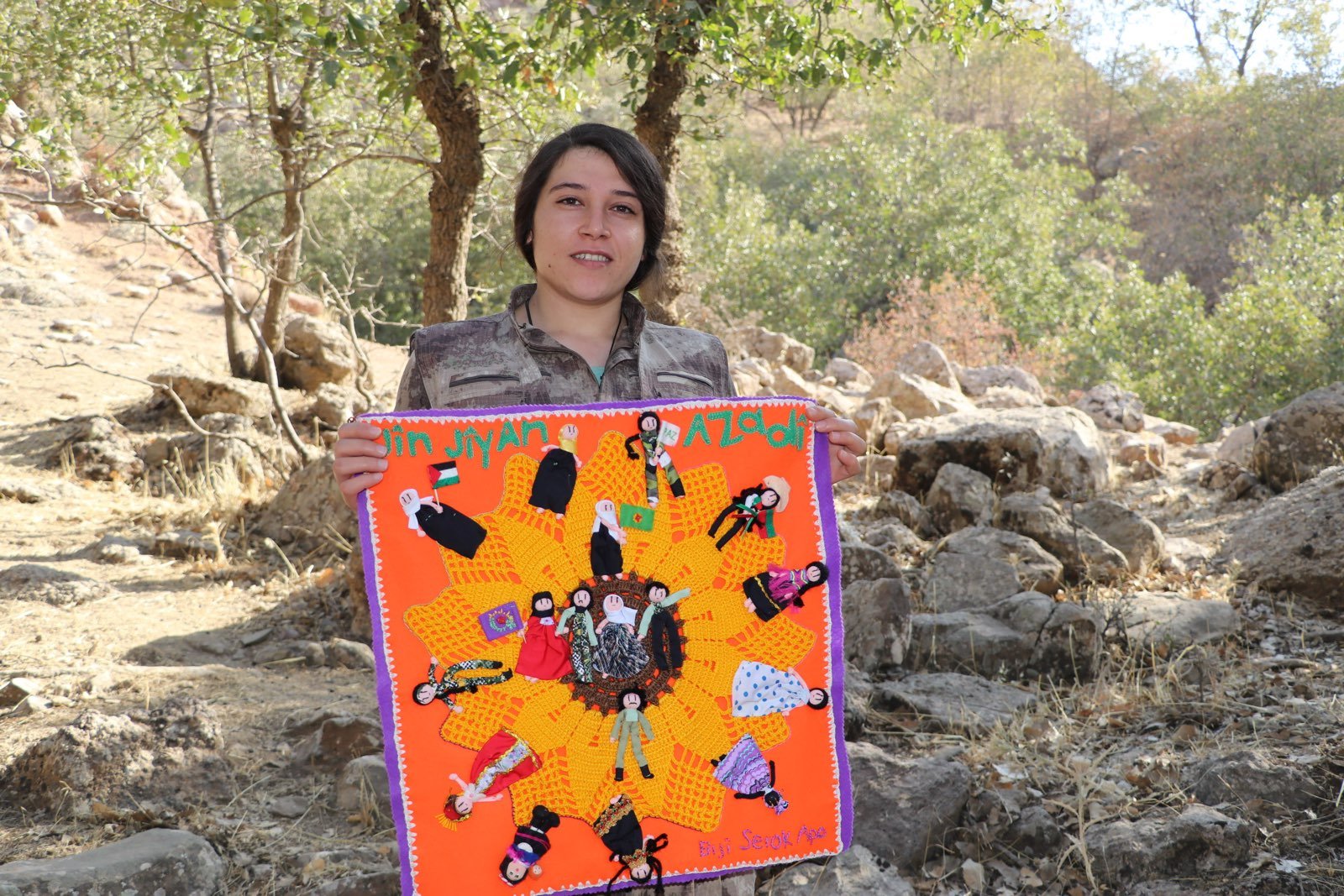
Interview with Cejna Alwoz, member of the Kurdistan Women’s Movement, on the history of links between the Kurdistan Women‘s movement and the movements in Abya Yala, and her perspective on the 2026 women’s conference.
The ties between the Kurdistan Liberation Movement and the movements of Abya Yala—those of women, indigenous peoples, and youth—are very strong. The physical distance might be huge, but hearts and struggles remain close. Could you tell us something about the history of these connections? What is the reason for the strength of this relationship?
The women’s movement in Kurdistan, especially since the 2000s, began to expand its relationships because the women’s party had been formed (the Free Women‘s Party, Partiya Jinên Azad), and that also meant that, as a party, it became more involved in the life of society and in relationships with other movements. It is true that there were already initiatives in the 1990s, such as a conference in 1994 that brought together women’s movements that were fighting with weapons against their oppressors. So there were already efforts in this direction, and there were also delegations visiting different countries. But after 2000, the formation of the Free Women’s Party—that is, a party whose priority is the pursuit of women’s freedom—intensified this work and it was thought out more broadly. I remember that we created the women’s social contract, and when we were writing it, we already had relationships with different movements, we were following what they were doing from afar. We sent them our contract so that they could share their perspectives. We didn’t have many possibilities or resources, but there were initiatives like this. To reach women around the world, we created these contacts. These efforts took on another organizational dimension with the declaration of the new paradigm of democratic confederalism in 2005. From then on, international work intensified even more. We planned this work in an organized way, that is, we gave some comrades the mission of creating and maintaining links with other women’s movements. It was no longer something random. Then, with the Kobanê revolution in 2015, many internationalists came to Rojava. And, in the same way, comrades went to Abya Yala. They took on this responsibility, both to learn about and to organize solidarity around the Kurdish movement. So we held meetings, shared experiences in Cuba, and above all with Heval Lêgerîn (Alina Sanchez, an Argentine comrade who joined the Revolution in Rojava and fell as a martyr for women’s freedom in March 2018), the movement became better known.
The role of Heval Legerîn was very important. In 2016, a group of comrades went there to organize solidarity work, and then in 2017 a delegation from Jineolojî went to Abya Yala. There we were able to share the rich experience of the Kurdish movement, both philosophically and practically. The resistance of Rojava had already resonated there. Like our star, this revolution was shining out to the farthest regions. People became informed, and our voice reached the world.
Through our work with solidarity committees, we saw that, beyond solidarity, we shared similar thoughts. When we told our story in seminars, we did not speak only to be heard, but we wanted to share our experience and learn from theirs as well. It caught our attention. And what we saw in the discussions during the seminars was that our thoughts and experiences were similar. Our destinies were similar: our ways of fighting, the aspiration to Xwebûn (being oneself). We say paradigm, and they say cosmovisión; we say we defend the earth, they say Pachamama. Many things were very close. The Jineolojî delegation was working on that: it is not necessary to use exactly the same terms or definitions, but how can we bring the thoughts of Abya Yala to Kurdistan, and those of Kurdistan to Abya Yala? This is what we discussed above all.
In Abya Yala and Kurdistan, we are also confronted to similar fascist attacks and colonialism. For example: the disappeared people in Argentina, the mothers of the Plaza de Mayo, the Saturday mothers in Kurdistan, the struggle to defend the territory in Abya Yala, as Berta Cáceres did, for example, and our struggle to protect the Hasankeyf valley, which was flooded by the construction of a dam. All the stories we heard taught us that we experience the same pain. Their way of relating to society is also similar to ours, unlike activists in Europe. We saw how similar we were in all these aspects.
But we also saw differences from which we learned. For example, before, whenever we talked about our struggle, we always referred to European arguments. Not because we agreed with them, but because we always took a position with respect to the Western perspective, to make our point clear: “You pretend that this is the case, but it is not.” We wanted to prove ourselves against the European mindset. That is something I understood much better with the movements in Abya Yala. And we learned that we don’t have to refer to philosophers or the arguments used by Europeans, we just have to talk about ourselves, directly. They do the same. That was the most important lesson from Abya Yala. And they were always very open with us and with their solidarity with Kurdistan.
A strategic and very deep relationship was born between us. We accompanied each other, they came to Europe to participate in seminars, they came for interviews with the movement. We got to know each other more and more, and not only through representatives, but they also got to know the reality of the movement. And little by little, some comrades, some movements, became convinced of the paradigm. This paradigm, developed by Rêber Apo, opens up a perspective of liberation struggle that one can take to one’s own country. But not to imitate, to copy schematically, but in a profound way. On this basis, comrades from Abya Yala came to the international women‘s conferences in 2018 (Frankfurt) and 2022 (Berlin) as a delegation. They did not co-organize, but came to share their experiences. And this link continued and deepened. There were feminist organizations, land defense organizations, indigenous peoples… And this relationship continues to deepen.
Reflection on women’s confederalism in Abya Yala began recently. In 2024, we launched the proposal and a dialogue was opened. From then on, this perspective of democratic confederalism guided our discussions in Abya Yala. Because we are not the only ones who need this perspective. It is true that the peoples of Abya Yala are engaged in a very strong struggle, especially the indigenous peoples. But many organize themselves with ideas that came from outside and inspired organizational processes, such as Marxism and feminism. If an ideology does not really correspond to a territory, it cannot have the desired impact.
Our goal is not to import Democratic Confederalism as an ideology from outside. We believe that confederalism already exists in Abya Yala. It should guide life, and that is only possible if it is organized and knowledge is developed around it. Sometimes we say so easily, that it is already there, democratic confederalism already exists. It also exists in Kurdistan. But if there is no organizational method, knowledge, or action with a long-term strategy, then this root cannot grow. This root will always remain underground. Changing this is our goal, and that is where our difference lies. We don’t want to become a template that is copied. We say that confederalism exists in Abya Yala, and according to their culture, they can develop more knowledge around it, according to their strength, their struggle. When two worlds, two ideas, come into contact, a transformation begins. It is not just one side that changes. When there is contact, exchange, nothing remains as it was before. There is always change on both sides.
The women in Abya Yala who are already convinced of this perspective work on their own. They do not act according to what we say. Above all, we have discussions with indigenous peoples, because the most fundamental struggles in Abya Yala are those of indigenous peoples. We work together and they are our main alliance. There are also the struggles of the left, feminists, and environmentalists. We also have links with these movements. It is a characteristic of the Kurdistan Women’s Movement: we go to a place, we make contact with one group, but we also go to find other groups. And we want these groups to meet and get to know each other. Sometimes we go to places and set up meetings between two groups that did not know each other before. Because our efforts are always in this direction, and it is our way of working: to always strengthen sociability and see what we have in common. Because that is what Democratic Confederalism is all about. It is about working together towards our goals, despite our differences, so that humans can live together and make decisions; that is fundamental.
In Abya Yala, many struggles and movements converge. There are hundreds, thousands of struggles that exist and take many different forms. We cannot say that we have reached them all. But we try to understand and learn more. In every country, we have managed to forge links with a wide variety of movements. And this work continues; it is an ongoing process. It is in line with the principles of Democratic Confederalism. Every movement can become an alliance. But when we organize together, points of disagreement may arise, and that is normal. We do not have to adapt completely to each other, or each other to us. But the important thing is how we can understand each other. There are popular feminist struggles, but within indigenous communities, women’s struggles and women’s freedom are not at the center of the struggle. We believe that this needs to change. It has to be a main issue.
It is well known that the Kurdish women’s movement has never been limited to the struggle for the freedom of Kurdistan, but has always been guided by the perspective of the struggle of women around the world. And now, under the leadership of Reber Apo, the perspective of a worldwide women’s confederalism has emerged. Why is so much effort being made to build a democratic confederalism for women around the world? What is the essence of this perspective?
Global women’s confederalism, the model of Democratic Confederalism for the 21st century, after so much practical struggle and so much theory, can provide part of the answer. It can respond to the long-term needs and problems of societies. It is a model of life, not just an alternative system. The system sometimes attacks society, and sometimes society lives in peace with the state. But this way of life exists in the long term, and in all parts of the world. We believe in that. And our goal is to share these ideas. For example, in Abya Yala, there is a lot of struggle, there is a lot of resistance, they do not surrender to the system; but when resistance is not sufficiently thought out, then all these efforts do not achieve results. That is why, when we talk about Democratic Confederalism in Abya Yala, it is not to serve the interests of the Kurdish people. Rather, it is to support the struggles of all peoples, to strengthen these movements, and to contribute jointly to the construction of a long-term solution.
Sometimes we were asked in Abya Yala: why are you here? We believe that this model can provide answers to the problems of peoples because it includes self-management, knowledge, philosophy, understanding of oneself, one’s history, and connection to one’s roots. This search corresponds to Abya Yala. Very quickly, this thinking could lead to results. But not as an ideology imposed from outside, rather this thinking can play the role of a bridge between struggles.
As leader Apo also said, may the 21st century be the century of the women’s revolution. The women of Abya Yala have always fought hard, especially in recent years. From the perspective of the Kurdish women’s movement, what is the role of the Abya Yala women’s movement globally?
The women of Abya Yala are an example, with their resistance, always. That is the first thing. They do not surrender to modernity, and thus they have become an example. When ideas come from Europe, or new lifestyles, they may influence groups in Abya Yala, but the peoples there will always retain a strong link to their own roots. These roots are still very strong. And with this characteristic, they can have a great impact and inspire the whole world, because they share their critiques of modernity very openly. These societies are very healthy and clear in the sense that they are not afraid to confront their own weaknesses and talk about them. If there are failures and defeats in society, they are not afraid to share this. They are very clear.
These are all very beautiful characteristics, and modernity has not managed to destroy them. That is why they inspire the whole world. But sometimes, this inspiration remains at an abstract level that does not allow us to think about how to strengthen the struggle. And that does not allow this society or this movement to see its own faults. But what I see above all is that they are peoples who are clear in their perspectives. Connected to their roots, they are always standing, fighting. If there is no struggle, if a woman in Abya Yala does not fight, she cannot live. That is why they say: por la vida (for life). It is a very clear reality, as in Kurdistan. If you do not fight, you cannot live. There are attacks against their bodies, their lands, their economies, their water. Society knows this, and that is why they are always on the move. There is this notion of militant joy. It is something I see a lot in Abya Yala. And where does this joy come from? From a life full of meaning, a life in search, which is clear about what it accepts and what it rejects. It comes from there. And on this continent there is a lot of this joy. Life is clear. Simple. It is expressed clearly. These are great advantages that can have a very strong impact. Whether one is politicized or not, the whole of society is touched by this and learns from it.
What are your hopes and expectations for the Abya Yala conference?
I have high expectations for the conference. The preparatory work has been going on for a year now. And the comrades who are working on it are doing so with great conviction. Conviction is the most important thing for building something. A group of 40 people, each seeing things differently, will not get very far, but a group of two people with strong conviction can achieve many things. All the comrades who participate in the preparatory work, the movements, the organizations, all have very strong conviction. They put in a lot of effort and take on a lot of responsibility. That can become an example, because at the other conferences, in Frankfurt and Berlin, we made the mistake of not sharing the responsibility more. We don’t want to repeat this mistake. There is a lot of work being done simultaneously, they rack their brains, they make both physical and intellectual efforts. So I have high expectations, especially because, as I said before, we hope that it will create something long-term for Democratic Confederalism. And we will no longer be needed to provide motivation, because the peoples themselves are their own seed. An organization that can do this work on its own. We have this hope. And this is the goal. The idea is not to reproduce Democratic Confederalism as the Kurdish movement does. Not in this way. Rather, taking this experience as a starting point, bringing together organizations and movements to expand the network, so that all those who are part of it, small groups and large movements, can support each other.
Make the 2026 Women’s Conference possible: From Abya Yala to Kurdistan, we are weaving the future
If you believe that another world, placing women at its center, is possible, support this powerful gathering of diverse women from Abya Yala!
In February 2026, around 500 women will travel to Bogotá from different towns and cities in Abya Yala (or Latin America) to make this powerful Conference of the Women Weaving the Future Network possible, which we are organizing hand in hand with the free women of Kurdistan. This space is created to bring forth all the wisdom of women, which has been buried for centuries, to build a more beautiful, free society, according to our dreams. Mother Earth is grateful for this gathering because we are doing it to protect her from depredation while giving life to a joint path for the defense of our bodies and our territories.
Preparing breakfast, lunch, and dinner for hundreds of mouths, including their children; paying for lodging or plane tickets for a few; ensuring translation to communicate among the many languages that will be present; gathering enough educational materials to read about the journey of our ancestors, understand the historical task we have, and draw the future… All of these are million-dollar costs that we are approaching with your contributions.
We invite you to join us in the same heartbeat with the Conference “We will flourish because war cannot destroy our roots. From Abya Yala to Kurdistan, women’s struggle against the destruction of life.”

Link to the original publication, on the website of Women Weaving the Future: https://womenweavingfuture.org/abya-yala/entrevista-con-cejna-alwoz
Link to the crowdfunding: https://womenweavingfuture.org/abya-yala/crowdfunding