
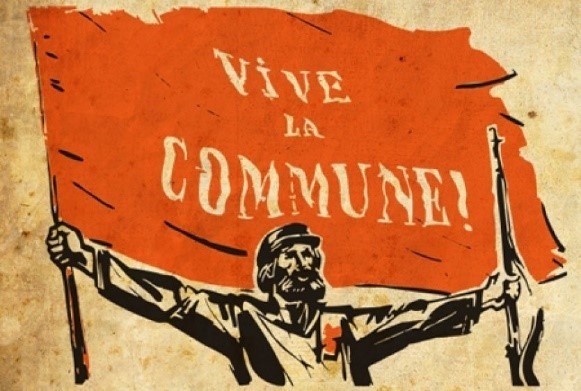
Interview with Jasper Bernes, author of “The Future of Revolution: Communist Prospects from the Paris Commune to the George Floyd Uprising”
Recently, the Kurdistan Freedom Movement (KFM) has once again seen a resurgence in the concept of communes. While this concept is not new to the KFM, its imprisoned leader, Abdullah Öcalan, has explicitly shifted his emphasis towards the commune as a form of struggle, embracing a prefigurative approach to politics. I emphasise the prefigurative aspect rather than the vanguard aspect deliberately, since there is an ongoing discussion about vanguardism within the KFM. Although the concept of vanguardism persists, it should be noted that its implementation was invariably accompanied by a series of stipulations. The fundamental difference between these two concepts lies in their respective emphasis on the future or the present. While vanguardism emphasises societal transformation in the future, the KFM’s prefigurative approach focuses on bringing about change in the present based on the concepts of the commune and communalism. The concept of the commune was central to ‘Beyond State, Power and Violence‘, Öcalan’s monumental work and his defence in court, which played an instrumental role in the reorganisation of the Kurdistan Freedom Movement. So, in short, although the concept of the commune is not new, it has re-emerged in the public sphere with Öcalan’s latest perspectives, and it may now be discussed more widely. From an internationalist perspective, the emergence of the commune concept, or the conceptualisation of struggles based on communes, is not coincidental; it reflects the pursuit of broader egalitarian struggles. In this context, your fascinating book with the title “The Future of Revolution: Communist Prospects from the Paris Commune to the George Floyd Uprising” comes into play, offering profound insights into historical discussions ranging from European experiences to the George Floyd uprising. I would like to discuss some of the concepts from your book, as well as your perspective, and ask your opinion on matters such as Rojava.
In the very beginning, could you introduce the distinction between the concepts of commune, council, and soviet? In the book, you clearly referred to the different nature of the concepts of commune and council, underlining the council’s—and soviet as organic continuity of the logic of council—tendency to be exclusively a workers’ democracy. But, on the other hand, the concept of the commune is closer to being the governing body of society through a hyper-democratic way, as opposed to the function of the council. The distinctions, especially based on their spatiality and possible capabilities, were inspiring. Could we break it down from the beginning?
Yes, that’s the key difference. Whereas the workers’ councils and soviets of the twentieth century were rooted in workplaces, the Paris Commune was more of a municipal organization. What was important about the Commune for Marx and for later revolutionaries was its form. Decisions were made by mandated, recallable, and rotating delegates responsible to their base committees. This was for Marx the “form at last discovered in which to work out the economic emancipation of labor” but in truth the Paris Commune did not have deep roots in the workplaces, and had just barely begun the socializing of production. When the soviets emerge in 1905 in Russia they do so as part of a mass strike wave and therefore they are immediately workers’ associations, more or less using the delegate structure of the Commune to coordinate among striking workers. Because they are organized, the soviets find it easier to begin the work of socializing production. In fact, they must partially socialize some production, deciding to keep the lights running and maintaining other basic services in the midst of the mass strike. Later, in 1917 in Russia and 1918 in Germany, when the form reappears, some workers immediately seized control of their workplaces and organize councils but in other places the process occurred through external intervention, selected delegates by various arbitrary measures. Then as now there were lots of ideas about how to organize councils and soviets and even what these words mean. It hadn’t been worked out. In Russia in 1917, for example, the soviets were not really workplace organizations and instead delegates were elected by region and selected from among party members. This happened as I note above in some places in Germany as well. Council communism as a practical and theoretical current emerges during the German Revolution as an attempt to rigorously found the councils in the workplaces independently of the parties and there begin the work of directly socializing production.
All of this raises questions about how exactly these organizations are to coordinate. Because workers’ councils are regional organization of workplaces, and not industrial organizations, like the unions, they have some relationship to different communities, which of course need to be involved in decision-making about housing, food, distribution, childcare, all of which also needs to be socialized. None of this got worked out during the German Revolution, as the councils were weakened and destroyed by social democracy and emergent fascism.
Today it seems that we need some kind of fusion of commune and council. In the US at present, for example, it probably would not make sense to root councils entirely in workplaces, since so much of what is produced will not be of use during the revolution and many proletarians have no connection to meaningful workplaces. But in other places perhaps workers’ councils as such might make more sense. What matters is that the councils are mechanisms for socializing and distributing commonly planned and produced wealth. There are different concrete structures that might be proposed, but what’s still important is the idea of mandated, recallable, and revolving delegates, so that everyone has control over their conditions of life and can, at the same time, coordinate with others across social and geographical distances.
The expansionist nature of the commune, if I may put it like that, was another fascinating analysis of the book. You describe it again, from the commune to the outside of the commune and through the inside of the commune. Additionally, it does not seek geographical continuity or relation; it can be like a cormorant, invisible somewhere and again appearing in any other place in the sea of struggles, as you underlined. And the commune has universalist emancipation parole in every case. By saying so, we also refer to the inclusive nature of the commune, which means the commune must be as open as possible. So, I put it in a very confusing way. Could you elaborate on our understanding of the expansionist, inclusive, and internationalist nature of the commune?
Yes, like a cormorant, or like a mountain spring, bubbling up from the rock. Sometimes we must describe these things through poetry. Marx describes the Commune as a “thoroughly expansive form,” so when he is writing about the Paris Commune he is writing not just about what it was but also what it could become. Though the Commune had not thoroughly socialized and organized workplaces in Paris, it displayed the capacity to do so, just as the later workers’ councils did, from a more advanced but nonetheless not yet fully realized point—it was an idea in practice, but one not fully worked out. The Paris Commune was both “rallying cry and the thing itself,” as Kristin Ross writes in Communal Luxury, her book on the afterlives of the Paris Commune. The Paris Commune was also, as I write, “a fragment of future communism.” This is because it needed to expand or die—limited to the Paris walls it would surely fail, as all could see; it needed to spread throughout France and beyond. Insofar as it represented a hope for world communism, for a “universal Republic,” it mobilized international solidarity. When a revolution breaks out somewhere in the world, it becomes the hope of proletarians everywhere. Furthermore, many of the participants in the Paris Commune were migrants and exiles. There was therefore a powerful internationalism to the Commune, and of course many of Marx’s associates in the First Workingman’s International participated in the events. Because of the complex situation of the Franco-Prussian war, the Commune was opposed both to the Prussians (and therefore on the side of the German workers’ movement) but also the French Second Empire. It was anti-national.
Because the commune has partisans both inside and outside its walls, and because it is a thoroughly expansive form, its geography is non-contiguous. Revolution leaps from place to place, and across non-revolutionary zones. But this capacity to expand is also at the same its need to expand or die. In this sense we give the name commune largely to experiments that were destroyed. Commune might perhaps be best reserved as the name for an emergent communism, but not a victorious one which had overcome these contradictions and sent capital fleeing to the margins of the planet.
On the other hand, as you promote, the commune cannot prevail before the accomplishment of the disarmament process of state power. In here, of course, we ought to consider the confrontations with the state power. I am, however, heavily keen on thinking about confrontations, which, if we may call them, are the politics of confrontations. What I have seen, however, is that the commune follows the failed state or total collapse of the state. The Rojava Revolution was, for instance, exactly like a failed-state experience. The Syrian State was not able to govern these districts because of the civil war, or else we can look at the Spanish Civil War, the Chinese Revolution, etc. What I intend to say about this is that, actually, it seems to me that the commune has not done it by itself; it was a part of a compatible process of the collapsing of the state, and in the “Hic Rhodus, hic salta” moment, the commune, or a part of the commune, expands itself to conquer the power. On the other hand, every experience shows us that the commune must defend itself, either pursuing the disarmament process or firmly focusing on self-defense. So, my question here is, how can we consider the confrontation politics of the commune? I mean, you underscored that the destruction of the armed power of the state cannot emerge through direct military confrontations, but rather it could happen through mass mobilizations. Following your historical analysis of this, how can we consider current confrontations, disarmament of state power, or self-defense of the commune?
We can say that the first condition of the revolution is the suspension and eventually cancellation of the armed power of the state and, ultimately, of capital. This is a process that happens by degrees, however, rather than all at once. The greater the collapse of the armed power of the state and the international system of states, the greater the possibilities for socializing and expropriating wealth for the good of each and all. But the disarming of the state is often something that happens indirectly, due to some breakdown from within, as much as it is the result of revolutionary disarmament. At the same time, the disarming of the state means the arming of the revolution—these are two sides of the same coin in a world in which arms and efficient machines for killing are, sadly and terrifyingly, always ready to hand. The way I see it, the distribution and use of arms in the revolution can follow the same principles of free association outlined above—armed power is organized voluntarily and not through conscription or payment of wages. Where tactical leadership or strategic centralization is necessary it is delegated, revocable, and valid only for the period of engagement, just as with the worker’s councils. But in the end, I think it’s important to emphasize that the survival of the revolution is not only a military question, and that the confinement of the revolution to the field of military and political struggle is the way that revolutions die. Revolutions spread and flourish to the extent that they directly transform society, meeting social needs and involving the participation of millions and then billions. To the extent that the military question overwhelms all others the revolution has already lost.
Related to the above question, and I think a very insightful proposition of the book, is counter-logistics politics. Especially, you reside in the pre-revolutionary moment and transition to the revolutionary moment as a prefigurative order of the commune, if I may say so. It is insightful because you shed light on one of the main weaknesses of the commune. Tending to reproduction, rather than only focusing on the production process, makes the commune a real political project, in my mind. Could you elaborate on the counter-logistics politics, in theoretical and practical manners, for us? What does it mean for today’s society, current capitalism, and current, broadly speaking, anti-capitalistic movements?
Capitalism has transformed massively in the last fifty years. This is first a result of de-industrialization and secondly of globalization. Industrial jobs have declined worldwide at the same time as new technologies of communication and transportation have allowed for the construction of a distributed, planetary factory, where capitalists can seek out the lowest wages anywhere in the world. This is a challenge to the conventional view of revolution, in which the cultivation of class power within production eventually enables proletarians to seize the means of production. Most proletarian, especially in the United States, don’t have access to these means, and don’t work in fields that produce useful things.
As a result of this restructuring, then, struggle tends to emerge where proletarians have power, in the space of circulation. It emerges as riot, as blockade, as occupation, as my late and eternal friend Joshua Clover has shown in his magisterial book Riot. Strike. Riot. Insofar as logistics is the name we give to capitalist circulation—the management of production through the management of circulation—struggle today is often counter-logistical. It aims to interrupt the flows of goods at a distance from their production. This is obviously a limit for many struggles—in order to become truly revolutionary they will have to penetrate into the heart of production, expropriating socially useful and necessary means of production and using them to meet people’s needs. How this happens is something about which I can unfortunately only be vague, since this is a problem that class struggle will need to solve itself. Suffice it to say, for now and as a starting point, that there will need to be struggles both inside and outside production that eventually converge.
It is also the case that revolutionaries will find the existing means of production inadequate to their needs. In this sense, part of the process of revolution will involve cultivating new ways of meeting people’s needs, as we see happening in many struggles from the start. This will be a process of invention, creation, and making do, as much as expropriation of existing resources. Much of the work of expropriation will likely involve finding ways to do things with resources that were designed for other purposes. It will be a process of tinkering and retooling, recycling and reinvention. For example, in California we produce an enormous amount of food but much of it is produced for export—things like almonds, and wine, and other high-value products. The kinds of food grown here will need to change, and that’s a process both of expropriation and transformation. Perhaps a better term is transpropriation.
Related to the aforementioned discussions, the Rojava Revolution, if we take it in parentheses in the revolutionary moment, I mean, if we put aside the ongoing widely known discussion, could we see some lessons for the commune and self-defense? To put it simply, the Rojava Revolution, which we all know for its military aspects, actually began with the spread of communes in Rojava Kurdistan. After Assad’s ability to govern in this area was severely limited, PYD-led communes spread throughout Rojava, meaning Qamishlo, Kobane, Afrin, etc. The important dates are as follows: The administration body was announced and started to be embodied after 19th August 2012, and the formation of YPG-YPJ, the self-defense unit, started in 20131. As we can see, intriguingly, it started with communes, and the communes embodied self-defense units in the very complex civil war field. One of the first actions taken by the Rojava Revolution was the takeover of the governmental offices and the disarmament of the remnants of the government. In sum, transforming the party’s frontal organization to the communes may allow us to understand the paradigm change from the concept of vanguardism to the prefigurative understanding of political work. ( I meant this because of Novara Media’s question and your answer there. Actually, you intuitively put it as the interesting fusion of vanguardism and the commune. To accommodate this discussion, I have added it. Actually, it became two questions; you can answer them as two different questions, and I will adjust the questions accordingly based on your answers. ) However, what I wanted to ask is that, within this complex picture, can we illustrate some relations about the commune and part, the commune and self-defense, and exactly as you said, the vitality of the expansionism of the commune?
I think that discussion of the “party” or even vanguardism are confusing because the terms can refer to different things and different ideas. I would argue that in any revolution there is always a party and a vanguard, even if they are not formally designated or organized as such. As such, these are not things you can be for or against, as they are the natural outcome of a revolutionary process —a process of partisanization. Pro-revolutionaries will always organize themselves, but the question is how. It is interesting to look at the ideas of the party that emerged in the wake of the German Revolution. Some council communists thought that there was a need for a formal council communist party, and others didn’t, instead arguing for the creation of “factory groups” in workplaces. But even those who participated in the council communist party—the KAPD, the German Communist Workers Party—had a very different idea about the party than the Bolsheviks in the KPD, the German Communist Party and the social democrats in the SPD, the German Socialist Party. For the KAPD, the function of the party was to act as a catalyst for proletarian self-organization. Rather than directing or leading or educating class struggle, the goal of the party was to clear the way for self-organization and the formation of communist workers councils by the revolutionary workers themselves. Such a party is largely tactical, insurrectionary. It acts as an amplifier, rather than a director or educator. Effectively, this meant the formation of armed groups engaged in acts of expropriation and proletarian defense during moments of heightened class struggle, such as the Germany-wide 1921 March Action, probably the height of the KAPD’s effectiveness, which in hindsight was rather limited.
My understanding of the Rojavan Revolution is also limited but it seems there was a tension between commune and party, between the mass assemblies and councils and the formal organization of revolutionary partisans. I have watched an interesting film, Belkî Sibê, which explores some of these contradictions and how they unfolded in Rojava the context of a life or death military struggle. In any case, this tension is common to all revolutions, even where there isn’t a formal party. The problem is that communes and councils aren’t necessarily revolutionary—participants in these forms may be interested in their own benefit above the revolution, or they may even be counter-revolutionary. How to handle this problem is the big question. Suffice it to say that subordinating commune or council to party, as happened in Russia and to a degree in Germany, effectively limits the intensification or extension of these forms. This is why I like the idea of amplifier or catalyst. But in the end it is the revolutionary masses which will decide—if one can’t convince the majority to go the way of communism, or revolution, then one is unlikely to succeed. In this sense as I say movements of years and movements of weeks converge in revolutionary days. Revolution succeeds where there is revolutionary unanimity. Vanguardism here is best thought of as adventurism—a pejorative term that I recuperate. The formal or informal vanguard can clear the way—it can say yes but not no. This means that it is limited but accepting those limits and the failure they promise is the only way to find success.
A part of this question is also not just about the organization of partisans and the organizations of councils but also the organization of the armed revolution, the Red Army, if you will. A Red Army is a strange organization which can have tactical but not strategic centralization accept where that strategy is consistent with underlying revolutionary unanimity. Here we might think of the formation of the Red Army of the Ruhr in March 1920, in response to an attempted coup, where the German proletariat through its councils and factory groups and militias armed itself and disarmed the state over a vast and wealthy region, laying claim to the center of German and European heavy industry. This kind of army cannot accept strategic centralization where such centralization means the laying down of arms or surrender, such a process will always split a Red Army to the extent that it remains one. This makes it very different from what is often meant by the term “army,” in which the entire armed body is subordinated to central decision.
Finally, I would like to send my greetings to the revolutionary communes of Rojava past, present, and future. We must unravel the knot of capitalism and the state from all sides.
The article first appeared in issue 345 of the monthly Turkish and Kurdish-language magazine PolitikART, and is republished here with the permission of the editorial team. Kaan A. Korkmaz conducted the interview.
1 https://rojavainformationcenter.org/2022/07/10-years-of-the-rojava-revolution-much-achieved-still-much-to-come/