
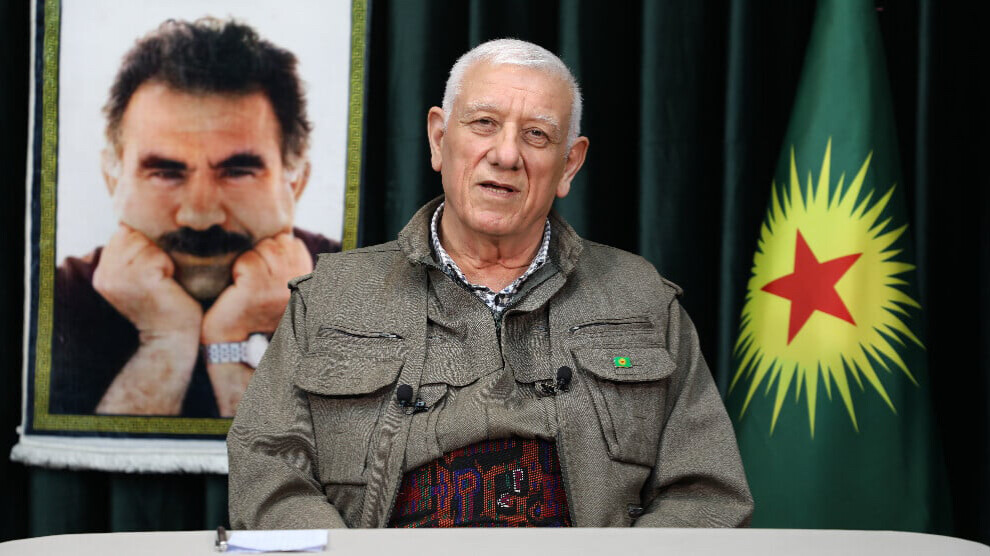
We are publishing a comprehensive interview with Cemil Bayik, Co-Chair of the Kurdistan Democratic Communities Union (KCK) Executive Council. In the interview, he provides a precise analysis of the ongoing Third World War and its geopolitical situation. He contextualises the attacks in Syria and Rojava, discusses their implications and offers an outlook based on the paradigm of Kurdish leader Abdullah Öcalan’s vision of a democratic society as a way out of crisis-ridden capitalism. He also elaborates on nationalism as the greatest threat to the Kurdish people and the entire Middle East, describing the concept of a democratic nation as the only realistic solution to society’s prevailing problems. Bayik also discusses the tactical alliance between the Autonomous Administration of North and East Syria and the USA, as well as the future of Syria. He emphasises the importance of Kurds standing together in national democratic unity, as well as the need for international solidarity. Bayik also evaluates the current status of the ‘Peace and Democratic Society Process’.
The whole world is undergoing a process of structural changes, with developments taking place on a daily basis. There are conflicts and wars at the local and regional level in many parts of the world. One could speak of a war that has spread everywhere, with economic, social, and diplomatic crises. Kurdish people’s leader Abdullah Öcalan defined this as the Third World War. How come that the center of the war is the Middle East and Kurdistan in particular?
The Third World War was initiated with the First Gulf War, and it has continued since. It might be hard for some to realize that the Third World War has already begun because it does not resemble the First and Second World Wars. The Third World War is unfolding under the conditions of globalized capitalism. It is not a harsh war based on rigid polarization like the First and Second World Wars. This is because there is no polarization and style of warfare aimed at defeating each other in the shortest time possible, as there was in the First and Second World Wars. The warfare today continues in various forms. A struggle within the system, seeking to push back other capitalist countries and strengthen itself through various and changing alliances, is being waged continuously.
All the World Wars occurred during periods when old balances were destroyed and new political balances and a relative status quo were sought to be established. Now, with the end of the Cold War, the war to create new political balances and establish a relative status quo according to the needs of the global capitalist system continues in place of the shattered political balances and status quo. Due to the nature of global capitalism, this war is a protracted but continuous one. It is primarily taking the form of regional conflicts. All this tension, conflict, and warfare are part of the Third World War. One must recognize its connection to the reality of global capitalism.
At the same time, the Third World War is also intertwined with the crisis of global capitalism. Global capitalism is experiencing multiple crises. The income gap between communities and countries, the ecological crisis, the continued heavy domination of women, the migration problem, armament, and the perpetuation of wars are the fundamental dimensions of this crisis. Since the systemic left opposition has failed to provide a solution to these problems, right-wing parties are coming to power in most countries. The proliferation of right-wing governments is an expression of the deepening crisis of capitalism. It is clear that the deepening crisis imposes a historical task on those forces struggling for democracy and freedom. In this context, those with the appropriate ideological-political approaches and solution projects have a high chance of succeeding.
The paradigm of Kurdish people’s leader Abdullah Öcalan has the capability to respond to the problems that created this crisis. This shows that our struggle will develop further. The continuation of the Third World War in the Middle East and Kurdistan shows that the paradigm and solution projects of Kurdish people’s leader, Abdullah Öcalan have gained ground for development and results. Our freedom movement, which has developed to date, shows that, no matter how many difficulties and obstacles there are, if the paradigm of our leader is correctly put into practice, it will achieve even more than the developments created so far. Just as difficult conditions gave birth to our movement, the difficult conditions that will arise before us will be our reason to struggle and win.
Throughout history, the Middle East has been the geography where political balances and relative statuses have been established. Today again, the Middle East has become a battlefield where world balances will be established. Since Kurdistan is at the center of the Middle East, the war is intensifying in Kurdistan and its surroundings. The Middle East retains its importance for the world politically, economically, and socially. In our globalizing world, the Middle East must be viewed as a whole with Europe and Africa. If Western Asia is added to this, one can understand how geopolitically important the Middle East is. When also taking into account that energy is as vital as water for globalized capitalism and consumer society, one can better understand why this war is being waged in the Middle East and Kurdistan at its center.
Israel’s existence and its desire to increase its influence in the region, along with its moves in this direction, are another fundamental factor contributing to the concentration of the Third World War in the Middle East. Kurdistan, meanwhile, remains within the borders of four Middle Eastern states. These four states determine the balance of power in the Middle East. As such, Kurdistan remains at the center of the conflict in the Middle East. However, through decades of struggle, the Kurds have become a significant political force. They hold a crucial position both in the four countries into which their homeland was divided and in the political balance of the general Middle East. No international or regional power can pursue an accurate and effective Middle East policy without taking the Kurds into account. Undoubtedly, although they still primarily consider states due to their position, the Kurds will inevitably have a place within these political balances. Without resolving the issue of the Kurds’ existence and freedom, neither the countries that have established sovereignty over Kurdistan will achieve stability, nor will the regional policies of international powers yield results. The unresolved Kurdish issue is the most fundamental factor in the political crisis and problems in the Middle East. And the effectiveness of the struggle of the Kurds in the four parts of Kurdistan also brings with it the efforts of international and regional powers to bring the Kurds under their influence. They want to either neutralize the Kurds or make them part of their own policies. From this perspective, the regional war is also being waged over Kurdistan. But the Kurds are also using their important position in the political struggle to fight for their gains in the struggle for existence and freedom.
During the negotiations between 2013 and 2015, Kurdish people’s leader Abdullah Öcalan mentioned that the imperialist attacks and war, which had stalled in Syria, would eventually shift north and east. The latest developments have proven that. What are your thoughts on the intensification of the war in Syria? The US has recently explicitly targeted Iraq and Iran. Is there a possibility that the war will spread to these countries too? What would be the possible consequences? How would Turkey be affected?
The eastern Mediterranean is like a gateway to the Middle East and Europe. Syria, Lebanon, and Israel are located here, as is Gaza, which is now occupied by Israel. Throughout history, there has been significant struggle over Syria. The Ottoman Empire gained control over the entire Middle East by opening the Syrian gate. This was also the area most intensely affected by the Crusades. During the First World War, it was again at the forefront of important battles and political struggles in the Middle East. It was an arena of struggle between Britain and France. Ultimately, France sought to dominate Syria, while Britain aimed to control Iraq and Jordan to assert influence in the region. The establishment of Israel further heightened the strategic importance of Lebanon and Syria. As long as Syria’s political balances and situation fail to achieve stability, uncertainty will persist in the Middle East’s future. For this reason, the US and the UK, with Turkey’s support, mobilized HTS and ended the Ba’ath regime in Syria. Undoubtedly, Israel also played a role in ending the Ba’ath regime. Israel’s intervention in Syria after the collapse of the regime was also part of this plan for destruction.
The current political regime in Iran is a target of the US and Israel. First, they neutralized Iran’s proxy forces in the Middle East. Now they are targeting Iran directly. In Iraq, a new political system was established with the US occupation. It is still a country under US influence. However, since Iraq is one of the places where Iran breathes, they want to remove the Iraqi government from a position of supporting Iran. They particularly aim to neutralize the Hashd al-Shaabi. Some steps were taken in this regard during the Sudani government. But the US and Israel do not consider this sufficient. They want to remove Iran from a position where it can take initiative. For this reason, Trump threatened the Shiite prime minister candidate. If no compromise can be reached, there will be some developments in Iraq as well. Political balances in Iraq, which has not gained stability, may change. The US’s first choice may also be to create a compromise. Indeed, Maliki seems to have given up on his candidacy.
It has become clear that the current Iranian regime has no chance to survive in its current form. This regime will either change or collapse. If it does not make fundamental changes, this outcome seems inevitable. However, a foreign intervention-based administration in Iran could further exacerbate the crisis and problems. This is partly why the 12-day war was halted. The uprisings that followed further weakened the regime. While harsh interventions may have caused a temporary decline in the popular uprising, it cannot be said that the regime has grown stronger. Israel and the US favor Iran remaining intact but with a change in regime. They see a unified Iran as more beneficial to their own interests. If Iran does not fragment when the regime falls, a democratic system based on autonomous regions becomes inevitable. In fact, Iran’s history is one of local autonomy. The modernization of this in Iran could bring stability. The history of the Middle East is a history of locals living within autonomy. The strife of nationalism came from the West. If the Middle East is in constant crisis today, an important reason for this is that the concept of the nation-state, which is contrary to the political history of the Middle East, has been introduced into the Middle East as a source of strife. The famous divide-and-rule policy is also based on this single-minded understanding of the nation-state.
Regarding Turkey, if the country does not change itself and become a democratic system based on Turkish-Kurdish brotherhood within the framework of the concept of the democratic nation, it will not escape its position as a country that constantly experiences and is used in crises. International powers that benefit from this situation can implement a design in Turkey based on their interests. The unsolved Kurdish issue is its weakest point; it creates real survival problems for Turkey. The Turkish state sees the dangers that may arise. On one hand, it may face dangers because it has not shown the will to change the Kurdish policy it has pursued so far.
Why have the Rojava Revolution and the Kurdish nation become targets of attacks? What message do you want to convey in this regard to the Kurdish forces and peoples? And what is the position of Kurdish people’s leader Abdullah Öcalan on this issue?
The situation that most complicates the solution to the Kurdish question is the division of the Kurds in Turkey, Iran, Iraq, and Syria. Kurds are the second largest ethnic group in all of these countries. There are Azeris in Iran, but since Shiism is their dominant identity, their ethnic side does not come to the fore or is not brought to the fore. These four states were shaped by the concept of the nation-state in the 20th century. Although the harshest approach to the Kurdish presence is found in Turkey, a hegemonic policy has also been pursued towards the Kurds in the other three countries. Given the Middle East’s crucial role in global balances, international powers base their policies on these states. This is a significant handicap for the Kurdish people’s struggle for freedom. And even if the four states are opposed on other issues, they can produce a common policy when it comes to the Kurds. This reality shows the difficulties the Kurdish people’s struggle for freedom will face. It must be taken into account when pursuing policies regarding the Kurdish people’s struggle for freedom. Overcoming these handicaps requires, on the one hand, a determined and strong struggle, and on the other hand, political subtlety and skill. In this respect, rhetoric and simplistic statements find no use in the Kurdish issue. The Kurdish issue cannot be compared to similar issues elsewhere in the world. The Kurdish issue remains unsolved not because of the scarcity or abundance of demands. It remains unsolved as a result of policies aimed at eliminating the existence of the Kurds through the concept of the nation-state.
The attacks on Rojava have both international and regional dimensions. International powers, considering that maintaining tactical relations with Rojava, with which they had formed an alliance against ISIS, was not in their own interests anymore, deemed relations with Turkey and some Arab countries more important. They reached an agreement with Turkey and the Arab countries on the overthrow of Assad. Again, Israel’s interests were taken into account. When the policy of establishing new political balances in the Middle East on the basis of partnership with these countries was pursued, HTS’s attacks were overlooked. Since international powers are based on states, there is no comprehensive Kurdish policy. From this perspective, other political balances and interests were preferred. In fact, the Turkish Republic and HTS had always planned to facilitate this and launch an attack. Once the agreement was reached to hand over southern Syria to Israel, the attack was launched.
Everyone can see that the Kurds are influential in the Middle East. The struggle waged for decades in the four parts of Kurdistan has made the Kurds a very influential political force. The Kurdish freedom movement’s goal of a Middle East based on brotherhood among peoples, transcending the divide-and-conquer policies, does not suit certain powers. In the 20th century, the role assigned to the Kurds was to be a source of instability. In this way, the hegemonic powers kept the countries of the region under their domination. Although some cracks have appeared in this 20th-century policy, they still persist. The Kurds are not ignored; however, they do not pursue a unified Kurdish policy because they do not see it in their interest to remove themselves from a position of conflict and resolve the issue through democratic compromise. However, since the Kurds have become a significant force in every part of Kurdistan today, it has become difficult to maintain this policy. If the Kurds continue the struggle they have waged so far, and if the Kurdish political forces abandon the policy of blocking each other’s path or asserting their dominance, this policy will be overcome, and the Kurds will achieve a free and democratic life in every country where they reside. The democratic solution project of Kurdish people’s leader Abdullah Öcalan, based on the concept of the democratic nation, is also a project to overcome the policies pursued by both international and regional powers against the Kurds. These policies cannot be overcome with narrow nationalist approaches and will only confront the Kurds with policies of genocide. When the Kurdish people’s struggle as a whole in all parts gains strength, the issue of the Kurds’ existence and freedom in the four parts will be resolved. Kurdish people’s leader Abdullah Öcalan presents a strategic vision for the Kurds and aims for the democratization of all countries in the region. The convergence of the need for democratization in the Middle East with the Kurdish vision will usher in a new era not only for the Kurds but for the Middle East as well. The vision presented by him will also make the 21st century the Kurdish century.
The Kurdish people’s uprising in the four parts of Kurdistan in response to the attacks on Rojava and the impact of this uprising on world public opinion have once again demonstrated the immense power of the Kurdish people to achieve their freedom.
Kurdish people’s leader Abdullah Öcalan also evaluated that the ongoing attacks are a threat to the paradigm of the democratic society. Could you further elaborate on this?
The paradigm of Kurdish people’s leader Abdullah Öcalan, which is based on the democratic, ecological society oriented towards the freedom of the women, is a paradigm opposed to power, the state, and capitalism. Undoubtedly, those who exercise authoritarian power over the people and the capitalist modernist forces that have brought humanity to the brink of destruction do not accept this paradigm. They stand in the way of its development. From this perspective, not only in Rojava, but everywhere where Kurdish people’s leader Abdullah Öcalan and the Kurdish freedom movement have an influence, they take a stance against this paradigm. Women, youth, workers, and all oppressed communities will not bow to power, to the state, which is an instrument of oppression over societies, and to capitalist modernity, which exploits and destroys nature. Indeed, people with different ideological or political tendencies all over the world are fighting against these forces that are hostile to society and nature. Our movement has a systematic ideology and theory on this issue. We prefer to wage this struggle in a democratic environment, not head-on and in direct confrontation. One dimension of our struggle is to achieve this ground for struggle. Oppressed peoples and societies wage their struggles most effectively under these conditions. We aim for and want to adopt such a style of struggle in the four parts of Kurdistan and in the countries in question. We believe that such an ideological and political struggle is also correct for Southern Kurdistan.
An important dimension of the attacks on Rojava and North and East Syria is that they targeted the democratic society. The Damascus regime, HTS, could not accept the democratic system in Rojav and North and East Syria. It was clear that there would be tension. Would this tension exist within a democratic environment, or would it involve the use of violent means? It was no secret that the rulers of Damascus would resort to violence, lacking a democratic mindset. Of course, they did not have the groundwork or power to do this alone. With the approval of international powers and the support of regional countries, they were mobilized to both eliminate this democratic system and break the Kurdish will. And it is clear that Rojava’s democratic system is being targeted. Tom Barrack said that there can be no democracy in the Middle East and that monarchy is appropriate. This is actually an insult to the peoples of the Middle East; it does not consider the peoples of the Middle East worthy of democracy. With this statement, North and East Syria were threatened. If monarchy is proposed for the Middle East, then of course the democratic system of Rojava and North and East Syria is seen as a threat. This democratic system is seen as a threat to the capitalist modernist system envisioned for the Middle East. One of the aims of the attack on Rojava and North and East Syria, on their democratic autonomous system, is to eliminate what they see as a threat to themselves.
Turkey has already viewed democratization as a threat to its survival. It has not taken steps toward democratization for fear that the Kurds would benefit from it. Democracy naturally means local democracy, taking local will into account. Turkey does not accept the European condition of local autonomy. There is no country that is democratic but does not accept the uniqueness and self-governance of different identities. If democracy is the realization of the will of the people, then the will emerging on the local level must also be accepted. In Turkey, however, the authority of governors in provinces and district governors in districts exceeds that of mayors elected by the people. Municipalities have a limited scope of work, confined to activities such as roads, water, sewage, and garbage collection.
Neither the coalition forces nor HTS nor Turkey have ever accepted the self-governance system established by Rojava and North and East Syria. They see democracy as a system of governance that will render their own systems ineffective. In this respect, they have aimed to break the will of the Kurds and eliminate the democratic system in North and East Syria. This is because this system, based on the Arab, Syriac, Circassian, Turkmen, and Armenian societies, was brought about by the Kurdish will that emerged from the Rojava Revolution. Therefore, this attack on the Kurdish will is a direct attack on the paradigm of the democratic society. They have seen that if this paradigm becomes effective in Syria, it will spread throughout the Middle East.
Given this situation, how do you view the assessments that the paradigm has been undermined, that the construction of a democratic society and the idea that peoples can live together democratically, freely, and justly have collapsed, and that this is even a fantasy, a utopia?
To say that the paradigm of women’s freedom, social ecology, and radical democracy of Kurdish people’s leader Abdullah Öcalan has collapsed is to say that humanity is dependent on capitalism and oppressive exploitative systems. Francis Fukuyama once said that history had come to an end. In other words, neoliberalism was the final system for humanity, and no other political, social, or economic system could exist beyond it. When real socialism dissolved, mainly due to its own internal flaws, this was seen as a victory for capitalism. If any system is collapsing today, it is the statist, power-driven, capitalist, modernist system. Don’t the problems and crises this system is causing humanity around the world every day prove that it must be overcome? Those who say that the idea of democratic, free, and just living for peoples has collapsed in the case of North and East Syria are themselves in a state of collapse. More accurately, they are segments of society that are slaves to other ideas, devoid of the idea of free and democratic living. Let’s leave aside the collapse of this paradigm; it is an idea that offers new hope to humanity and will be increasingly embraced, along with the social and political system it envisions. What you mention is the demagogic rhetoric of those who know no system other than the nationalist and capitalist modernist system. It is their opposition to our leader and the PKK that makes them say these things. It is the discourse of those who have been paranoid about finding fault with our leader and the PKK for 50 years. However, the peoples, workers, women, youth, and forces seeking freedom see this paradigm as a hope.
This paradigm has been put into practice for 14 years, with its shortcomings and inadequacies, in Rojava and North and East Syria. It has become a model that the world looks up to, except for those who oppose Turkey and Kurdish people’s leader Abdullah Öcalan. It has been proven that a social system based on such a paradigm can be established. There are shortcomings in the implementation in Rojava that can be criticized, and we also criticize them. But a social life system had been established. Women have gained a level of freedom they have never had anywhere else. Kurds, Arabs, Circassians, Syriacs, Armenians, and Turkmens have lived together as brothers and sisters without conflict. Although this system has been struck in certain ways by the attacks of international powers and forces hostile to the Kurds and democracy, it cannot be said that this idea and project have collapsed. Only some areas where this project was intended to be implemented have been occupied by the enemies of democracy.
It is known that both the ideas of Jesus Christ and Muhammad were seen as a fantasy and utopia, and attempts were made to dissuade people from them. Failing to offer a utopia that gives people hope in the face of the capitalist modernist system that is destroying humanity is tantamount to humanity lying down to die. Humanity is not dead. The paradigm of Kurdish people’s leader Abdullah Öcalan clearly states that humanity is not dead and that sociality, which is a condition for human existence, will be revived with democratic values. This is precisely a call that can be realized, a project of salvation. Humanity can accept neither the current power-wielding state system nor the capitalist modernist system. If there is a collapsed idea and system, it is the male-dominated, power-wielding state system. The system that is alive, that will sustain life, and that is the future of humanity will be provided by the paradigm of Kurdish people’s leader Abdullah Öcalan.
Can it be said that peoples cannot live together but only become enemies and slaughter each other? Can it be said that a democratic, free, and just system cannot be established? The Middle East is the cradle of humanity; many values have spread from here to the world. To say that nothing will come out of the Middle East because dogmatism and conservatism later emerged is to disregard the historical values of the Middle East. It is to look at the Middle East with an Orientalist, i.e., Westernized, mindset. It is to belittle oneself. Such thinking has no future. Kurdish people’s leader Abdullah Öcalan presents a liberation project for all humanity. The values he puts forward are praised and embraced, but such approaches say that humanity cannot live freely, democratically, and fraternally. Once upon a time, people with right-wing and fascist mindsets used to say to socialists that human nature is selfish and individualistic, and that such a communal system cannot be established. Now it is clear that those who seek flaws in this paradigm have this very obsession. In short, this paradigm and the project it envisions have not collapsed; on the contrary, they will continue to develop and be embraced by the people.
Following the developments in Rojava and Syria, and particularly after the withdrawal of the Syrian Democratic Forces (SDF) from Raqqa and Tabqa, there had been some criticisms and accusations regarding the paradigm of democratic nation. There are assessments that the concept of the democratic nation weakens Kurdish unity and that it does not correspond with the reality of Rojava. What is your response to these criticisms and approaches?
The concept of the democratic nation is like a medicine; it is the only solution to the problems in the Middle East, which still remains unable to recover from all the ethnic and religious conflicts that took place in the region. What other approach could prevent a continuation of this, other than the concept of the democratic nation? Europe is also a region that is heavily exhausted by ethnic and religious conflicts, but with an approach close to the concept of the democratic nation of Kurdish people’s leader Abdullah Öcalan, a common ground for ethnic and religious communities to live in coexistence and in peace has been prepared. One can criticize Europe and capitalist modernity in many ways; however, the coexistence of different ethnic and religious communities based on mutual respect is an important achievement of Europe.
In Rojava and in North and East Syria, the people have commonly organized their lives for 14 years based on the concept of the democratic nation. Arabs from many areas of Syria fled the war and moved to the areas under the autonomous administration. This project was a project to democratize Syria. The existence of the Kurdish identity in the countries that they live in can only be guaranteed by democratization. Undemocratic states are always a threat to the Kurds and their identity. Seeking a solution based on democratization rather than conflict is the necessary strategy for the Kurds.
If the Kurds, Arabs, Syriacs, and other peoples of Syria had not established a democratic system together, Arab nationalism would have been provoked early on, and a Kurdish-Arab war would have unfolded. The Ba’ath regime had made similar attempts but failed. If international powers had not pursued a policy of allowing HTS to dominate Syria and Turkey had not pursued an inflammatory policy, Arabs and Kurds would have lived together and formed the basis of a democratic Syria. In an environment of external intervention and intense provocation, the withdrawal of the SDF from Raqqa and Tepqa was not wrong. As a force defending the brotherhood of peoples and the concept of democratic nation, it had to thwart the provocations aimed at starting an Arab-Kurdish conflict. The criticisms of the paradigm of the democratic nation are truly reactionary. There can be no more correct approach for peoples living within the same state borders and as neighbors. Actually, there should be no need to respond to those who criticize the democratic nation concept; however, I’m compelled to say a few things because some try to play with the emotions of our people. The democratic nation is a project for living in peace and brotherhood in a multi-ethnic and multi-faith geography such as the Middle East. It is based on mutual respect for everyone’s identity and beliefs. Everyone shall live together with their identity, culture, and self-administration. It is crucial to achieve this in the Middle East. Therefore, the concept of the democratic nation is historic.
The claim that the concept of the democratic nation would weaken Kurdish unity is ridiculous. Those who embrace the democratic nation defend Kurdish unity more strongly, as a democratic understanding is necessary for Kurdish unity. The undemocratic approaches solely pit peoples against each other and do not ensure Kurdish unity; they create problems among Kurds. The concept of democratic nation does not cause conflict and strife among Kurds; on the contrary, the nationalist mindset, which seeks to control and make all Kurds submit to a single authority, prevents national unity. The PKK always prioritized a solution based on brotherhood among peoples, but nationalist tendencies prioritize relations with regional states.
The reasons for the Kurds’ lack of unity should be searched historically and objectively. This will reveal that the true reasons for this lie both in the pursuit of authoritarian hegemonic interests and in the influence of external powers. In the course of the work regarding national unity, a representative of one of the international powers dealing with the Kurds clearly stated that the conditions for a national congress were not met and that this was not in their interest. This is something this person himself expressed. On the other hand, when conflict with Turkey came to the fore again, there were those who, out of political calculation, did not contribute to the formation of national unity work. The answer to the question of why the Kurds did not and cannot unite is a long one. Raising this issue at this stage would not be appropriate in a process where our people have achieved unity on the social level.
Our movement organized and became effective in the four parts of Kurdistan. It overcame the borders between the parts and strengthened the national spirit. Undoubtedly, there has been a century-long struggle and quest for freedom, but it is commonly known how this has unfolded its effect in the four parts of Kurdistan over the last fifty years. The slogan ‘Başûr, Bakur, Rojava, Rojhilat e, Kurdistan yek welat e’ (The South, the North, the West, and the East, Kurdistan is one country) developed. Today, slogans expressing that the ‘Kurds are one’ are being chanted. The claims that the concept of democratic nation that we have developed as a project over the last twenty years has weakened unity are empty words. On the contrary, the sense of unity among Kurds has grown stronger over the last twenty years. Looking at the reality of society, that is a simple fact. Our society also knows the sources of the problems between political forces. The truth cannot be distorted with demagogic rhetoric. Such rhetoric weakens unity among Kurds. Those who say such things have no concern for national unity. They are merely part of the attacks against our freedom movement and our leadership. But they cannot distort the facts; you cannot darken the sun!
Again, to say that the democratic nation does not fit the reality of Rojava is pure ignorance. Neither in Başûr (southern Kurdistan, in the borders of today’s Iraq), nor in Bakur (northern Kurdistan, in the borders of today’s Turkey), nor in Rojhilat (eastern Kurdistan, in the borders of today’s Iran) do different peoples live as intertwined as they do in Rojava. In Dêrik, Qamişlo, Hesekê, Serêkaniyê, and around Kobanê, peoples live alongside others. Establishing a democratic system based on the concept of the democratic nation is a project that best meets the needs of Rojava.
Kurdistan is divided into four parts. The Middle East is consuming itself with ethnic and sectarian conflicts. Looking at this, the concept of democratic nation is most necessary for the Kurds and the Middle East. In fact, all these ravings and demagoguery are the current expression of the opposition that has been going on for years against the anti-power and anti-state mentality and paradigm of Kurdish people’s leader Abdullah Öcalan.
Alongside the wave of attacks that began with assaults on the Kurdish neighborhoods of Aleppo and extended to Rojava, there are claims that the separation of some Arab tribes in regions such as Deir ez-Zor and Raqqa from the Autonomous Administration and the SDF has caused distrust between the Arabic and Kurdish people. At the same time, the Turkish state media created a scenario of provocation by staging an incident with a flag. It seems Kurdish hostility has been revived. Polarization and nationalism are gaining momentum. How do you assess this development?
The revolutionaries of Rojava fought alongside Arab youth in the struggle against ISIS. There are thousands of Arab martyrs and veterans. Currently, there are Arab youth fighting within the military forces and in the social struggle in Rojava. We have always acted according to an ideological-political line that separates the ruling classes from the people. Our approach will continue to be this way. We do not fall for the approach that ‘the Turk has no friend but the Turk,’ as is said in Turkey. Currently, the Kurds have friends among the Turks, Arabs, Persians, and other peoples. Internationalist revolutionaries from all over the world have fallen as martyrs in Rojava, and so have Turkish revolutionaries. Their effort is part of the ideological-political line and achievements of the Rojava Revolution.
The Kurdish people have a democratic mindset. There is no hostility towards other peoples. There is no blanket distrustful approach of this or that people, and the political views of peoples are not a single bloc either. The discussions currently taking place on digital media in this direction are both the result of emotionality and of deliberate provocation and are primarily unconscious statements that will harm the Kurds.
The SDF withdrew from Deir ez-Zor, Raqqa, and Tabqa to prevent provocation. While withdrawing, there were no attacks against SDF in areas that were entirely Arab villages. Only in Raqqa, some HTS supporters carried out attacks after the military forces of HTS arrived. The SDF had been conducting operations against Daesh cells for years in the area. The character of the Arab tribes is known. As long as the coalition forces did not support HTS, they did not have a negative attitude towards the SDF and the Autonomous Administration. When the SDF decided to withdraw, it was clear that the tribes would associate with HTS entering the area. The Arab tribes were particularly mindful of the stance of the US and coalition forces. They have always tended to maintain their existence and livelihoods by acting according to the balance of power.
The revolutionaries of Rojava wanted to set into effect a democratization in Syria together with the Arab people. However, when the coalition forces showed their irresponsible attitude, the SDF withdrew from Arab areas and established a resistance line in the geography of Rojava. Political balances and the stage the war had reached necessitated this. One cannot conclude from this situation that the Arabs should not have been trusted. Moreover, the issue is not one of trust or distrust. The realities created by the balances of organized power, military power, and political power determine the direction. The political representatives and democratic institutions of the Kurdish people have a responsibility to increase their friends and supporters among the peoples of the region. This is made even more necessary by the denialist and genocidal policies of the countries in the region. Therefore, it makes no sense to say that ‘Arabs are like this, and Turks are like that.’ States impose nationalist and chauvinist conditioning on their own societies. This has been seen most clearly in the case of Turkey. Seeing and knowing these realities is one thing; policies and efforts to win over the peoples of the region and remove them from their anti-Kurdish positions are another.
Our discourse of Kurdish-Arab and Kurdish-Turkish brotherhood, that is, the brotherhood of peoples, and the approach we have shown to these peoples so far will continue. Not doing so would be irresponsible, first and foremost, towards the Kurdish people’s struggle for freedom.
We are very well aware that there is a revival of Kurdish hostility in Turkey that is being initiated by their special warfare. This is a century-old policy. Especially in our 52-year struggle, this has been continued in a planned and organized manner. The special warfare in Turkey has made the development of nationalism its fundamental policy in order to wage war against the Kurdish freedom movement more comfortably, with the support of western Turkey. So much so that they have been disturbed by the HDP being a political party that speaks to Turkey. What they fear most is that the Kurdish people’s struggle for freedom will find supporters and friends in western Turkey. Policies and attitudes that will feed nationalism and hostility towards Kurds in Turkey must be avoided. Their special warfare must not be provided with material that will fuel nationalism. Nationalism on the one side breeds nationalism on the other side; it does not benefit the people. It does not benefit the Kurds in particular. Spreading full distrust against Turkey and the Turks is also a sweeping generalization. These cannot be the approach of those who are political, who engage in political struggle.
We have waged the harshest and longest struggle against the Turkish state. We know the Turkish state, the Turkish social reality, and the policies pursued against the Kurds better than anyone else. To fight means to know the power you are fighting. Kurdish people’s leader Abdullah Öcalan said, “I am neither deceived nor deceiving.” Because he knows the reality of Turkey, the reality of the Middle East, and the regional and Kurdish policies of international powers best. Our people must know that the revolutionaries Kemal Pir and Haki Karer were the first friends with Kurdish people’s leader Abdullah Öcalan from the Turkish people. These two friends played a decisive role in shaping the spirit and character of our freedom movement. And Kurdish people’s leader Abdullah Öcalan said of these two friends, that they were his “secret soul”. Kemal was the pioneer of the prison resistance and a martyr of the great hunger strike of July 14. We have hundreds of Turkish martyrs, and hundreds more are today part of our movement and this struggle. There is an important part of society, revolutionary organizations, and personalities in Turkey that support our freedom struggle. Instead of spreading general distrust against Turks it should be the aim to make more friends and allies. This is what is right and necessary for the Kurds.
We have had dozens of ceasefires and negotiations with Turkey. Political struggle is not one-dimensional. Ceasefires and negotiations are one important dimension of it. All forces fighting for national, democratic, and freedom struggles have undergone such struggle processes. These processes do not proceed within a dilemma of trust or distrust. That would be the most apolitical approach. Policies based on trust are as wrong as policies based on distrust. There are no such measures in political struggle, nor is political struggle conducted with this approach. Trust and distrust are situations that arise from attitudes within the process. It is wrong to think of political struggles as straightforward and single-method; it is even tantamount to remaining without struggle.
There is a process ongoing with Turkey. An environment for democratic political struggle is being attempted to be created. There is a direct link between democratization and the Kurdish issue. Indeed, without a proper approach to the Kurdish issue, genuine democratization and the freedom to engage in democratic politics cannot be achieved. If the Kurdish presence and the Kurds are not incorporated into the law with guarantees of existence and freedom, this political process will not advance; it may stall. However, utilizing the subtleties and pioneering characteristics of politics is also a political responsibility for the process to move forward. Kurdish people’s leader Abdullah Öcalan acts with this sensitivity, as required by his responsibility to the Kurdish people and the peoples of Turkey.
In short, it is wrong to create a perspective through the lens of trust and distrust. In particular, the general statement that a specific people cannot be trusted is both wrong and apolitical. It is very important to act with political responsibility in the struggle for freedom and democracy. Nothing can be achieved by calling neighboring peoples “untrustworthy.” Such statements have no political value. We will continue, we must continue, our approach of living in brotherhood with neighboring peoples. Neighbors are not a choice. We have a responsibility to eliminate the negative attitudes of neighboring peoples towards each other. Neighboring peoples and democratic forces also have this responsibility. Nationalism and hostility or negative attitudes towards neighboring peoples are not a healthy way of thinking or stance. As human beings, as forces fighting for freedom and democracy, we distance ourselves from such wrong thinking and tendencies, and we strive to eliminate the basis of such tendencies within society. Undoubtedly, we will also keep our people in the struggle against all forms of oppression and tyranny, as we have the duty to create a people who fight for freedom and to ensure that this becomes a reality. For us, unacceptable situations include bowing to forces opposed to freedom and democracy, collaborating with them, and being in a position where one does not think or live for one’s country and people; the escalation of nationalism means strangulation.
In addition to the emotional approaches and criticisms arising from the massacres that have taken place, we also see provocative and malicious accusations. Recently, there appears to be a deliberate campaign to discredit and slander Kurdish people’s leader Abdullah Öcalan. In particular, the timing is noteworthy: the publication of parliamentary transcripts coinciding with attacks on Rojava and their manipulation, followed by the controversy surrounding the rug presented to Devlet Bahçeli. Again, the ruling circles are saying that what Kurdish people’s leader Abdullah Öcalan says is not taken into consideration by the relevant circles. What do you think is the purpose of these discussions?
There have always been smear campaigns and statements aimed at discrediting Kurdish people’s leader Abdullah Öcalan and our movement. When fighting for freedom and democracy, a difficult struggle for a people, one will encounter such things. For decades, the Turkish special war system and the press under its direction have been the most active in this regard. It is well known what they have been saying about our leader over the past years. The essence of the attacks currently primarily being carried out on digital media is also directed by these special warfare centers. People affiliated with this special warfare are conducting a smear campaign against Kurdish people’s leader Abdullah Öcalan in the name of Kurdishness. One should know that a significant portion of the posts attributed to Kurds are made by this special warfare center. They consider what kind of black propaganda may find an audience, select topics accordingly, and try to spread them on digital media. On the other hand, some Kurds whose political interests have been blocked as a result of the struggle waged by Kurdish people’s leader Abdullah Öcalan and the PKK always express their hostility when the opportunity arises. They are decades-old sworn enemies of our leader and the PKK. It is their practice to play with the sensitivities of society. But no matter how hard they try, it is impossible for them to shake the position of Kurdish people’s leader Abdullah Öcalan, who has pioneered a 52-year struggle, fought in prison for 27 years, created an ideological and theoretical development that is a source of honor and pride for the Kurds, and brought Kurdish intellect to the fore. The smears made by those who lack ideological, philosophical, and political power may have a temporary effect on some people, but they will not achieve any results. Such attitudes towards the greatest Kurdish politician, fighter, revolutionary, thinker, and philosopher in history are essentially Kurdish hostility. They do not think about Kurdishness. They have a complex about Kurdish people’s leader Abdullah Öcalan and the freedom movement.
It is said that the parliamentary report exceeds fifty pages. Kurdish people’s leader Abdullah Öcalan is showing a political approach to advance the process. He has taken the parliamentary commission seriously and wanted to get it to take action. At this stage, it has become clear that this commission will not play a serious role in democratization and the resolution of the Kurdish issue. It is already clear that the report and recommendations they intend to prepare will be along these lines. Kurdish people’s leader Abdullah Öcalan wants all political leaders to come together and reach a decision on his role. Because although this issue is one that will be resolved in parliament, it is the political parties that will determine parliament’s stance.
Speculating on the statements of Kurdish people’s leader Abdullah Öcalan in the parliament report, taken out of context, and using them to attack him is the work of those with malicious intent. Devlet Bahçeli sent a gift to Kurdish people’s leader Abdullah Öcalan, and he requested that a gift with Kurdish characteristics be sent in return. The DEM Party Imrali delegation has fulfilled its obligations in this regard. Trying to create negative perceptions based on these gifts is ridiculous. Every event can be evaluated differently if taken out of context.
Also, those who say that Kurdish people’s leader Abdullah Öcalan is not being listened to are expressing the opposite of reality. Kurdish people’s leader Abdullah Öcalan is the guiding leadership who will lead our struggle to victory. Our people see Kurdish people’s leader Abdullah Öcalan as their leader and chief negotiator. The Peace Mothers are the conscience of the Kurdish people. They are the pillar and foundation of the Kurdish people’s struggle for freedom. If the Peace Mothers accept Kurdish people’s leader Abdullah Öcalan as their leader, no one can say anything against it. Kurdish people’s leader Abdullah Öcalan is a leader whose words are listened to and taken seriously by everyone among the Kurds. Not only the Kurds, but also regional and international powers are aware of this reality. Rojava, for example, has always been at the forefront in terms of loyalty to Kurdish people’s leader Abdullah Öcalan. Thousands of martyrs have given their lives on the basis of loyalty to Kurdish people’s leader Abdullah Öcalan. The administration of Rojava is also fully loyal to Kurdish people’s leader Abdullah Öcalan; they take his words into consideration. Anything can be done, but the administration in Rojava cannot be brought into conflict with Kurdish people’s leader Abdullah Öcalan. The women in Rojava have risen up and liberated themselves according to the paradigm of freedom by Kurdish people’s leader Abdullah Öcalan. The women have changed the entire society of Rojava.
Kurdish people’s leader Abdullah Öcalan showed a clear approach when he said that the hegemonic forces want to create a hundred Gazas in Kurdistan and that this needs to be prevented. And despite his statement that Rojava is his red line, the claims spread by some ill-intentioned circles, especially on digital platforms, are noteworthy. There are also accusations and smear campaigns claiming that the process with the Turkish state led to attacks on Rojava and that Kurdish people’s leader Abdullah Öcalan would be aligned with the Turkish state. Do you want to comment on this?
The extent to which such rhetoric is a malicious smear campaign is evident from its contradiction with the existing facts. Before Kurdish people’s leader Abdullah Öcalan took the initiative to pursue this process, Turkish state drones were bombing cities in Rojava on a daily basis, killing many revolutionaries and patriots. With Kurdish people’s leader Abdullah Öcalan taking the initiative, these attacks ceased, and a de facto ceasefire was in effect until the attack on the neighborhoods Sheikh Maqsoud and Eshrefiye on January 6. One reason Kurdish people’s leader Abdullah Öcalan initiated this process was to give Rojava breathing space. And indeed, the first positive reflection of this process has been on Rojava. While the administration of Rojava and its people assess the situation in this way, the discourse that the process being carried out with Turkey has led to attacks on Rojava is emerging as a special war against Kurdish people’s leader and our freedom movement. Some circles calling themselves Kurdish have also adopted this rhetoric.
Kurdish people’s leader Abdullah Öcalan and our movement have been waging a great struggle against the Turkish state’s policies of denial and annihilation for 52 years. Those who are currently continuing this smear campaign have supported the Turkish state and its special war system with such approaches for decades. Our people know very well who has been intertwined with the Turkish state and who has positioned themselves against our freedom movement. The process currently underway with the Turkish state in Imrali aims to guarantee and secure the existence of the Kurdish people and their free and democratic life. How the Turkish state approaches this process and how appropriately it responds is the state’s problem. Kurdish people’s leader Abdullah Öcalan’s entire effort in Imrali is directed towards protecting the gains in Rojava. We, as well as the administration of Rojava Kurdistan and its people, are very well aware of this.
What does it mean when similar opportunists, who have never even flicked a finger at the enemy, sit in their virtual spaces and attack Leader Apo, his line, the Freedom Movement, and its components by fabricating war, resistance, and enemy strategies?
How should we understand their use of the attacks on Rojava as a tool for their approach and turning them into ammunition? How should we fight against these circles, who, to put it bluntly, have found an empty field and have no connection to reality; how should the people approach such approaches, and to what extent should they be taken into consideration?
Opportunists who are not themselves struggling against hostility towards the Kurds are using digital media to weaken the resistance and attack Kurdish leader Abdullah Öcalan, his paradigm, the freedom movement, and its components. How should this be addressed?
These are in fact marginal individuals that should not be taken seriously. Digital media gives them a platform to speak. The whole world knows how and by whom the Rojava Revolution was carried out. It is known how and by whom the people of Şengal [Sinjar] were saved from genocide. Our people and the democratic forces know best how our leader and our movement have struggled for 52 years and what values have been created.
If this 52-year struggle had not been waged, what would have remained of the Kurds and Kurdistan? Every patriotic person with a sound mind and conscience appreciates this. The Kurdish climate and political environment created by this struggle is the protector, guarantor, and future source of power for all gains. Nothing is achieved by sitting around and throwing around empty words. Even the smallest value is only achieved through great effort and sacrifice. The people should ask these individuals where they had been when all the achievements had been created, when so much had to be sacrificed to protect them, and where they will position themselves in the future. What they do is sit in a comfortable chair and play the role of the constant nagger.
Looking at the past and present attacks on Rojava, one must always assess which forces are involved, and one must also assess who is leading the struggle against them. The first calls against the attacks on Rojava came from us, and the people were mobilized everywhere in an organized manner. Our movement has been at the heart of the struggle for 52 years. Those who speak loudly, if they have eyes for the struggle, establish their organizations, form their armed forces, and take to the streets.
What are the intentions of those who are taking advantage of the attacks on Rojava? What concrete actions have those who attack the women’s freedom struggle, social progress, and the ideology and philosophy of the Freedom Movement actually taken?
The character of those who speak ill of Kurdish people’s leader Abdullah Öcalan and our freedom movement is evident in their approach to the line of women’s freedom. While Kurdish people’s leader Abdullah Öcalan’s paradigm of women’s freedom is appreciated by all women and democratic humanity, the fact that those who call themselves Kurds attack the philosophy and paradigm of our leader based on the paradigm of women’s freedom shows what they are really like. The geography on which the paradigm of women’s freedom is based is the geography of Kurdistan. Just as Kurdish culture is the root culture of humanity, women’s freedom is also found in the social genes of this geography and the Kurds. Those who attack Kurdish people’s leader Abdullah Öcalan’s paradigm based on women’s freedom, social ecology, and the democratic society are those who remain behind in history and under the influence of reactionary forces.
Kurdish people’s leader Abdullah Öcalan’s philosophy, thought, ideology, theory, and paradigm are the honor and pride of all Kurds. He has examined history like an archaeologist from the perspective of the Kurds, synthesized all of humanity’s positive values within himself, and brought forth a Kurdish intellect. The Kurds’ view of history, society, and politics has become clear. This is a major achievement for the Kurds. Their attacks on Kurdish people’s leader Abdullah Öcalan, whom they should be proud of, are the result of their superficial view of the world, society, and Kurdish reality. Opposition to Kurdish people’s leader Abdullah Öcalan and the PKK has blinded these groups and disrupted their compass. It would not be right to give them too much credit. In fact, we do not have a culture or tradition of responding to such things; however, their malicious interpretation of the attacks on Rojava requires us to say a few things.
Along with the developments in Rojava, there are intense discussions about the stance of the US and Western states in general. While this stance is interpreted as a betrayal of the Kurds on the one hand, on the other hand, there are criticisms that the process in Rojava is a result of placing too much trust in the US presence. How do you assess this?
Rojava’s tactical alliance with the US and coalition forces emerged in the course of the fight against ISIS. ISIS attacked the Êzidî Kurds in Şengal, and it was the guerrilla fighters of HPG and YJA-Star, together with the fighters of YPG and YPJ, that saved the Êzidî Kurds from genocide. It was due to this that ISIS then turned towards Kobanê instead of Damascus and Aleppo, targeting the Kurds. ISIS attacked people all around the world and carried out massacres. It was in this context that a tactical alliance was formed. The US and the other coalition forces saw the Kurds’ self-sacrificing resistance against ISIS as beneficial to their own interests.
This tactical relationship resembles the tactical relationship formed between the Soviets, democratic forces, and the capitalist modernist forces of the West against Hitler’s fascism during the Second World War. Strategic relationships are formed with ideologically and politically similar forces that share similar goals. Tactical alliances emerge during periods when the struggle against a common enemy intersects. Indeed, the fight against ISIS has brought this to light. Rojava and North and East Syria have also benefited from this tactical alliance.
Political struggles are not only waged through strategic alliances; tactical alliances are also formed when necessary. Every struggle is, in a sense, conducted through alliances. A struggle without alliances is unthinkable. Those who do not know how to form alliances lack political intelligence and creativity and are condemned to fail. The tactical alliance with the US and coalition forces was within the framework of the fight against ISIS. The relations of the Autonomous Administration of North and East Syria also continued within this framework until January 6.
As a matter of fact, the US and the other coalition forces never provided political support to Rojava and North and East Syria. They openly stated this to the people of Rojava. The US’s relations with Rojava ended when they found an apparatus they could use in the form of HTS. From this perspective, the end of a tactical relationship cannot be explained by the concept of betrayal. However, the relationship established by the US with an organization that attacked the Twin Towers in New York, killing three thousand Americans, and which was used as a pretext for the invasion of Afghanistan, is, first and foremost, a betrayal of its own people. This is also an approach contrary to the essence of a tactical relationship. The relationship the US established with Rojava was not a strategic relationship or alliance that could be called betrayal. But giving HTS so much support and paving the way for it is a dirty policy in terms of political ethics and human values. It is a policy that should be exposed from this perspective. Society, pioneered by its intellectuals and politicians in the US and France, have opposed their own governments. Even the press has exposed this policy.
Undoubtedly, the administration of Rojava was aware of the US administration and US policy and approach. But in the public opinion there was a lack of understanding of the matter of the tactical relationshi,p and too much meaning was attributed to it, which has caused disappointment for them. Criticism can be directed at the administration of Rojava for not sufficiently informing the public in this regard. When a struggle is waged based on self-reliance and strategic relationships, it brings real success. Tactical relationships can only have an impact on success if they are approached within the framework of self-reliance and strategic relationships and on a basis that strengthens them. Establishing tactical relationships is not wrong, on the contrary, tactical relationships are also relationships that should be established when appropriate and necessary for the success of the struggle.
The approach of the West and the US towards Rojava is related to their general policies and interests in the Middle East. They do not conduct policy based solely on local relations. They have a general Middle East policy and address Rojava within this framework. They prefer powers that are collaborative and serve their hegemony in the region, rather than administrations based on democracy and the will of the people for the Middle East. Tom Barrack has stated that monarchies, not democracies, are more suited to the reality of the Middle East. In saying this, he did not take into account the different historical developments, social and political structures of each Middle Eastern country; he made this judgment based on certain countries with which he has relations. In fact, he made this speech in a country with a monarchy.
In connection with this question, the public is debating whether a structure like HTS, which stems from ISIS and al-Qaeda, should be given such a role in Syria. What is the plan of the hegemonic powers, and what role is HTS being assigned in it?
The role given to HTS in Syria should be debated extensively. While claiming to oppose Daesh, an organization with a similar mindset is being made the ruler of Syria. Above all, the American people, who experienced the Twin Towers tragedy, the democratic forces, and political structures, should oppose this support given to HTS. HTS has been deployed to attack the SDF and the Autonomous Administration of North and East Syria, which are in a tactical alliance with coalition forces in the fight against Daesh. There is no aspect of this that can be defended in the name of humanity, democracy, morality, or conscience. It is a policy that must be strongly condemned and rejected.
It has become clear that HTS is a useful tool for international powers in their Syria policy and Middle East hegemony. They have also seen that removing Syria as a threat to Israel can be achieved with such a force. The Golan Heights and Southern Syria have effectively been handed over to Israel.
The developments in Syria also influenced Lebanese policies. HTS has been persuaded not to interfere in Lebanon and to view it as an area of influence for Israel and the West. HTS will be used as a compliant tool of hegemonic powers in the regional design. Undoubtedly, Turkey will also try to use HTS to be influential in Syria and the Middle East. Essentially, it is understood that it will be the executor of international powers and Saudi Arabia’s policies. However, such a force will not be one that international powers and Israel will trust and accept in the medium and long term. Once its assigned task is completed, it will be sidelined in some way. Perhaps Jolani is also pursuing this policy with full awareness. There are probably those who advise Jolani in this direction and encourage him. The existence of such a regime in Syria will also be used as a means of pressure on Iraq. Indeed, Iraq has entered into such a state of concern.
In the wake of the attacks, many impressive acts of solidarity took place worldwide. These actions are seen to be comparable in scope and impact to the wave of international solidarity historically associated with 1968. How do you evaluate the reasons for the emergence of such a strong level of international solidarity? What impact does it have?
In the course of the Kobanê resistance in 2014, socialist and revolutionary democratic forces from all around the world carried out powerful actions of solidarity. Hundreds of internationalists rushed to Kobanê and Rojava to join the resistance, and dozens of them fell as martyrs. The bond between internationalists and the revolution of Rojava goes back many years. Hundreds of internationalists from every corner of the world have come to the area to witness the experience there, and they participated in the creation of the democratic system. Hundreds of internationalists who went to Rojava and experienced the women’s revolution and the democratic confederal system there have returned to their countries. They learned about the paradigm of Kurdish people’s leader Abdullah Öcalan and its concrete manifestation, albeit all its shortcomings, and today they are dealing with the question of how they can implement what they have learned from the democratic system in their own country.
The youth of the ’68 generation expressed a rebellion against the system of capitalist modernity. In essence, it also expressed a rebellion against real socialism that created the authoritarian, statist, and bureaucratic system. The most radical reflection of this generation could be found in Turkey. In Turkey, the ‘68 generation was inclined to embrace socialism and aimed to organize and struggle on this basis. What this generation lacked was a systematic ideological and theoretical direction.
The majority of those who developed actions of solidarity for Rojava embrace Kurdish people’s leader Abdullah Öcalan’s paradigm that is based on women’s freedom, social ecology, and democratic society. The influence of Kurdish people’s leader Abdullah Öcalan’s paradigm has spread globally.
The European democratic public considers it a duty to help Rojava, which has defeated ISIS and saved Europe from this scourge. Not only the peoples of Europe, but peoples all over the world know well that it was the revolutionaries of Rojava who defeated ISIS. This has paved the way for a massive participation of the international community in solidarity actions with the resistance of Rojava. The Kurds should be proud to have such friends. One of the tasks of the Kurds in Europe should be to get their friends further involved. The participation of other peoples does not diminish the contribution of the Kurdish people in the slightest but rather underlines its importance. The Kurds’ struggle has international support. The Kurds are no longer, as was once said, a ‘people without advocates.’ The revolutionary democratic forces of the world embrace the Kurds.
It is decisive for international socialists, democratic forces, and society in general to express this solidarity with the Kurds. In the past, Kurdistan was closed off to the world, and as a result, the Kurds faced massacres and genocidal attacks. The Kurds managed to find a way out of this through their own effort and struggle. Today the world sees what the Kurds have been confronted with, and the world sees the struggle of the Kurds. It is due to the paradigm of women’s freedom, social ecology, and democratic society, and its implementation, that people worldwide look to the Kurds with inspiration today.
The growth of this solidarity strengthens our struggle for freedom, it presents our struggle to the world, and it exposes the capitalist modernist forces’ interests. It is a decisive factor in changing the views of governments and political forces in Europe. Facing the massive spread of solidarity with Kobanê in reaction to the attack, which was the result of an international conspiracy, the involved powers and political forces had to change their stance. Today, with their democratic mentality of women’s freedom, Kurds are an example for the peoples of the world. And this influence is constantly growing. This had been seen in the actions taken in support and solidarity for Rojava, and we are proud of this.
In the course of the attacks on Rojava, a unified national stance among the Kurdish people, the likes of which has never been seen before in history, has formed. Wherever Kurds live, they have responded to the calls for mobilization, taken to the streets, and raised their voices. Kurdish parties and organizations have taken positive stances in this process. How do you assess this development? Do you see that there is a possibility that this will go beyond a short-term stance and turn into a common mind and organization?
The actions to support and to take responsibility for Rojava were seen in all four parts of Kurdistan and abroad. The rise of the Kurdish people’s passion for freedom was demonstrated. Our people have a century-long history of resistance against oppression and tyranny. In particular, the uninterrupted 52-year struggle under the guidance of Kurdish people’s leader Abdullah Öcalan has recreated the basis for these Kurdish people. The Kurdish people have been constantly on their feet for decades. There is no province or district where there has not repeatedly been uprising. In Bakur (northern Kurdistan, in today’s borders of Turkey), a struggle has been waged for decades at a heavy cost. This struggle has been so intense and relentless that every uprising and every passing moment has shaped society with new achievements and values. Patriotism and the passion for freedom have risen among the Kurdish people. This struggle in Bakur has deeply affected all parts of Kurdistan. This struggle has been seen as the guarantee, future, and honor of the Kurds. The prestige and influence of Kurdish people’s leader Abdullah Öcalan and the PKK in the four parts of Kurdistan increased significantly. The four parts of Kurdistan recognized this leader as their leader and the struggle as their own struggle. The psychology and climate created in Kurdistan by this 52-year struggle has been a great gain for the Kurds. It is this fact that forms the basis for the strong solidarity shown with Rojava against the attacks today. Our people know very well the role of our leadership and movement, which has fought a great struggle and created great values within the Kurdish people and history.
The artificial boundaries they had drawn on the maps were also reflected in the way people thought, felt, and dreamed. The struggle we waged in the four parts of Kurdistan removed these boundaries. Kurdish people’s leader Abdullah Öcalan’s ideas and paradigm were put into practice as organization and struggle in Kurdistan. Influencing the four parts of Kurdistan at this level has played an important role in the results that have emerged today. Our people know well that this was essentially created by our movement.
The actions in solidarity with Rojava are the result of decades of struggle. It is not a momentary reaction. In this sense, the Kurdish people’s unity on the social level has demonstrated that our people have gained great strength and experience in struggle. This reality has greatly raised our people’s hopes for the future and strengthened their belief that they will succeed with their struggle.
This attitude of the people has also influenced all Kurdish political forces, and so they played a positive role in the development of actions to support Rojava. We believe that the need for all political forces to demonstrate a unified political stance commensurate with the will of our people has emerged. The environment created by our people’s united stance will bring about further results in the political arena. The need for democratic national unity will assert itself more strongly. It has become a historical responsibility for all democratic social organizations, alongside Kurdish political parties, to play their roles in creating a strong national unity on a political level. The stance of democratic national unity demonstrated by our people clearly expresses the expectation that the political forces need to move beyond rhetoric and into practice. The opportunity to establish a national platform that will find solutions to the problems of the Kurdish people, primarily through joint self-defense and joint diplomacy, is greater than ever. In the statement in the name of the co-presidency of our Executive Council made in recent days, we stated that we are ready to develop such an effort and that we will be involved in initiatives and efforts in this direction. We have always communicated this to other Kurdish political parties, stating that we need to establish joint committees and begin working. We hope that after the actions to embrace Rojava, practical steps in this direction can be developed.
It can be observed that some Kurdish parties and nationalist tendencies are attempting to exploit the attacks on Rojava as some kind of opportunity. While they have adopted a narrative claiming to favor national unity and thus try to gain popularity, their practice continues to primarily reflect a policy focused on their own self-interest. They continued to collaborate with the colonial and occupying forces. How do you assess this?
In the phase we are currently in, we will not focus on that but rather try to look at it from a positive perspective. The most fundamental problem is that Kurdish parties are not open with each other. Even when there is an outwardly positive approach, negative practices are seen. This must be overcome. Each party has its own ideology, thoughts, and policies. The struggle needs to be based on a democratic fundament. The Kurdish people will embrace whatever ideas they find correct and act accordingly. From the perspective of political parties, we prefer to look at the positive side in this process. Talking about the half-full and half-empty glass of water – we see that the glass is half full.
We see that a smear campaign against Kurdish people’s leader Abdullah Öcalan and our freedom movement is currently taking place in the name of nationalism. It is not the concerns of the Kurdish people that drive those leading this campaign, but rather their personal aversion to Kurdish people’s leader Abdullah Öcalan and the PKK. Much could be said about them, but instead of engaging with them, we are focusing on how to develop the struggle and what gains we can achieve for the Kurds. We pay attention to the thoughts expressed by our people and political forces in open sources rather than digital media. We are occasionally informed about what is happening on digital media. Otherwise, we have neither the time to deal with digital media nor to chase after what is being said there. But of course, we try to learn what is being written and said in general.
Simultaneously with the attacks unfolding in Rojava and Syria, attacks also developed against the free press. There was an intense wave of attacks targeting both institutional addresses and digital media accounts. The Turkish special war media’s disinformation campaign reached its peak in this course. Still these attacks are being continued. How to approach this?
The Turkish state has a one-hundred-year-old tradition of a press that is hostile to Kurds. It disregards them and serves the genocide of Kurds. Especially in the last 15-20 years, the press in Turkey has become even more reckless. The press and journalism once had an ethic and culture. This has been completely destroyed in Turkey. It has become a press that serves to suppress the Kurdish people’s struggle for freedom and is controlled from a central point. A significant part of the opposition press has also been reduced to defending the denialist and genocidal state policy.
Turkey’s policy to date has been so distorted and characterized by special warfare. They fear that a few free and opposition media outlets and a few words of truth will bring down their policies. So much so that the editor-in-chief of the opposition media outlet Tele1 has been arrested on unfounded grounds, and a trustee has been appointed to Tele1. Also, pressure and arrests against the free press and Kurdish journalists continue. Although the state media has so many channels at its disposal and the free press is so severely restricted, its true colors still come through and its lies are exposed. Their fight against the Kurds can only be sustained through lies and distortion, through special warfare. Turkey is governed neither by official laws nor by a normal press. A dirty war is being waged against the Kurds through unconstitutional and illegal policies and practices.
They have not abandoned these special warfare methods in the ‘Peace and Democratic Society Process’ either. As long as there is no fundamental change in their Kurdish politics, such practices are to be expected. One can also understand from the language of the press that the process has not progressed very far, as the press also reflects government policy. The press of those who think about permanent and fundamental solutions is not like this. Although statements affirming the process are seen from time to time, the style, rhetoric used, and assessments are reminiscent of previous years. On the other hand, certain habits and preconceptions in the Turkish press have become dogma for journalists.
There is a process underway in Turkey, pioneered by Kurdish people’s leader Abdullah Öcalan. As movement, we are also part of this process and are closely following the developments. The rhetoric of the press close to the AKP-MHP government serves those who oppose the process. This partisan press legitimizes the attitudes of those who oppose the process. The press affiliated with the AKP-MHP government does not engage in publishing that provides social support for the process. In fact, they play an even worse role than those who are openly opposed to the process. Since this language is one of intransigence, one sometimes wonders if this press is being directed by some external forces.
Although the free press has limited resources, it takes the right stance in the process through its publications. It strives for the process to advance towards democratization and the resolution of the Kurdish issue. The power of the truth to spread and influence always remains greater than the lie.
In light of all these developments, where are the ‘Peace and Democratic Society Process’ pioneered by Kurdish people’s leader Abdullah Öcalan and the direct negotiations with the Turkish state headed? Will the process continue in this manner?
The essence of the Peace and Democratic Society Process has been clearly and concisely outlined in Kurdish people’s leader Abdullah Öcalan’s call on February 27. However, the parliamentary commission, which should play a role in this regard, has not fulfilled its responsibility. There is a recent statement that views have converged on the issue of the so-called ‘Right to Hope.’ But in Turkey, it’s easy to say things without following through with actions. For us, practice is fundamental. Kurdish people’s leader Abdullah Öcalan’s freedom and ability to work freely are decisive. Only when this is ensured will we see the Right to Hope as implemented. It is without a doubt difficult to advance the process without Kurdish people’s leader Abdullah Öcalan being able to work freely and without him being in a position to play his role.
If democratization and the resolution of the Kurdish issue come to the fore in Turkey, the interests of many groups will be shaken; the taps flowing for them will be turned off. It is due to this that there are quite a few who want to obstruct the process. Meanwhile, the AKP-MHP government has not yet demonstrated a consistent commitment or the will to take the necessary steps. This raises questions in the public sphere about how far the process can progress. Of course, Kurdish people’s leader Abdullah Öcalan and we also want to advance the process with patience. But our efforts can only go so far. This is not a process that can be carried out unilaterally. Most importantly, Kurdish people’s leader Abdullah Öcalan must be in a position to meet with various individuals and circles.
And those who want to prevent the resolution of the Kurdish issue in Turkey are not only inside the country. Many outside of Turkey also do not see a democratic solution to the Kurdish issue as being in their interests. Due to this, they are pursuing policies aimed at disrupting the process. In fact, the attack on the Kurdish neighborhood of Aleppo by HTS on January 6, and its subsequent redirection to North and East Syria, was also aimed at disrupting the process. Because the democratic society process cannot be carried out in an environment where conflict is intensifying and spreading. We therefore consider an attack process involving international powers and Turkey to be an international conspiracy. If the process underway in Turkey progresses towards democratization and the resolution of the Kurdish issue, the plans of certain internal and external forces will be thwarted. In order to achieve peace and democratic society and foil the conspirators and provocateurs, the Kurdish people must organize and struggle in unity and take responsibility for this process. Either such an understanding and struggle will thwart the conspirators and lead the process to success, or the conflict-based plans of internal and external forces will come into play. Kurdish people’s leader Abdullah Öcalan and we are trying to thwart this plan. However, if it is not completely thwarted, there is a possibility that a period of conflict will begin, dragging Turkey back into chaos and uncertainty. In this case, there will be changes in the organization and methods of struggle, but resistance will be offered using all means against the attacks. The process was initiated to put an end to this. From this perspective, it is important for us to succeed in the Peace and Democratic Society Process to prevent this situation from arising. For this, organization and multifaceted struggle are essential for the Kurdish people and our international friends.
The original interview was published on the KCK-Info website from 7 to 9 February.
Links to the original publication of the interview:
Part 1: https://kck-info.com/interviews070226/
Part 2: https://kck-info.com/interviews080226/
Part 3: https://kck-info.com/interviews090226/