
Context and objectives
People’s Power in the Latin American left is a central concept that refers to the active and direct participation of the people in political and social decision-making. This concept has been promoted mainly by Marxism, an ideological trend influencing several revolutionary movements in Latin America. Far from a closed-frame ideology, it’s more an open concept for movements referring to their revolutionary strategy.
People’s Power is based on the idea that the working class and grassroots sectors should organise and mobilise to transform society and build a more just and equitable system. A new system, usually socialism, can be achieved by the progressive control of means of production that allow the working class to manage, organise and develop economic, cultural and social programs. Organised communities identify their needs and look for opportunities to respond to the collective needs according to the conditions in their environments and territories. As a result, the strength of the social fabric and the capacity for transformation increase based on productivity and work.
“Experience teaches us that the activities and projects we develop must embody what the new society should be like”. The aim is to multiply experiences in different social and territorial contexts, an ongoing process that should create space to let new experiences rise and flourish. One outcome could be a new economy, as a multiplicity of associations transform into socio-productive community projects. The interconnection of diverse experiences is facilitated by the development of the political movement, which makes possible the promotion and coordination of most of them as part of one single project.
Communities use collective planning to identify what needs to be done, how to proceed, and what is expected in terms of benefits; while on the other hand, the “objective” conditions end up imposing themselves as an unavoidable difficulty for the collective plans. It’s an ongoing process between the different levels of organisation, from the bottom up and vice versa, as planning becomes a process of collective learning and transformation.
People’s Power seeks to overcome traditional representative democracy, which is considered incapable of guaranteeing the interests and rights of the majorities. Instead, participatory democracy is proposed, where communities and social movements are central to decision-making processes. People’s democracy implies the creation of spaces for participation: people’s assemblies and community councils, among other things, where people can discuss and decide on policies and projects that affect their lives. People’s Power also implies the construction of a collective consciousness and people’s mobilisation as a tool for social change through concrete actions like cooperative infrastructure to ensure the reproduction of life. In doing so, a new culture emerges, and therefore, a new society can emerge.
The experience of Arauca
The department of Arauca is located in the eastern region of Colombia; made up of 23,818 km and 300 thousand inhabitants. Characterised by its long history of social struggle since the War of Independence in the XIX century, Arauca has always been seen as a nest of rebels. In the last 50 years, the communities who settled in this department have contributed greatly to the construction of economic, social, and political alternatives. Self-organisation appears as a solution to the constant abandonment by the State and its institutions, the ongoing persecution, the exploitation of natural resources, and the little to no satisfaction of basic needs. This department shares an important part of the border with Venezuela (with almost 1,100 kilometres of river border), which means that historically, these two territories have exchanged important commercial and cultural relations. To understand social formation, we need to know that the social fabric goes beyond the border in many ways, across which we can find migratory processes and the smuggling of oil, food, livestock, and other essential goods. As a result, we can find shared cultural expressions as part of the idiosyncrasy of the east of the country and this particular region of Latin America.
Since the beginning of this century, the Bolivarian revolution has become a key factor in favour of grassroots movements in Colombia, especially in this region, where social initiatives and exchanges have taken place from a revolutionary perspective.
This region was colonised in the 50s by massively displacing the population from a liberal background during the war between the Liberal and Conservative party guerillas. At the time, liberals were fighting for Land reform, a key issue for class struggle in Colombia since the country’s creation. People tell the story of how they had to self-organise for decades without any presence from the Colombian State–this is how they started, for example, to build infrastructure like community-owned water supply services co-managed with indigenous communities. In 1957, people organised the municipality of Saravena–recognised by the State in 1973–after its inhabitant’s first mass mobilisation in 1972.
Historically, State presence expressed itself mainly through repression, militarisation, and criminalisation of the region’s population. That is why the State is seen as an opponent, and communities have solved their issues by themselves since the 50s. Nevertheless, communities have also constantly demanded that the State and private oil companies build basic infrastructures and fund productive projects through different pressure mechanisms such as strikes, negotiation tables, demonstrations, and road blockades that can last for weeks.
The movement results from an ongoing search to satisfy social demands so people can remain in their territories in dignified conditions. Still, it has gone beyond and reached a political level by enabling communities to propose and create a life plan (Plan de Vida) for themselves. This life plan has different historical roots related to previous strategic goals, integrating new social sectors, permanent regional planning, evaluation, and restructuring. Likewise, in 2012, joint efforts between more than seven departments of the central region allowed the life plan to be updated to include five sectors: workers and unions; peasants and cooperatives; youth and students; ethnic groups (black and indigenous communities), and civic organisations (women, LGBTQ, Human Rights and local associations).
On the ground, in the centre of the small town of Saravena, there is a four-floor building where the local alternative media, youth association (ASOJER), human rights association (Joel Sierra Foundation), unions, and other associations have workspaces. A few blocks away, you can find ECAAS, a community-owned company that provides the cleanest water in the country to the 50,000 inhabitants of Saravena. ECAAS also manages sewerage and wastewater; it recently started to provide domestic gas and is looking forward to producing solar energy locally.
Close by is the local community radio that hosts programs for all the associations and organised sectors of society next to the coop that sells chocolate produced locally by a women’s association, along with the products of dozens of cooperatives, such as cheese, raw sugar, vegetables, meat, and so on.
Main achievements
ECAAS has an assembly every six months at which delegates from all neighbourhoods, sectors, and associations meet. Indigenous communities caring for and protecting the water source also attend. ECAAS is a non-profit organisation obliged by the State to charge for their services but to reinvest all the benefits in the services and environmental fund managed by the indigenous authorities. Each sector votes for its delegates to work for and manage the legally recognised structure. The current president, Bernardo Arguello, was accused twice of rebellion and served about six years in prison until he proved he was a humble servant of his community. Colombian State institutions tried to find legal grounds to close up the company but have failed to get rid of it.
One of the sectors participating in ECAAS is ASOJER, the youth organisation where urban and rural youth converge. ASOJER recently organised a strike with blockades to compel municipal authorities to guarantee access to transportation and food for all students; they also managed to ensure local cooperatives provided food services. Most schools are public, but in rural areas, some are self-organised by rural communities who gather around collective peasant territories to produce food. For example, Caño Limón is a territory where hundreds of families displaced by a US-based oil company in the 90s took back their land in 2013. Caño Limón oil fields account for almost a third of Colombian oil outputs, and it’s a militarised territory under a concession to perpetuity in favour of the oil company Oxy Petroleum, currently known as SierraCol Energy. No one can get in or out without going through one of the checkpoints. Saravena’s community initially faced armed repression and criminalisation, and they are now recognised as a self-governed peasant territory and are advocating for a collective title over their land.
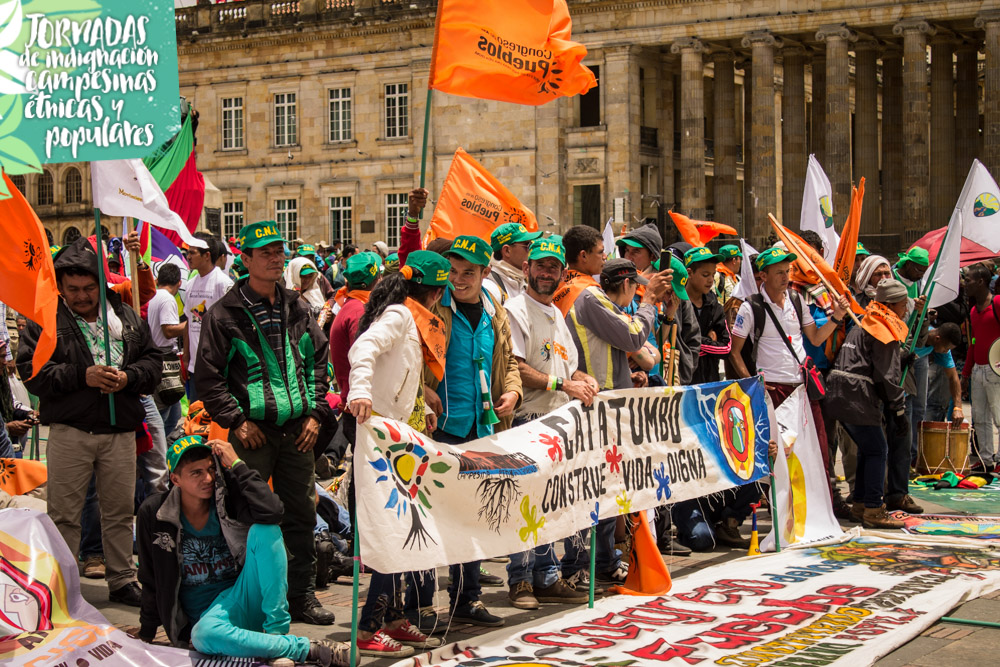
The peasant-self-governed territories are part of a national strategy where the Agrarian National Coordinator (CNA, by its Spanish acronym) is trying to preserve ten million hectares of land for farming. Part of the strategy included constitutional recognition of peasants, accomplished when Congress finally approved the Legislative Act N. 1 in 2023. In those territories, activities such as agriculture, livestock, forestry, and fishing are developed, as well as small-scale mining combined with agriculture. These activities feed peasant families and the population of the large cities that their production reaches.
Part of the peasant-self-government territory strategy includes the constitution of unarmed guards composed of delegates from the local associations. They are volunteers of all genders who carry a symbolic stick, representing the collective authority the communities can give or take back. The guards protect communities against repression and help implement collective agreements.
People’s Power as an alternative in Latin America today
In the southern part of the continent, the relationship between emancipatory projects and the idea of a State has a complex history. The process of independence from the Spanish coloniser nourished the belief that building strong, independent States was necessary for people to free themselves from oppression. People’s Power as a concept has been used in Latin America by anarchists with a clear stand against the State; Marxists have also used it, including those who think socialism can not be achieved without controlling the State. For example, the Cuban revolution and the other revolutionary intents inspired the idea that the State is also a tool to support People’s Power.
As we’ve seen in Colombia, communities use mobilisation to pressure the State’s investment in infrastructure; in some cases, they also organise leftist parties to join the State, as is the case in the current government. The 1st progressive government was elected in Colombia in 2022 after a six-month popular uprising. This government is the result of a coalition, with both parties constantly experiencing great tension. However, some hope it can be the beginning of a new era for Colombia.
In the case of Venezuela, the Bolivarian revolution has been promoted by the State through the People’s Power Ministry, which supports the Commune’s grassroots process. People, organised in communes, are the revolution’s powerhouse. Their strength sustained the revolution and allowed it to survive international blockades and other imperialist attacks from the United States of America, including the threat of military invasion from the Colombian border. The imperialist economic, political, and military control of the USA is a core issue across the continent. It is also why anti-imperialist States and governments have been essential to decrease the permanent pressure. Progressive governments in the early 2000s also became a factor in favour of people’s movements, who managed to get their support, mainly to fund local economies and education. Furthermore, people’s actions used the space opened by the State to strengthen their struggle through land occupation and the formalisation of collective property.
People’s Power and Democratic Confederalism: a necessary dialogue
Democratic Confederalism and People’s Power do not share a common analysis of the state but share common practices. They both try to open space for self-government for society to collectively take back its capacity to respond to its own needs. Beyond differences, a dialogue of practices can strengthen the global struggle toward freedom.
peasant : T.N: We use “peasant” (campesino) instead of the more familiar word “farmer” to signal the difference between the social category (peasant) and the type of labour. In Latin America, the campesino concept includes people living in the rural area who may or may not have land and may or may not work the land. Their struggles go beyond their labour and include historical identity struggles.