Since the beginning of the year, events in Rojava and Syria have escalated dramatically. In view of the rapid developments, there is an urgent need for a thorough analysis of the current situation and the goals and interests of the actors involved in this complex web of political relationships.
This is not the first time that the Democratic Autonomous Administration of North and East Syria (DAANES) has come under severe pressure. Since the outbreak of the Syrian war in 2011, the revolution in Rojava has repeatedly been targeted by a range of actors, including the so-called Islamic State (IS), the Assad regime, and—most persistently—the Turkish state.
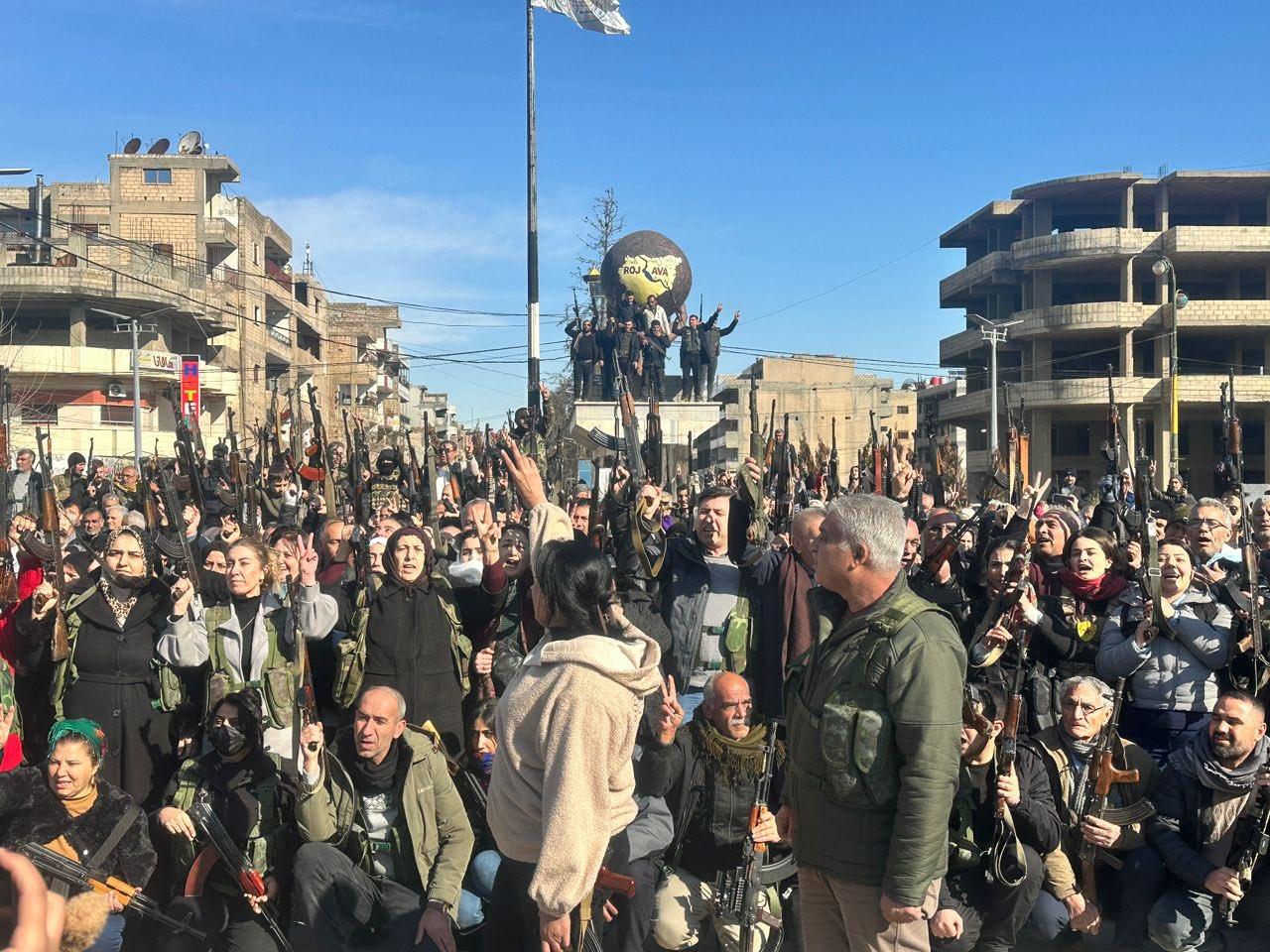
The latest escalation began on January 6th 2026, when troops and militias affiliated with the so-called Syrian transitional government launched attacks on the districts of Sheikh Maqsood, Ashrafiye, and Beni Zeyd in Aleppo. These attacks soon expanded across large parts of Rojava, effectively placing all of northern Syria under assault. Despite a ceasefire allegedly announced by the Syrian regime on January 18th, the violence has continued unabated and has since spread to Haseke and the areas surrounding Kobane. Reports indicate that civilians have been subjected to massacres.
As a result of these ongoing attacks, the very existence of Rojava is now at stake. The current developments reflect a shifting balance of power in the region and signal the onset of a new political phase in the Middle East.
In order to understand the main dynamics of the current situation, the background to the latest developments in Syria and their impact on Rojava, it is therefore necessary to analyse the comprehensive upheavals in the Middle East in more detail. A historically grounded understanding of these political processes is crucial for democratic forces to assert themselves against appropriation by capitalist modernity and to develop an independent, emancipatory perspective.
A new stage in the Third World War
The conceptual and theoretical framework of the ‘Third World War’ coined by Abdullah Öcalan in his works “Manifesto for a Democratic Civilization”, provides a central orientation for an appropriate assessment of current developments in Syria.
This term, which has been used by the Kurdistan Freedom Movement for over two decades, describes the global process of realignment of hegemonic forces and zones of influence that began with the collapse of the Soviet Union. The years 1989-90 marked the end of the bipolar world order, which divided the world between the Soviet bloc and the capitalist bloc, and led to the breakdown of former power balances, especially in the Middle East. In this chaotic phase, the goal of the forces of capitalist modernity is the complete integration of the region into capitalist hegemony.
In this context, three central groups of actors can be distinguished in the Middle East, each acting with different interests and objectives;
First, the international actors, led by the USA, form a dominant bloc. Since the early 1990s, the United States have pursued the goal of restructuring the region as part of the so-called ‘Greater Middle East Project’ (GME) with the aim of dominating the region’s resources and trade routes. The GME was developed in response to the power vacuum following the collapse of real socialism and aims to transform the Middle East in line with neoliberal ideas. A look at the bloody consequences of this policy over the past thirty years in countries such as Iraq, Afghanistan, Libya and Syria illustrates the devastating effects on societies in the region. The US strategy is based primarily on three pillars: eliminating potential threats to the US and the West, controlling energy resources and energy corridors, and ensuring Israel’s security and capacity to project war towards the region. In this context, both the dismantling of Iran’s Shiite crescent project and the establishment of a so-called “Arab NATO” play a central role. The latter manifests itself, among other things, in the Abraham Accords, which aim to strategically unite Sunni states – in particular Saudi Arabia and the Gulf states – with Israel.
The second group of actors consists of the existing nation states in the region, which are attempting to resist the Greater Middle East Project’s efforts to reshape the region and impose their policies of domination, dismantling the 20th century order of Sykes-Picot. Instead, they insist on the state order established around a hundred years ago by the Sykes-Picot Agreement.
The third actor is represented by social forces. Today, these are primarily represented by the Kurdistan Freedom Movement, which, with the development of the model of Democratic Confederalism and the democratic nation, is formulating an alternative to both the nation-state order and the Greater Middle East Project.
From October 7th 2023 to the fall of Syria’s Baath regime
With the Palestinan genocide that began on October 7th 2023, the process of reshaping the Middle East gained considerable momentum. The existing status quo was seen as an obstacle to Western hegemony and was therefore deliberately broken up in order to establish new power relations. In this context, Iranian influence in Palestine (Hamas) and Lebanon (Hezbollah) was weakened, while the change of power in Syria broke another central pillar of Iran’s regional hegemony. Iran is thus faced with the alternative of undergoing regime change or submitting to the existing hegemonic order.
Within this restructuring of the Middle East, Israel is assuming the role of the hegemonic centre. A new regional security architecture is being built around Israel. The Abraham Accords mark a process of gradual integration of Arab nation states into this system, with Israel as the central actor and representative of Western hegemony. At the same time, the Sunni bloc, which was significantly shaken by the Arab Spring, is being reformed. In this context, there are increasing calls for a strategic encirclement of Iran. Beyond the security policy dimension, the transformation of the Middle East region in line with the new world order also aims to control energy reserves and new energy routes, secure the unhindered movement of capital, dominate the Eastern Mediterranean, and establish political regimes that limit and contain the scope of action of Russia and China.
The fall of the Baath regime on December 8th 2024 after 62 years of rule represents a continuation of this policy and ushered in a new phase of uncertainty in Syria. When Hayat Tahrir al-Sham (HTS), which has its roots in al-Qaeda, recently developed from a previously small Islamist emirate in the Idlib region and was under the patronage and supervision of the Turkish state, took power, it became clear that the Syrian crisis was not over. HTS, which now forms the transitional government, marks the beginning of a new phase of instability.
HTS’s Syria as a new proxy force of the West
With the fall of the Assad regime and the takeover by Hayat Tahrir al-Sham (HTS), the network of relationships in Syria has changed qualitatively. A new balance of power has emerged that must be understood in order to correctly assess current developments. The developing situation should be analysed primarily from the perspective of the US and the Western bloc.
Since the beginning of the Syrian civil war in 2011, the goal of the US and its allies has been to overthrow the Assad regime and install a pro-Western government – a goal that has effectively been achieved with today’s transitional government. This put the US in direct opposition to Russia and Iran, which were the central pillars of support for the Assad regime during the war. Until Assad’s fall, Russian policy was aimed at stabilising Syria’s existing nation-state system by keeping him in power.
With HTS taking power, this balance of power has entered a new phase. With HTS, a force that was built up with significant preparation by the United Kingdom1, there is now a government in Damascus that is integrated into the US and Western-led reorganisation project. HTS accepts the rules of capitalist modernity, is economically integrated into the Western camp, de facto recognises Israeli hegemony and remains silent on the Israeli occupation of parts of southern Syria.
For America, this shift in alliances is nothing new. When the US allied itself with the Kurds, they were under attack from IS, Assad was in power in Syria, and the US was opposed to Assad. Considering the support they gave to the YPG and later the SDF, there was a serious change in relations with the SDF after the regime change in Syria as the US began to support the new Syrian regime. Previously, the US tried to control its predominantly tactical-military relations in Syria from east of the Euphrates, but now it is trying to implement its political and diplomatic strategy through Damascus.
This new strategy was formally sealed at the meeting in Paris on January 5th and 6th 2026, where Syria and Israel agreed on a joint communication mechanism under US supervision. However, this meeting was not limited to that. At the same time, an alliance was formed against the DAANES. It is no coincidence that Turkish Foreign Minister Hakan Fidan was also present in Paris on that day. This alliance against Rojava, supported by the US, France, Britain and Turkey, is also backed by the EU. This was clearly demonstrated during the visit of EU Commission President Ursula von der Leyen to Damascus, who pledged political support for the new regime, while a war of annihilation was being waged against Kurdish settlements. In this sense, the attack on Rojava is not an isolated event, but part of a coordinated approach between the al-Sharaa regime and the West.
To achieve more concrete interests, the victorious forces in Syria are now fighting amongst themselves and the project of a democratic Syria has no place in this. Israel genuinely wants Syria to remain fragmented. Turkey, meanwhile, wants a Syrian administration loyal to it and implement Neo-Ottomanism throughout the Middle East and Eastern Mediterranean. The Gulf states and Britain want to establish a sphere of influence in the Eastern Mediterranean through HTS. The most influential of all these powers, the US, wants to establish a balance among these countries, all of which are its allies, and will most likely ultimately take a position close to Israel’s arguments. Turkey’s project is, in fact, to revive a period similar to the Assad regime under different names; at this point, it is automatically antagonising the people of the region. This means, that they are pushing for a centralist nation-state power on the fundament of ethnic-based division and oppression. Israel, on the other hand, is taking a purely tactical approach to the region. Having secured all the short-term concessions it wanted from the HTS leadership after the Paris agreement, the Israeli government appears set to wield the HTS groups like the sword of Damocles over the rest of Syria for a long time to come. Note that Israel is merely observing HTS’s massacres after the Paris agreement. Turkey, on the other hand, will constantly provoke HTS against SDF, attempting to minimise the gains of the Kurds.
US pragmatism towards the Kurds
The pragmatic policy of the US towards the Kurds before the fall of Assad was primarily due to the fight against the Islamic State (ISIS). From the US perspective, this 12-year tactical alliance was driven by three key motives: firstly, cooperation with the YPG offered the most effective way to gain military prestige in the fight against ISIS. Secondly, the US pursued the goal of bringing the revolution under control, limiting its socialist or ‘Apoist’ (a term used for the supporters of Öcalan’s political line) orientation and steering it into a nationalist, nation-state direction. Thirdly, the Kurds served as a means of exerting pressure on the Assad regime and the Russia-Iran bloc.
With the new balance of power in Syria and the establishment of a pro-Western regime in Damascus, these tactical interests have shifted fundamentally. The former arguments and constraints have lost their significance. Against this backdrop, the US is now attempting to put the Kurds under massive political, military and economic pressure in order to force them into a de facto ‘voluntary’ integration into the Syrian state. At the same time, Turkey is being given greater leeway to limit the influence of the Kurds and push them further towards Damascus.
The US has made no secret of this position. On January 20th 2026, the US Special Envoy for Syria, Tom Barrack, openly expressed this tactical approach to the SDF in his statement: “Today, the situation has fundamentally changed. Syria now has an acknowledged central government that has joined the Global Coalition to Defeat ISIS (as its 90th member in late 2025), signalling a westward pivot and cooperation with the US on counterterrorism. This shifts the rationale for the US-SDF partnership: the original purpose of the SDF as the primary anti-ISIS force on the ground has largely expired, as Damascus is now both willing and positioned to take over security responsibilities, including control of ISIS detention facilities and camps.”2
The US has brought the new Syrian regime under al-Sharaa together with Israel (for the first time in the history of both countries), and continues to try to strengthen this regime and build a new Syria through al-Sharaa. In this context, the relationship between al-Sharaa and Israel is of utmost importance to the US. This also included al-Sharaa establishing a relationship with Israel in which he submits to its hegemony in the region, which he ultimately did at the Paris meeting. In a second step, the US is now trying to somehow “integrate” the Kurds, with whom it has had a military alliance for over ten years, into the new regime.
This is where the breakdowns and difficulties have arisen. Negotiations have been ongoing since March 10th 2025, and the regime in Damascus has largely turned a deaf ear to the SDF’s demands. Whenever an agreement with the SDF seemed within reach, Turkey intervened directly. On January 4th, immediately prior to the attack on Aleppo, negotiations between the SDF and the Damascus delegation were initially going well, according to press reports, and it looked as if an agreement would be signed. But then the Turkish-friendly Foreign Minister al-Sheibani entered the negotiating room and declared the negotiations over. A day later, negotiations on a security agreement with Israel began in Paris, and on January 6th, an agreement was reached. On the same day, the attack took place in Aleppo. Turkey was involved in the attack on Aleppo with all its might, and continues to be so now. From planning to implementation, Turkey has been involved militarily, diplomatically, in terms of intelligence and technically. This is an operation carried out jointly with the government in Damascus and the armed groups acting on behalf of Turkey. The attacks were essentially aimed at breaking the will of the Kurds in the negotiations between the SDF and Damascus, undermining their demands for recognition, forcing integration by weakening their military strength and weakening the SDF’s negotiating position in order to achieve complete capitulation.
With regard to relations between the Kurds and the US, a certain division between international and regional actors along the western and eastern Euphrates has emerged in recent years. Until the current turning point, the US had signalled to the Kurds that it would not interfere in matters west of the Euphrates. On this basis, the US did not oppose Turkish military operations in Afrin (2018), Manbij (2024) and Till Rifaat. Nevertheless they withdrew their troops and remained silent when Turkish army attacked and occupied Till Abyad and Ras Al-Ayn in 2019, both lying east of the Euphrates.
Now, again, we are witnessing a huge military offensive east of the Euphrates: cities such as Tabqah, Raqqa and Ayn Issa are now under the control of the Syrian regime, while Haseke and Kobane are under siege. The division between west and east, previously considered an imaginary ‘red line’, has lost its validity in this new phase. The US’s silence on these developments is effectively tantamount to supporting Ahmed al-Sharaa’s claim to establish state sovereignty over the whole of Syria. The current situation shows that the US’s fundamental concept is no longer to negotiate the division into a western and an eastern Euphrates region, but rather to weaken the SDF as much as possible.
US attempts to unite Damascus, Turkey, and Israel
From the US perspective, the underlying logic in Syria is to bring Israel and Turkey into alignment. On the one hand stands Israel, the West’s closest ally in the region; on the other hand stands Turkey, a NATO member whose relationship with the West has been marked by tensions but remains strategically indispensable. Washington seeks to encourage Turkey and Israel to identify shared security interests, coordinate their approaches, and present a joint framework for Syria. Ultimately, this strategy points toward the formation of a broader alignment linking Damascus, Turkey, and Israel.
Strategically, Turkey and Israel pursue divergent objectives in Syria. Turkey is determined to prevent the Kurds from establishing political, administrative, or military autonomy and has shown little willingness to compromise on this issue. Accordingly, Ankara favors the emergence of a strong, centralized Syrian leadership under al-Sharaa that would consolidate all levers of power. Israel, by contrast, despite having enforced certain demands on al-Sharaa, does not trust either the regime or the power bloc surrounding him. From Israel’s perspective, this leadership could pose a challenge to its security in the medium to long term. It is therefore not in Israel’s interest for Syria to become overly powerful or to significantly expand its military capabilities. Instead, Israel favors a more fragmented, decentralized, and flexible political structure—one in which Kurds, Druze, Alevis, and other social groups are represented—thereby limiting Damascus’s ability to project power and preserving Israel’s own room for influence. The reason for this is not an interest in democracy, but rather a desire to maintain their own hegemony and influence. In addition, it is essential to Israel and Western powers to be able to use the HTS against Iran and Shiite militias, like Hezbollah in Lebanon and the Popular Mobilization Forces in Iraq. Despite these fundamental differences, efforts to identify a shared middle ground between Turkey and Israel continue. The United States is actively attempting to bring Damascus, Ankara, and Tel Aviv to the negotiating table.
It should be emphasised that all of the state actors mentioned are ultimately part of capitalist modernity. Although they have different strategies for expanding their own hegemony, they come together in the short term to suffocate alternatives such as those represented by Rojava as a project of democratic socialism.
In this equation, the Kurds are now being pressured to integrate into the new regime by being diminished, weakened and ideologically diluted. Whether this will succeed is a question that will now depend on Rojava’s resistance.
The ideological essence of the attack
The attacks on Rojava are not only political and military in nature, but also have a profound ideological dimension. With the current pressure, the US is attempting to liberalise the revolutionary achievements and strengthen nationalist forces. On the one hand they want to push nationalist agendas, on the other hand they continue to try to divide the Kurds into good (KDP, etc.) and bad (PKK, etc.) in order to weaken the unity of the Kurds. At the heart of this is an attack on the idea of the democratic nation – the core of the revolution. Kurds are to be played off against Arabs and the project of coexistence undermined. Accordingly, the attacks were directed in the beginning of the war particularly against regions with a majority Arab population, such as Raqqa, Tabqa and Deir ez-Zor. The aim is to make division based on ethnic lines and from there to either force capitulation on the Kurds or to crush their political will by brute force, which would open the way for ethnic cleansing, massacres and systematic demographic change. So the current situation is intended not only to destroy the achievements of Kurdish society in Syria, but also to fuel hostilities between peoples. Weakening the Kurds in order to dominate the Middle East is a 200-year-old policy of ‘divide and rule’. It is a new version of the imperialist policy of ‘divide and rule’ that has maintained the hegemony of capitalist modernity in the Middle East for the past 200 years.
At the same time, Kurdish nationalist forces such as ENKS and KDP are being specifically promoted, as was recently evident at the meeting in Erbil on January 17th 2026. For years, these forces have been propagating a discourse that seeks to reduce self-government to a purely ethnic-cultural agenda. The decree issued by al-Sharaa on January 17th recognising the Kurdish language and making further concessions should also be understood in this context as a tactical manoeuvre intended to give impetus to this nationalist line. The decree has no constitutional binding force, while the regime itself is based on denial, division and massacres of Alevis, Druze and Kurds. The simultaneous continuation of military attacks by HTS makes it clear that what is sought for ultimately is complete submission to Damascus.
At this point, two different strategies towards the Kurds are evident. On the one hand, the Turkish state and the Syrian regime are pursuing a policy of crushing revolutionary achievements, which extends to genocidal practices. On the other hand, the US strategy is aimed less at physical destruction than at liberalising and depoliticising the revolution. Support for this plan aims to distort and channel the revolutionary-democratic potential of the Kurds. The policy of ‘divide and rule’ is implemented primarily through support for nationalist Kurdish elements. In particular, the revolutionary, radical democratic and socialist forces in Kurdistan are to be neutralised in this way. One of the main goals in this context is to isolate the PKK and the line of freedom. International support for this plan aims to distort and channel the revolutionary-democratic potential of the Kurds and finds broad support in the international diplomatic arena. This promotes a nation-state line that is limited to certain Kurdish rights and demands, and that subordinates itself to the US-Israeli project for the Middle East. At the same time, a weakened Kurdish minority remains a potential instrument for the forces of capitalist modernity to be used again as leverage in conflicts with Damascus.
In this context, there can be no talk of a ‘betrayal’ of the Kurds or Rojava by the US or the EU. Betrayal can only exist where there is a strategic partnership or a joint political project for the future. At most, those actors who have consciously tied their future to the US and placed their bets on a strategic alliance can be said to have been betrayed.
However, this does not apply to Rojava. At no point has there been a common ideological or political project between the Democratic Autonomous Administration of North and East Syria and the US. From the outset, relations have been purely tactical in nature, dependent on a specific geopolitical constellation and strictly limited to the joint fight against the so-called Islamic State.
The US, as an imperialist power and hegemon of the capitalist world system, pursues the goal of exploiting the achievements of a society’s struggle for freedom for its own interests. Against this backdrop, the current attacks must be understood not only in political and military terms, but above all, in terms of their ideological depth. The forces of capitalist modernity have coordinated their efforts to increase pressure on the Kurds, to contain them and to instrumentalise and exploit them in accordance with their own strategic plans. These attacks have once again shown that the forces of capitalist modernity are capable of trampling on all values in pursuit of their own interests.
In contrast, the strategic line of the Kurdistan Freedom Movement is clear: its partners are not imperialist states, but global democratic forces, social movements and anti-systemic actors who advocate self-determination, equality and an alternative social order.
Characterizing the policies of the HTS
In this context, it is worth taking a closer look at the Syrian government. The character of the Syrian transitional government controlled by HTS can only be understood in the context of its ideological orientation and political practice. From the outset, HTS leader Ahmed al-Sharaa has pursued a reactionary and monistic line. He has continuously threatened the Kurds, ignored the reconciliation initiatives of the Democratic Autonomous Administration of North and East Syria, and instead demanded their complete submission to his repressive rule. With the HTS, the Islamic State is part of the Syrian government, and the liberation of IS terrorists by HTS militias, such as on January 19th in the town of al-Shaddadah and in Raqqa, clearly demonstrates this connection. Through the identity of HTS, the hegemonic forces brought ISIS to statehood.
This policy aims to destroy the Democratic Autonomous Administration of North and East Syria, which was built by Kurds, Arabs, Assyrians and other population groups on the basis of the concept of a democratic nation. It is to be replaced by an authoritarian system based on a single nation and a single faith. This thinking represents a direct attack on the centuries-old fraternal coexistence of peoples and religious communities in the Middle East. The aim is to prevent the democratic understanding of nationhood that could enable peace and stability in Syria and the region.
The attacks by HTS are therefore not an isolated security policy measure, but part of a comprehensive plot against the future of Syria. HTS is acting as a central player in a policy that aims not at national unity, but at division and fragmentation. While the Democratic Autonomous Administration of North and East Syria had created a Kurdish-Arab unity, HTS is deliberately trying to stir up hostility between Kurds and Arabs. The HTS in that sense is waging a proxy war under the influence of external powers. With such a strategy, neither a democratic unity of Syria nor a stable future for the state is possible.
‘Integration’ or assimilation?
Since the beginning of negotiations on the integration of North-East Syrian autonomous regions into the new Syrian order, it is now clear that, for HTS, integration actually means assimilation. The latest decree on January 17th by the president of the transitional government, Ahmed al-Sharaa, which superficially appears to recognise Kurdish rights, does not represent a break with previous policy. Rather, it is a tactical exercise of power within a strictly state-centred mindset. This does not resolve the crisis, but rather reorganises it and makes it controllable.
At its core, the decree recognises elements of cultural identity, but refuses to acknowledge the collective political subjectivity and self-governing capacity of society. Local decision-making mechanisms and forms of self-organisation are excluded from the legitimate political sphere. The recognition thus has a restrictive rather than a liberating effect.
The central question is what and whom this recognition concerns: Is a struggling, organised society being recognised – or merely a fragmented, individualised and controllable social group? In actuality, the decree aims to undermine the political and military balance in northern Syria, in particular the Syrian Democratic Forces (SDF).
This strategy does not rely on open military destruction, but on more subtle means. The aim is to separate society from its collective political will, isolate the SDF and portray it as a purely ‘military problem’. While individual cultural rights are granted, these are deliberately decoupled from the Democratic Autonomous Administration of North and East Syria and the SDF in order to deprive them of their social legitimacy. Terms such as ‘national unity,’ ‘one roof’ and ‘no privileges’ do not serve pluralism, but rather the enforcement of a centralised state model as the only legitimate order.
Diversity is not understood as a constituent political force, but as a condition that must be controlled. The existence of the Democratic Autonomous Administration of North and East Syria and the SDF is marked as a deviation from the norm. The goal is not to understand the Kurdish question, but to crush and reshape it.
Ethnic division and instrumentalization of Arab tribes
Another key factor in current developments is the deliberate ethnic division between Kurds and Arabs. Parallel to diplomatic talks between Ankara and Damascus, concrete military and political preparations were therefore underway.
A central component of these preparations was the deliberate exertion of influence on Arab tribes in the DAANES areas. Both the al-Sharaa government and Turkey have been working for some time to dissuade these tribes from cooperating with the self-administration. These efforts have been intensified in recent months in particular.
According to Syrian sources, even before the fighting began, the transitional government had already succeeded in winning over some Arab forces in Aleppo that had been cooperating with Kurdish units. This change of sides served as a test run for similar strategies east of the Euphrates. These activities were coordinated by al-Sharaa’s advisor on tribal affairs, Jihad Isa al-Sheikh (Abu Ahmed Zekkur), who was active in both Turkey and north-eastern Syria3.
At the end of 2025, a delegation travelled to Turkey and held meetings with tribal leaders in Kilis, Urfa and Mardin. This was followed by talks in Ras Al-Ayn, Raqqa and Deir ez-Zor. The aim was to restore trust with the Arab tribes and win them over to cooperate with HTS.
Officially, this initiative is presented as a contribution to the ‘social unity of Syria’. In fact, it aims to increase unrest in the areas controlled by the SDF, to detach Arab tribes from the Democratic Autonomous Administration of North and East Syria and to instrumentalise them against other social groups, such as the Druze in Sweida. In the short term, this strategy may strengthen HTS, but in the long term it exacerbates ethnic tensions and paves the way for further division in Syria.
International plan to destroy a democratic model for the region
On this basis, the attack on Rojava is not solely aimed at destroying the achievements of Kurdish society. Rather, the goal of this international plan, which is supported by regional actors such as Israel and Turkey as well as international forces – above all the US and European states – is to destroy the project and idea of a democratic Syria and a democratic Middle East.
The attack is directed against the principles of local democracy, women’s liberation, equal rights for ethnic and religious communities, and the idea of a ‘third way.’ It is intended to demonstrate that alternatives beyond the nation state, nationalism and power politics are not possible. The Democratic Autonomous Administration of North and East Syria is therefore being forced into either total surrender in order to return to the order that existed before 2011 or complete physical annihilation.
Today, especially under conditions of war, it is essential to make clear to the world who is truly defending freedom. This struggle cannot be carried out through states or governments; it must be rooted in society itself, in the streets. Genuine legitimacy and lasting power emerge only through mass solidarity. When such collective strength exists, it becomes far more difficult for states to sustain violence and repression. Otherwise, decisions are made from above, and people are reduced to passive spectators. There is no reason to place trust in governments. They shift positions overnight when their interests change. History is filled with examples of this, and we continue to witness it today. For this reason, the form of engagement we need is not official diplomacy, but people’s diplomacy. People must be able to understand one another directly, across borders. What is happening must be explained openly and without mediation to societies themselves. This is not only a moral necessity but also a powerful geopolitical force. The responsibility to communicate the reality of the world cannot be left to states alone. Every state is willing to abandon its principles the moment its interests are threatened. That is why the only sustainable source of pressure lies in the shared awareness and solidarity of peoples. Explaining the realities of the world to societies everywhere is the foundation of a durable and effective people’s diplomacy. If this does not happen, plans will continue to be made from above, and once again, people will be left watching from the sidelines.
The Democratic Autonomous Administration of North and East Syria and the Kurdistan Freedom Movement have now called for the expansion of resistance against the attacks and is counting on total resistance. The benchmark for this is the resistance in Kobanê in 2014–2015. It were not only the fighters of the YPG and YPJ who defeated ISIS, but also the broad support, moral backing and solidarity of societies, democratic and socialist forces worldwide. In this sense, it is now time to once again provide such support to the resistance fighters in Rojava-Kurdistan. Against the united forces of capitalist modernity, the forces of democratic modernity must unite to create a second Kobanê and prove that the resistance of the peoples remains unbroken and that the idea of democratic socialism lives on as an alternative to the existing system of exploitation and oppression.
1https://www.telegraph.co.uk/politics/2025/11/21/jonathan-powell-syrian-terror-group-national-security/
2https://x.com/USAMBTurkiye/status/2013635851570336016
3https://yeniyasamgazetesi9.com/saranin-sabikali-asiret-danismani/