
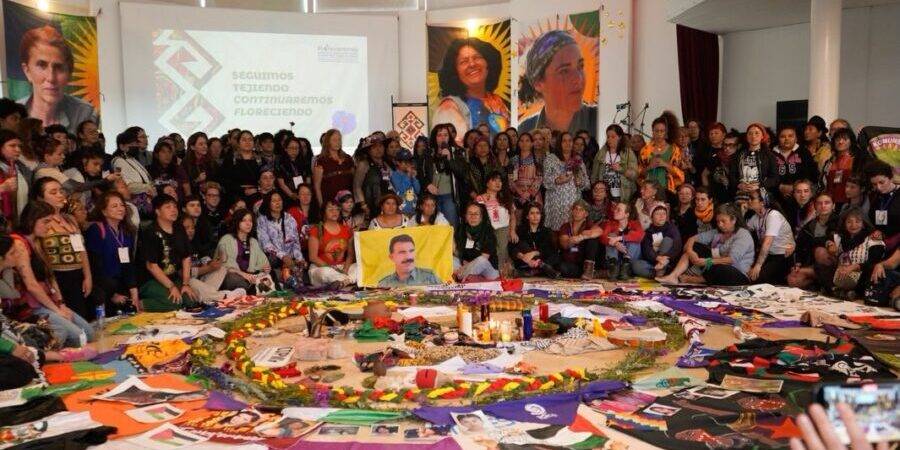
From February 11 to 15, 2026, more than 400 women gathered in Bogotá, Colombia, for a historic encounter convened by the Network of Women Weaving the Future. Delegates arrived from across Abya Yala — the name many Indigenous peoples use for the American continent — as well as from Kurdistan and other regions of the world. They came from communities shaped by mountains and rainforests, deserts and cities, territories scarred by extractivism and war, and homelands sustained by memory and resistance. They spoke different languages and carried distinct histories, yet shared a common conviction: that the freedom of women is inseparable from the freedom of peoples and the defense of the earth. They came because the times demand it.
The conference was a regional continuation of previous international women’s conferences held in Frankfurt in 2018 and Berlin in 2022. Those meetings laid the foundation for what is now known as the Women Weaving the Future Network.
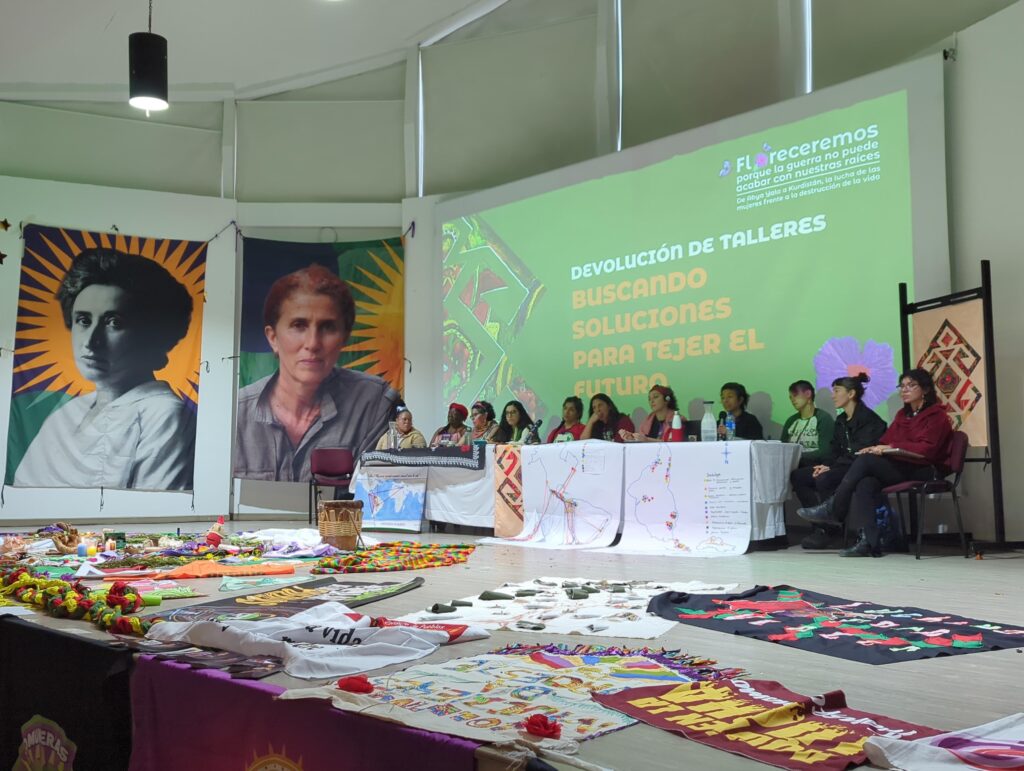
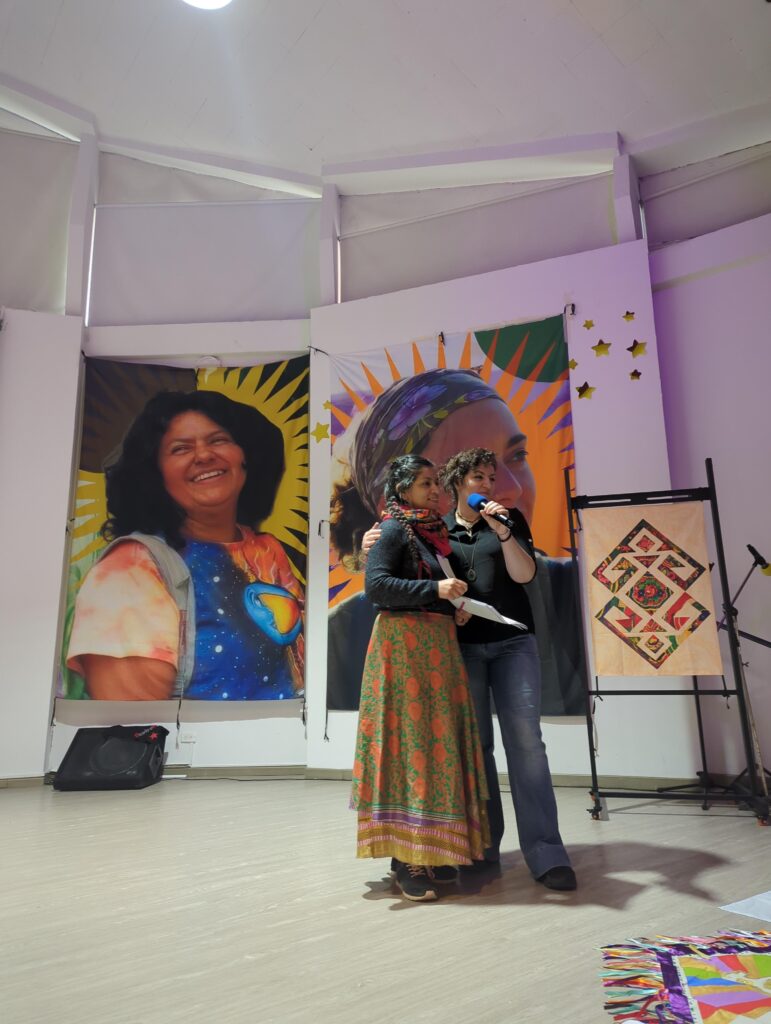
The conference unfolded under the motto, “We will flourish, because war cannot destroy our roots.” It expressed both grief and determination — an acknowledgment of the violence that communities endure and a refusal to surrender to it. It was dedicated to women whose lives symbolize transnational resistance: Berta Cáceres, the Honduran Indigenous leader assassinated for defending her territory; Rosa Luxemburg, whose revolutionary thought continues to inspire debates on socialism and democracy; Sakine Cansız, a founding member of the Kurdistan women’s movement; and Alina Sánchez, an Argentinian internationalist who joined the Kurdistan Freedom struggle.
Their names were spoken not as distant icons but as presences woven into current struggles. Participants emphasized that the dead are not abstractions; they are teachers whose dreams we are fighting for.
The sound of the path echoed firmly among the words of the women of the world. From Kurdistan to Abya Yala, the voice of struggle, resistance, and hope resounded. After four days of gathering, the participants did more than exchange experiences: they united dreams and needs, perspectives and comradeship. They recognized that to walk the territories means strengthening steps together in networked unity. Women are not waiting to be saved; they are building structures of autonomy in their communities. They are planting ancestral seeds, defending water sources, establishing cooperatives, and educating new generations.
A Ceremony of Grounding and Intention
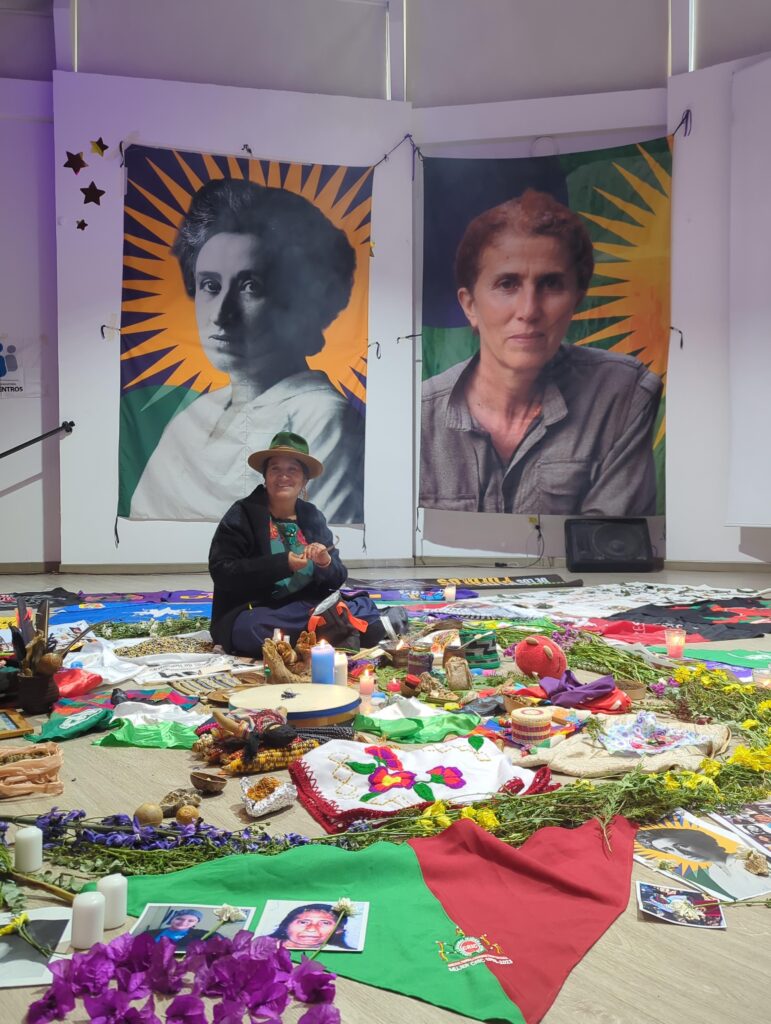
The gathering opened with a ritual led by spiritual authorities from Mapuche, Quechua, Lenka, Aymara, and other Indigenous nations. They invited the mother of Alina Sanchez, Sehid Legerin Ciya, to speak among them. She talked about her pride to see her daughter’s dreams come true. Smoke rose; water was poured; seeds were placed at the center; candles were lit for those murdered, disappeared, imprisoned. Women brought woven textiles, essential oils, photographs of comrades, and sacred objects from their territories. The ceremony asked permission from ancestral forces and from the land itself for the conference to unfold with harmony and clarity.
There was sorrow in the room — sorrow for communities displaced, rivers poisoned, forests cut, daughters lost to war, femicide or repression. Yet there was also palpable strength. Women embraced, sang, and offered prayers in multiple languages. In this shared act of remembrance and invocation, the conference established its tone: political analysis grounded in spiritual connection; resistance rooted in reverence. The fabric of the conference was woven from both.
Vanessa Jeudi is a member of the feminist organization Dantó in Haiti, and of “UNIR,” on behalf of which she participated in the conference. UNIR carries out cultural exchange programs between Haitians and other countries in Abya Yala, for the defense of territories, against extractivism, against patriarchy, and for the decolonization of Haitian culture.
Why was it important for you to participate in this conference?
We need to organize ourselves to find a solution to everything we are experiencing. And I think it is not possible to organize at the Abya Yala level, against imperialism, against patriarchy, racism, and land expropriation, without Haiti. Because in Haiti, we had the deportation of all these Africans from different ethnic groups in Africa. We didn’t speak the same language, we didn’t have the same culture, but Creole and Haitian voodoo emerged as a common culture, in resistance to colonialism and today in resistance to imperialism and everything that comes with it. So with my presence at this conference I aim to unite and organize with other organizations, other structures, other communities of Abya Yala, who are guardians of ancestral culture, so that we can organize together. I think it’s important to organize together at the level of Abya Yala, Kurdistan, Palestine. To organize because the operating model of capitalism, patriarchy, and exploitation is precisely to appropriate our bodies. And our operating model is to decode all these strategies, to build our own strategy, and to come together.
What impressed you most during this conference?
I am a practitioner of Voodoo, that is to say, I practice the Haitian Voodoo culture. What struck me most here is that spirituality and politics are not dissociated. We do all this, but we do it in the name of our ancestors. We do it in the name of those who came before us, who were murdered, but who still watch over us and give us the strength to continue our struggle. And that struck me because in Haiti, even today, voodoo is an oppressed culture. What I see here is that through politics, we are reclaiming our spiritual culture.
What are your proposals for the future of this network?
What I propose is that we accept our differences, of course, but that we see how we can intertwine our struggles. We experience the same realities with nuances, with differences. We don’t speak the same languages, we don’t have the same cultures, but we have a lot in common. Currently, the world is heading down a slippery slope, leading to a dizzying fall, but I also think that through these conferences, through these organizations, through the meeting of these women, each inspiring in their own way, there is hope and that we can climb back up that slope.
Naming the Systems that Threaten Life – Colonial Policy and Attacks in Abya Yala: The Struggle to Defend the Land
The days that followed were devoted to analysis and strategy. The first day different panel discussions addressed what participants described as the intertwined systems of colonialism, patriarchy, capitalism, and militarism. Speakers detailed how extractivist policies — the large-scale exploitation of minerals, oil, water, and land — continue to devastate territories across Abya Yala and beyond. They described multinational corporations operating with the complicity of governments and paramilitary forces, extracting wealth while leaving behind contamination, displacement, and broken communal structures.
Women described repression, assassinations, imprisonment, and financial strangulation in multiple territories. They named imperialist wars and internal armed conflicts. They denounced the “special war” waged by hegemonic media against women and peoples — a war that distorts narratives, criminalizes resistance, and isolates communities.
Participants emphasized that these systems do not only target land; they target memory, language, and communal life. Financial blockades, political persecution, and cultural erasure were identified as tools used to weaken resistance. From Venezuela and Cuba to Indigenous territories in Colombia, Mexico, Honduras, and Brazil, testimonies recounted attempts to strangle communities by undermining their ability to sustain themselves materially and culturally.
‘It may be that my words sound radical. But what we are concerned with is that it is our earth, our land, where we want to raise our children. Decisions are being made about us and our land, just as about our bodies as women, which are not decisions we make ourselves.’
– Nadia Umaña, Congreso de los Pueblos from Cauca, Colombia
“Our river was our life, our water, the source of our existence. Today, this river has been raped. It is barely alive anymore.”
– Atahualpa Sophia, El Salto de la Vida, Jalisco, Mexiko
Women from Kurdistan described parallel realities. They spoke of war, state repression, imprisonment, and the assassination of activists. They explained how women’s autonomous organizing has become both a source of hope and a target of attack. Across regions, a pattern emerged: violence against women and violence against the earth operate through the same logic of domination.
Body as Territory
The central concepts explored during the second round of panel discussions was “the body as territory,”. It affirms that a woman’s body is not merely an individual physical entity but part of a broader territorial fabric — inseparable from land, water, and community. To violate women’s bodies is to violate territory; to defend territory is to defend women’s bodies.
Panelists shared harrowing accounts of femicides, sexual violence, forced displacement, and criminalization of women defenders. Yet they also described strategies of collective protection and healing. Self-defense was discussed not only in physical terms but as a comprehensive practice — including legal literacy, community watch networks, psychological support, and the cultivation of confidence and solidarity.
The discussions were not abstract. They were grounded in lived experience. Daughters of assassinated leaders spoke alongside young organizers from urban neighborhoods. Indigenous elders shared ancestral knowledge alongside activists trained in modern communications and media strategy. The room became a living archive of resistance.
Bringing the Color of Women into the Resistance
The last round of panel discussion focused on the intertwined systems of patriarchy, colonialism, capitalism, and state repression, examining their devastating impacts on both women and the land. Discussions highlighted how capitalist structures exploit and oppress marginalized communities, particularly those living in poverty, while also perpetuating racial and gender injustices, particularly targeting women. Participants emphasized the need for cross-border solidarity, recognizing that struggles in one region can have far-reaching effects elsewhere.
A central theme emerged around the role of women as both creators of life and protectors of territory, linking the defense of women’s rights with the defense of the earth. The fight against patriarchy was framed not only as a physical struggle but as a mental and cultural battle, where remembering and carrying forward ancestral legacies is essential for sustaining resistance. The discussion reinforced the idea that women’s autonomy is key to challenging the systems of oppression that aim to control both bodies and lands. The need for unity across diverse struggles was strongly emphasized, with participants calling for rebellious hope to blossom despite the overwhelming forces of violence and exploitation.
“Women are those who create life – those who carry the water of life within them.”
– Sleydo and Jennifer Witcamp, Gidimt’en Checkpoint, Wet’suwet’en peoples
Resistance means to fight. We must remain rebellious – to help hope blossom. The fight against patriarchy is also a mental struggle. We must remember – and carry forward the legacy of our ancestors.
– “Claudia, Mujeres MODEP (Colombia)
Workshops: Systematizing Wisdom
On the second day, the conference shifted into ten simultaneous workshops. Topics ranged from self-defense and political education to communal economies, health, culture and art, communication, and Jineolojî — a women’s science proposed by the Kurdistan woman’s movement, that seeks to re-center knowledge from a women’s perspectives.
In smaller circles, the exchange deepened. Women discussed how to preserve native seeds and ancestral foods, how to organize cooperatives, how to create community radios and theater groups, how to document human rights violations, and how to educate children with materials rooted in their histories. And most importantly, how to weave these projects with each other.
There was laughter as well as seriousness. Women compared songs, embroidery patterns, and herbal remedies. They debated strategies for confronting state institutions without being co-opted by them. They examined successes and failures with honesty. The atmosphere was neither naïve nor cynical; it was attentive and constructive.
When workshop conclusions were presented in plenary, recurring themes surfaced. Participants emphasized the urgency of political organization and education; the need to organize collective anger so it becomes transformative rather than destructive; the importance of art and culture in sustaining morale; and the necessity of defending biodiversity as living beings with rights. Participants called for systematizing and sharing wisdom, building trust, and creating autonomous means of communication. Strengthening internationalism means recognizing the diversity of knowledge and experience — and creating spaces where these can meet.
Weaving Networks Across Differences
Throughout the conference, the concept of democratic confederalism — a model emphasizing grassroots democracy, autonomy, and networked communities — appeared as a point of dialogue, especially between Kurdish and Abya Yala movements. Participants explored how locally rooted structures can be linked across regions without erasing cultural specificity.
The phrase “weaving the future” was more than poetic metaphor. It described a deliberate practice of building connections: between rural and urban struggles, between generations, between spiritual and political dimensions of life. Women spoke of creating permanent spaces of exchange, joint campaigns, and coordinated days of action.
They also addressed internal challenges. Differences in language, strategy, and political context can create misunderstandings. The conference did not ignore these tensions. Instead, it treated them as material for learning. The goal was not uniformity but alignment around shared principles: autonomy, dignity, ecological balance, and women’s leadership.
Culture as Resistance
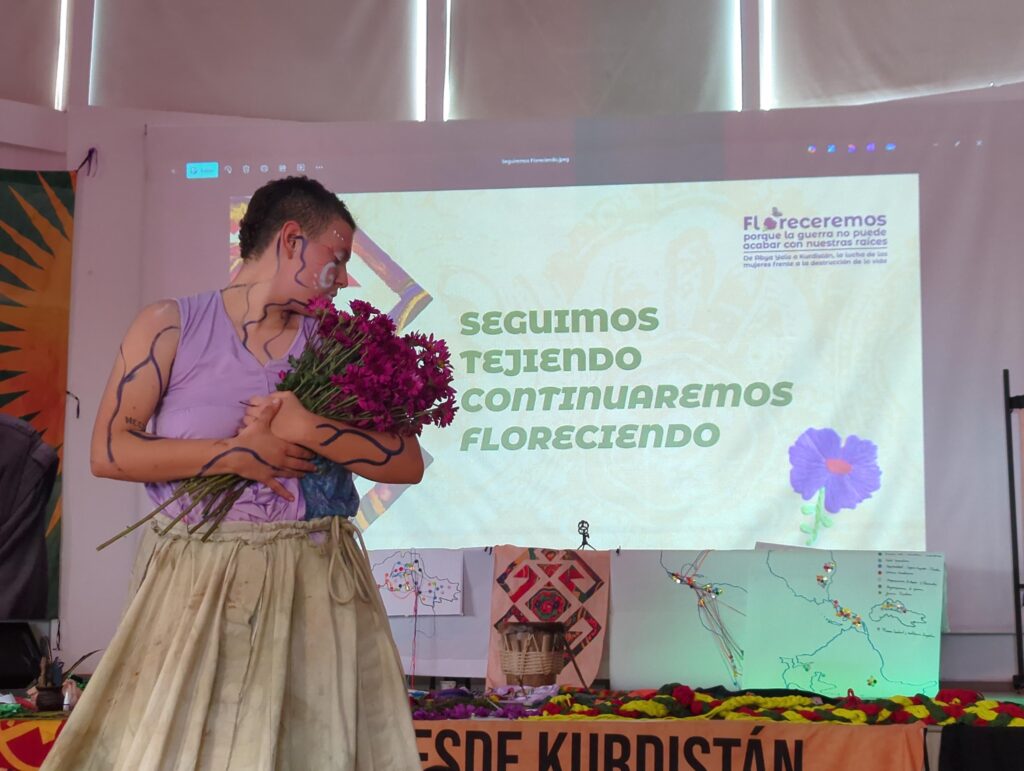
Evenings were dedicated to cultural expression. A bazaar allowed participants to share crafts, books, textiles, and foods from their territories. Performances included music and dance from multiple traditions. At one event, women danced together in a circle, echoing global feminist expressions such as “Ni Una Menos” and the choreographies inspired by Las Tesis. These gestures linked local resistance to global movements.
Culture means resistance and diversity; it is neither a product nor merely aesthetic.
Art must exist in dialogue and in flow. Aesthetics is the sensitivity that accompanies ethics. Diversity deepens the path of resistance. Languages, dances, ways of living, ancestral heritages — these are our roots.
Participants insisted on organizing culture and art so that hegemonic power cannot manipulate them. They are not ashes; they are the fire that dances with freedom — in the mountains of Kurdistan, in Wallmapu, in the quilombola communities of Brazil, in the Amazon, in the Andes, in every territory of the world.
Toward a Common Horizon
On the final day, attention turned to drafting a closing declaration and outlining next steps. Three pillars guided the discussion: transforming destroyed life into new meaning; identifying shared agendas and obstacles in local practice; and seeking solutions for the future.
Throughout the gathering, participants articulated collective principles: autonomy; anti-patriarchal, anti-capitalist, anti-racist, anti-colonial, and anti-statist struggle; diversity in unity; horizontality; comradeship; and an ethic of rebellion.
They affirmed the need to build their own agenda — to rewrite history, recover knowledge from the archaeology of memory, analyze past and present, and construct a shared horizon. The reciprocity of women, embodied in Jineolojî, reaches Abya Yala to walk and learn alongside the knowledge of Mapuche, Lenca, Aymara, Nasa, and many other women.
To continue in network is to continue on multiple levels. It means articulating actions and campaigns, strengthening spirituality, opening doors across territories for urgent needs and solidarity, and maintaining communication between Kurdistan, Abya Yala, and beyond.
It means sustaining and caring for the fabric created together.
The final declaration affirmed commitment to building stronger networks, deepening political education, and strengthening self-defense and communal economies. It called on women worldwide who yearn for life beyond systems of oppression to join and reinforce this collective struggle.
Lourdes Huanca is President of the National Federation of Rural, Artisan, Indigenous, Native, and Salaried Women of Peru (FENMUCARINAP), an organization of rural and urban women in Peru. Founded in 2006, it brings together approximately 126,000 women distributed across 22 of the country’s 25 regions.
Why was it important for you to participate in this conference?
FENMUCARINAP is celebrating 20 years of struggle as rural women this year. Our struggle is against this neoliberal capitalist system, against a macho, patriarchal, and sexist system. So participating in this conference is in line with our agenda. We came to this great forum to feed our knowledge, to gain more positive energy, and to forge alliances.
What impressed you most during this conference?
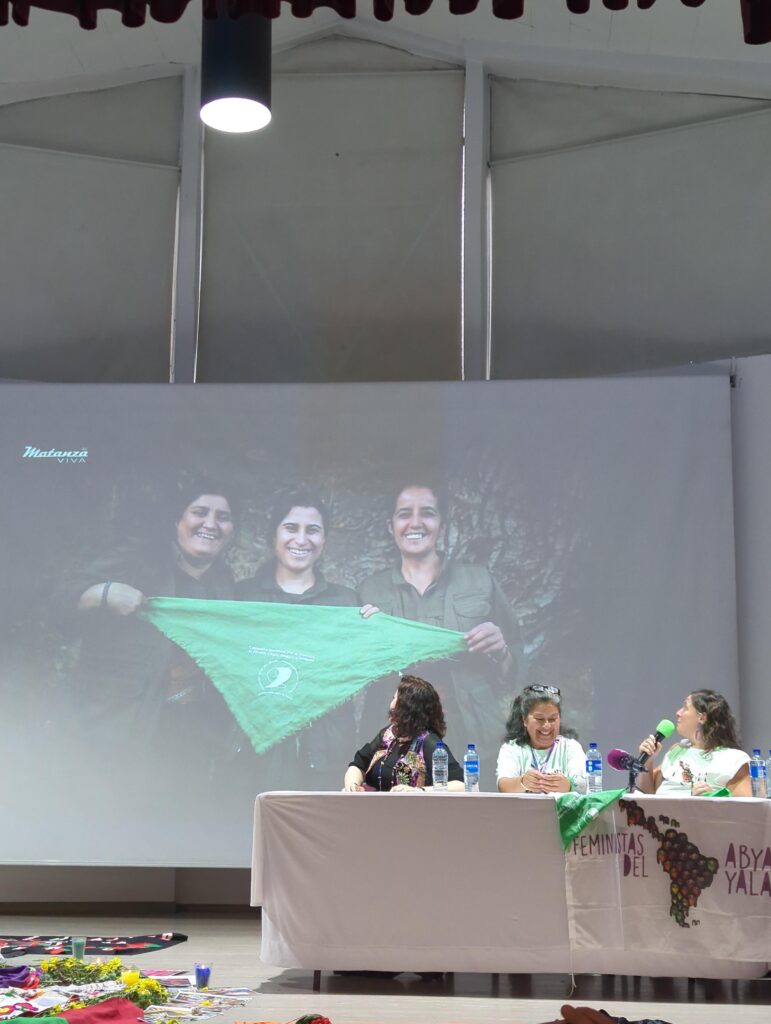
They showed a video from Kurdistan, and the woman who was speaking always had a smile on her face. In other words, the pain is so immense because they kill us, they make us disappear, but we never lose our smile. That is important.
What are your proposals for the future of this network?
We, as FENMUCARINAP, are going to join this process with more power and more strength. My proposal would be to open our hearts, but also to open the doors of our homes in different countries to our sisters. When we are in danger, we can move to another country and find asylum there. We want political asylum, but without giving up on our struggle. Something that we need to strengthen is to feel like compatriots, whether we are Bolivian, Ecuadorian, or from anywhere in Abya Yala. We should never forget to show solidarity and sisterhood among ourselves.
The other proposal that has been put forward is that this great event, with the different bloods of all races, should be transferred to the different countries that we have come to participate in. The entire Andean region was represented here, right? Peru, Ecuador, Bolivia, Venezuela, and Colombia. There are five countries in the Andean region that we are transforming.
Our sisters are dying. They kill us for defending Pachamama. So, it is part of our struggle to raise our voices. And always weaving together the youth with the accumulated youth. We don’t call ourselves old people, we call ourselves accumulated youth. That has to be woven together because the youth give us their strength, with all their strength and mischief. And we give the knowledge and wisdom of how far we have come. So, we have to walk together with all that strength.
Flourishing Despite War
As the conference closed with a public cultural event in a park near the venue, music rose into the Bogotá air. Women embraced before departing for airports, bus stations, and border crossings. Some would return to regions marked by conflict or repression. Others would resume organizing in quieter but equally demanding contexts.
The motto lingered: “We will flourish, because war cannot destroy our roots.” It is both promise and challenge. Flourishing does not deny the reality of violence; it asserts continuity despite it. Roots, after all, grow underground, often unseen. They interlace, strengthen one another, and push upward even after fire.
In Bogotá, women from Abya Yala, Kurdistan, and beyond affirmed that their struggles are interconnected. They named the systems that threaten life and committed themselves to collective resistance. They honored their dead, celebrated their cultures, and drafted plans for the future.
In a world fractured by exploitation and war, they chose to weave.
Link to the final declaration: https://womenweavingfuture.org/declaraci-n-final