
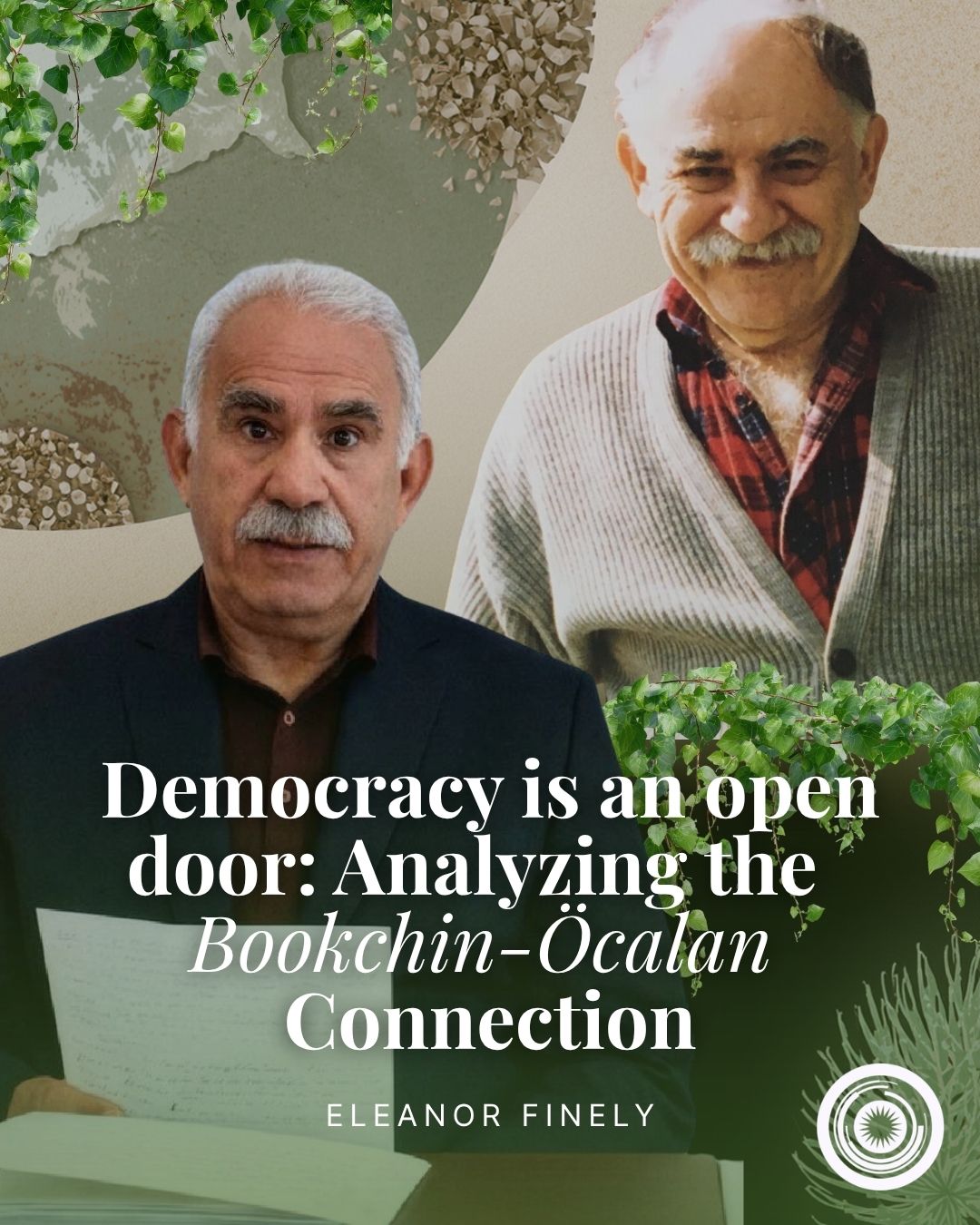
Eleanor Finley, a member of the Institute for Social Ecology (ISE) in Vermont, United States, for the Academy of Democratic Modernity.
Could you present yourself and the Institute for Social Ecology?
I am a political activist and anthropologist who has dedicated my life to studying, sharing, and implementing the ideas of social ecology. Brought up in the imperial capital of Washington, D.C., I have understood from an early age that something is fundamentally wrong with our system of government. The alternative, however, was not clear to me until I discovered social ecology, which occurred just a few months before Occupy Wall Street. Ever since, I have strived to discover the essence of “real democracy,” only to find that its mysteries go on and on. Last year, I published a book that weaves a portrait of social ecology, titled Practicing Social Ecology: From Bookchin to Rojava and Beyondi. It explores not only the theory but also the history of social ecology through movements, where, of course, the Kurdish freedom movement figures prominently.
In this work, I have had the good fortune to be mentored at the Institute for Social Ecology (ISE), a school for revolutionary education that Murray Bookchin founded alongside a then-university student named Daniel Chodorkoff in 1974. The Institute, located in the remote hills of central Vermont, quickly became a beacon for young people to learn skills like organic gardening, ecological architectural design, and renewable energy. These skills were taught in conjunction with dialectical philosophy, critical theory, feminism, and political history. Today, the Institute no longer runs a farm, but continues to teach digital courses, a mentorship program, and an annual seminar. It endures as one of the oldest radical organizations in the US.
Could you say something about the history of the relationship between Murray Bookchin and Abdullah Öcalan and the exchange that they had?
The connection between the ideas of Murray Bookchin and Abdullah Öcalan will surely be discussed by historians for years to come. At first glance, the two men seem to have little in common. Bookchin was a relatively niche intellectual raised in the global metropole of New York City and largely associated with neo-anarchism. Öcalan was born in a small village in Bakur, Kurdistan, yet went on to head a powerful, well-disciplined force of Marxist militants, playing a key role in Middle East politics.
Yet both men have ultimately become figures in the reinvention of socialism as a democratic project. As early as the Cold War, Bookchin was beginning to question the state-socialist demand for party discipline. In 1956, Bookchin led international support for Hungary in its struggle against the Soviet invasion, working alongside his mentor, Josef Weber, and their group, Contemporary Issuesii. Decades later, Öcalan and his circles within the Kurdistan Workers Party undertook a similar reckoning with nationalism, authoritarianism, and the state, opting for a “third way” between Kurdish nationalism and neoliberalism.
Both men also understood what it means to be poor and marginalized. Bookchin came from a family of Russian-speaking Jewish refugees who settled in the Bronx. He was raised in large part by his grandmother, a woman who helped ferment a revolutionary uprising in 1905 as a member of the Socialist Revolutionary Partyiii. Öcalan, born to a struggling family in the Sanliurfa province, was regularly exposed to material deprivation, political disempowerment, and violenceiv. From childhood, Öcalan noted the double oppression girls and women around him suffered, being both Kurds and women in a patriarchal world. These experiences no doubt inspired them toward a more expansive vision of liberation.
The two men did share a brief, indirect correspondence, which can be read herev in its entirety. Nearly a decade before the Rojava Revolution, an imprisoned Öcalan in the midst of peace negotiations with Turkey’s ruling party instructed his lawyers to make contact with Bookchin. This was made possible through a German translator named Reimar Heider as well as Bookchin’s domestic companion, Janet Biehl. No doubt, Öcalan’s letter came as quite a surprise to Bookchin, who was then in the final years of his life and long past his days of political organizing. Their correspondence, nevertheless, shows Öcalan keen to receive Bookchin’s feedback on his manuscripts, writing, describing himself as “a good student” and affirming the Kurdish movement’s determination to realize Bookchin’s ideas in the Middle East. Bookchin, although physically ailing, shows support for the Kurdish democratic project and Öcalan’s intellectual ambition.
Nevertheless, there is a tendency to overstate Bookchin’s influence on Öcalan’s thinking. For one thing, state development in Neolithic Mesopotamia was never merely an intellectual interest for Öcalan; it is the starting point of an ongoing struggle for the existence of some 45 million Kurdish people and their right to a dignified way of life. Furthermore, his philosophy of democratic modernity is clearly in dialogue with other thinkers such as Immanuel Wallerstein, Michael Foucault, and Friedrich Nietzsche. By Öcalan’s own admission, the sociologist Andre Gunder Frank and his book The World System: Five Hundred Years or Five Thousand? represent “the best possible presentation of my views”vi. It is also worth noting that great thinkers like Bookchin and Öcalan help galvanize, synthesize, and catalyze intellectual movements, but they do not own them. The politics of democratic confederalism has been shaped over many centuries of political struggle, and no one person can claim authorship over them.
Where do you see connections between the social ecology developed by Murray Bookchin and the paradigm of democratic modernity developed by Abdullah Öcalan and the Kurdish movement? Where do you see differences as well?
Social ecology and democratic modernity share a cosmology: an understanding of order in the universe as a whole and society in particular. This order is “ecological” in the sense that it is cumulative, relational, and defined by organic continuity. Although society is not reducible to natural history, we can identify the persistence of certain organizational principles. For example, in natural ecosystems, biodiversity is critical to stability. When one pollinator species is threatened, another ten can step in to fertilize the plants. The same principle holds broadly true for people and cultures. The peaceful coexistence of cultures and subcultures allows for greater human flourishing. Just as monocultures are unstable, social conformity causes suffering.
There is thus real substance behind the ecological metaphors we find spread throughout the philosophy of democratic modernity. In the Middle East, an astonishing variety of cultures, religions, languages, and ethnicities has accumulated over thousands of years, since the Neolithic period, in fact. When Öcalan speaks of a rose garden and its thorns, he means the mechanisms by which Kurdish people can protect both themselves and the great diversity of peoples with whom they are organically intertwined. Perhaps this is another way to interpret the powerful phrase “resistance is life”vii.
Another critical overlap in Bookchin’s and Öcalan’s work is a shared understanding of the world-historic significance of state development in ancient Sumer. Conventional Western historiography regards state development as inevitable. In this sense, it is not “historical”, but a natural phenomenon. Drawing on several of the same key sources that inspire Öcalan, Bookchin argued the stabilization of the state in Sumer was neither predestined nor predetermined. He also illuminated that “the state” is not merely a form of government. It is a particular mentality underpinned by a cosmology of rule. As he writes in The Ecology of Freedom (1981)viii,
The State is not merely a constellation of bureaucratic and coercive institutions. It is also a state of mind, an instilled mentality for ordering reality. Accordingly, the State has a long history-not only institutionally but also psychologically.
Decades later, Öcalan gave this worldview a name: capitalist modernity. Capitalist modernity embodies a long, cumulative development of an oppressive apparatus, both as a material reality and as a psychological reality. Yet, at every turn, this development necessarily led to its opposite: the development of a worldview of liberty and resistance. This is what Bookchin means when he says freedom has an “ecology.”
Öcalan also gave this worldview a name: democratic modernity. Democratic modernity reconciles the traditional knowledge of anti-state “organic societies,” such as the Kurds, with the liberatory elements of global modernity. In this way, social ecology and democratic modernity are two faces of the same coin. Social ecology is an expression of democratic modernity, and democratic modernity is an expression of social ecology.
In very recent years, this worldview (or worldviews) has increasingly converged upon a political vision rooted in a conceptual vocabulary of direct democracy, citizenship, popular assemblies, and confederations. In my view, the defining feature of this vision isn’t the structure of federalism, but a recognition that democracy is inherently linked to consciousness and rationality. Furthermore, that consciousness and rationality are developmental processes rooted in natural evolution. Democratic confederalism is thus necessarily open-ended. Democracy is an open door.
Despite these commonalities, social ecology and democratic confederalism really must be seen as independent intellectual histories. One is rooted in what we might see as the best of the Western philosophical tradition and dialectics. The other is rooted in an unbroken, Indigenous connection to land, life, and organic society. Although they arrive at a similar destination, they have different immediate concerns. Democratic confederalism, of course, is about defending and organizing the actual people living in the Middle East today. The other major difference, of course, is the primacy democratic confederalism ascribes to women’s oppression.
How do women’s struggle and ecology relate according to you?
For me, women’s struggle and ecology are at root one and the same. Gender is a tremendously fluid aspect of human life – containing with it innumerable contradictions, paradoxes, openings, and loopholes. However, the fact remains that, under the form of hierarchical society in the last few centuries has become in capitalist modernity, women are the proscribed keepers of life. I mean this in the sense that under capitalist modernity, we bear the children, care for the elderly, mend the wounds, tend the gardens, cook the meals, make the clothes, and maintain the home. At the same time, we have been blocked from politics, terrorized away from the public square, bullied into losing our sanity, humiliated, and shoved into positions of inferiority with respect to men wherever possible. Thus, this hierarchical value system denigrates women and the rest of life, – including children, animals, plants, and the biosphere itself – in the same breath.
The social ecofeminists who have taught and studied over the years at the Institute for Social Ecology are keenly aware of this connection. During the early 1980s, these women led powerful horizontal movements such as the Women’s Pentagon Action, a two-day civil disobedience and guerrilla theater mobilization that temporarily halted operations at the U.S. Department of Defense Headquartersix. Although feminist struggle in the US is undoubtedly at a weak point today, this legacy remains an important resource for future feminist movements.
Women’s struggle is also my personal struggle. It was my mother who brought me and my brothers to the forest as children, who showed us how to navigate the landscape, identify plants and animals, and read the weather. She gave us an ecological education. And yet, society punished her for doing so rather than rewarding her. When my father’s violence resulted in divorce, her time out of the labor market and his control over the family finances left her poor and struggling. Her skill as an educator went unrecognized because there are no mechanisms for recognizing or compensating mothers. In a very real way, then, our mother’s suffering is bound with the suffering of this planet.
In the Kurdish movement, jineolojî is the project of recovering women as a historical subject. It entails valorizing, and, to a certain extent, formalizing women’s traditional skills and knowledge in fields such as health, food production, textiles and handicrafts, and childrearing as the basis of a democratic modernity. Men under patriarchy are largely severed from these tasks, so jineoloji is not just about aiding women, but about training men in the arts of life-keeping.
Western activists often hold a very crude idea of jineolojî. They see it as an essentialist project to assert “woman” as some sacred and timeless entity. In fact, the opposite is the case. To liberate life, we have to liberate women, which means training men to become women in the sense of becoming life-keepers. What could be more queer or ecological than that?
How can social ecology as an approach and a philosophy strengthen internationalism today?
Ecology is more than mere concern, worry, or regard for the environment. It is an awareness that there really is no such thing as an external “environment” and that, rather, human beings are fully integrated within biological systems and relationships. The alienation we perceive between society and nature is a dangerous illusion.
For this reason, the formulation and implementation of democratic confederalism concerns not only Kurds, but all human beings. Not only human beings, but all life on Earth. As Öcalan says time and again, it matters how we formulate our analysis of the problem. All our efforts, no matter how tireless, will be in vain unless we are moving in the right direction. Nationalism, including its socialist varieties, is not moving in the right direction. Even when nation-states implement ostensibly protective environmental policies, they are not structured in an ecological way. They therefore will inevitably fail to protect the full diversity of human and non-human ecosystems.
Social ecology and democratic confederalism strengthen internationalism by providing a liberatory, global alternative. In the place of national identity and belonging, it offers city-based and community-based identity and belonging. This does not mean refusing to take pride in one’s culture, language, or ethnic identity. Rather, it means reinvigorating the city – in all its glorious social and ecological diversity – as the locus of political power and the ground of authentic political action. With the same gesture of going local, social ecology and democratic confederalism go global. They help build a truly global, truly internationalist left by clarifying humanity’s shared history, character, and purpose without erasing the suffering of colonization and inequality.
i Practicing Social Ecology: From Bookchin to Rojava and Beyond. Eleanor Finley. 2025. Pluto Press. https://www.plutobooks.com/9780745346908/practicing-social-ecology/
ii van der Linden, M. (2001). The Prehistory of Post-Scarcity Anarchism: Josef Weber and the Movement for a Democracy of Content (1947-1964). https://www.bopsecrets.org/images/weber.pdf
iiiEcology or Catastrophe: The Life of Murray Bookchin, Janet Biehl. Oxford University Press. 2015. (page 2)
iv International Initiative Freedom for Öcalan – Peace in Kurdistan. https://www.freeocalan.org/biography
v Bookchin- Öcalan Correspondence. Anarchist Archive. https://theanarchistlibrary.org/library/various-authors-bookchin-ocalan-correspondence
vi The Sociology of Freedom. Abdullah Öcalan. PM Press. 2020. (page 10)
vii YJA Star guerrillas: Our resistance is the legacy of Mazlum Doğan. Sema Gabar-Avrin Mazlum. ANF News. https://english.anf-news.com/kurdistan/yja-star-guerrillas-our-resistance-is-the-legacy-of-mazlum-dogan-50752
viii The Ecology of Freedom: The Emergence and Dissolution of Hierarchy. Murray Bookchin. Cheshire Books. 1982. (page 95)
ix Women’s Pentagon Action. Diana Mara Henry Collection, UMass, Amherst. http://exhibits.library.umass.edu/scua/s/diana-mara-henry/page/wpa