
Ecology is one of the greatest social problems and challenges of our time. While the ecological crisis is gaining relevance worldwide and some states are promoting system-internal solutions such as “green capitalism” or the “Green New Deal,” there are ecological movements around the world that are seeking a different, radical solution. Abdullah Öcalan links the ecological crisis to social conditions, arguing that the roots of the ecological crisis can be traced back to the very beginnings of civilization. For the development of alienation among people within society—arising from domination—also brings about alienation from nature. The idea that a solution can be found within a capitalist system is a fundamental contradiction to nature, and the ecological question can only be resolved through a socialist system. The ecosocialist movement, which operates from a Marxist tradition against global capitalism and imperialism, shares a similar perspective. Ecosocialism combines Marxist and socialist principles with environmental activism and draws on concepts such as degrowth. Michael Löwy, a leading thinker in the ecosocialist movement, has already made it clear in earlier discussions that democratic confederalism represents a promising democratic alternative for the Middle East and a meaningful response to the environmental crisis. In May 2026, the “VII International Ecosocialist Encounter” took place, providing an opportunity to speak with Vanessa Dourado, a member of ATTAC Argentina and the Ecosocialistas Collective – an organization within the PSOL1 in Brazil – about the ideas of ecosocialism.
So what was the conference about?
We had a very intense journey where we could debate very important issues related to the ecological crisis, considering also with the perspective of a civilizational crisis. For us, the ecosocialists, this perspective is very important, because we understand that we are now in a crisis, that is global and civilizational. In this sense it’s important to talk about the role of the countries that are imposing wars and also about the necessity of resources for these wars. We are talking about critical materials that are important for the weapons industry directly. We have been discussing about fossil fascism, which was interesting and about the expansion of new technologies and the need for water and other resources for its development. We are facing a multilateral crisis in the world, together with wars imposing more extractivism of critical minerals, especially in the Latin American territories. While more extraction is happening, and fossil fuels are being burned in huge quantities, we hear the rhetoric of ‘energy transition’, which will only promote more extraction. So those issues were important, as was that it was the first conference in which there had been a session about the world of labor, because as ecosocialists we have a perspective on class. Although we know that the labor world has been changing a lot lately there is a narrative saying in a reactionary sense that we are entering the post-work era, that we don’t need workers anymore, that the working class does not exist anymore. But we know that all the value that is created, is thanks to the workers and their labor. So this is a very important debate and also the role of the trade unions, because as socialist we also dream of a post-work future. It is important to involve workers in the discussion of an ecological crisis with an ecosocialist perspective. When we think about this transition, the transition of the capitalist system to an ecosocialist system we will need conversion of industry. And we are not talking about green jobs, we are really talking about a conversion of all the working world. To convert means to discuss with the sectors of fossil fuels and other contaminating jobs and make understandable that it’s not just because we have climate change, it’s because there is no dignity in this work. We want work that is decent work, we want work that respects nature and respects the metabolic relation that we have with nature.
Can you further develop on this relation to nature?
When we are talking about ecosocialism, we understand that in the capitalist system we have a rupture in our relationship as human beings and nature. But those two things cannot be disconnected, we are part of the nature. We have to understand that the human being doesn´t need to take care of nature or save the world, but actually this is a struggle that has a lot to do with our species and how we are going to guarantee that we human beings are going to continue our existence in this world. It’s the most important issue of our times, this metabolic rupture and the importance to reconnect with nature and to restore this social and metabolic relationship.
As we are living in a global crisis, in a global system, our answer also has to be a global one. What is your perspective on internationalism?
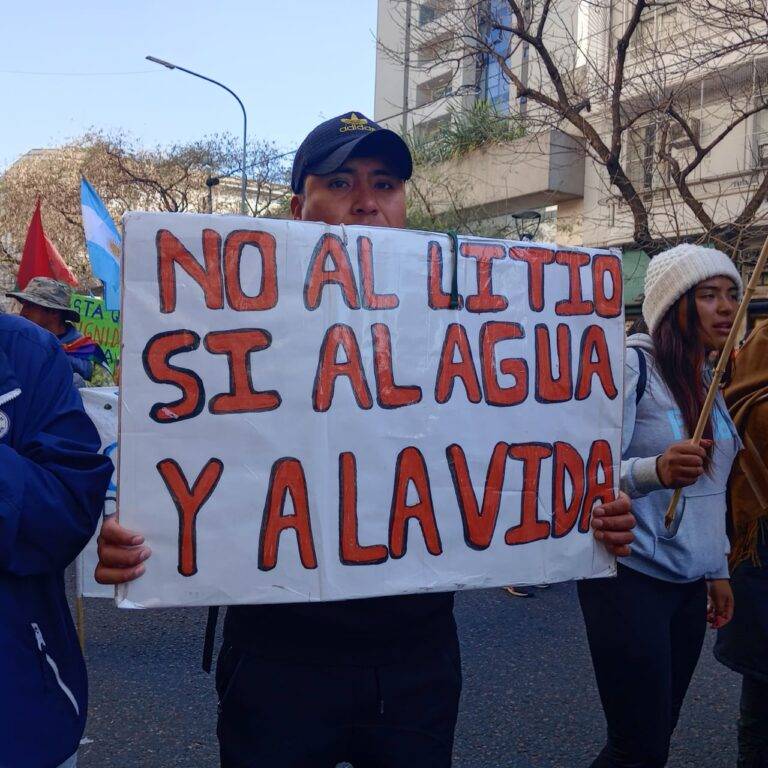
There is something that has been happening since 2024, when we first had the conference in Latin America, creating this dialogue between the North and the South. The global North and the global South have different perspectives. You think according to your feet; If your feet are in a place, you are going to think just where your feet are, this is what Paulo Freire used to say. Our mind thinks where our feet step so it’s very important to get to know the difference of perspectives and alternatives that are being developed in the global North and in the global South. This also means the alternative has to be an alternative for everyone. It cannot be an alternative for the global North which has negative consequences in the global South. A transition for the North based on minerals from the South will perpetuate extractivism. There is the need to debate other perspectives and that has to include the perspectives of indigenous peoples, it has to include the perspective of the peasants and it has to include the perspective of those who are most oppressed by this system. The South is in the periphery of this system so we have different problems and also we have different populations and many of those populations are in areas of risk. Areas of risk are the areas of sacrifice. Zones of sacrifice relate to the big projects of big international companies that undertake extractivism. So there are people being displaced and also murders happening. Many of those who defend territories are being murdered. And meanwhile what we see is that the indigenous people and the peasants are responsible for protecting nature so it is a reality that is different from the reality of the North. We must also think about environmental racism because we know that the consequences of these ecological crises are going to be deeper in some territories and the majority of them are in the global South. So it is really important to get a synthesis of our thoughts so that we can think together and see and try to find alternatives that could be important for everyone and not just for one part of the world.
What can we learn from the perspectives of indigenous peoples?
We have a lot to learn from them. Not only about their “technologies of life” but also to think in a different way about our relationship with nature. We know that we have internalized this idea of modernity and this is part of the problem, because this modernity, this industrial model of modernity really create the separation between us and nature. Modernity makes us think about nature as a resource and we, the ecosocialists, we think this idea is a mistake and we see that it is our relationship to nature that is essential to our own survival. So we cannot see nature as a market and we are completely against those relations of mercantilization and financialization of nature. So we also think that we need to plan how to organize a movement, a mass movement.
So how are we going to organize a mass movement?
This is one of our main challenges, because we know a lot of people are very worried about the environment. Many people are very worried about climate change and we see young people on street for this cause especially. It was also a radicalization of Greta herself saying that capitalism was the problem but what we can see is that this movement does not really have a perspective on a transition to another model. So it is not enough just to think that we need to surpass capitalism, we need to think what we want to put in place of capitalism. That’s why ecosocialism is pushing forward the discussion on what we are going to put in place of the things we don’t want. So instead of just challenge the crisis and getting tired by reactionary politics, we also try to push forward the necessity and need for hope. But not a naive hope; We need to have hope together with the action, and the possibility of building a different world. We have tools to make it possible, we have more possibilities than we know. We just need to mobilize, we need to have more conscience about this crisis. We need to have the conscience that there is a system, a structure, and we need to attack the structure, the root of this crisis. There is the need of being courageous to build something different and create the power, the necessary power to make it happen.
1Partido Socialismo e Liberdade – Socialism and Liberty Party