Recent years have seen a steady escalation of the Third World War, and the emergence of a crisis within the capitalist system which, without restraint, normalises war – both between states and within society. We have shared the warmth of solidarity in Italy’s streets, the opposition to European rearmament policies, and the mobilisation of millions of people, through a mix of spontaneity and organisation. In this context, we have often faced the difficulty of piecing together the reality shaped by capitalist modernity. There has been frequent discussion of the risk inherent in so-called ‘campist’ approaches to international solidarity. We have sensed the danger of falling into narratives suggesting that one must choose the ‘lesser evil’, or that one people’s struggle for liberation must necessarily conflict with another’s.
In an age of unprecedented access to information, we are simultaneously bombarded by fake news and deliberate disinformation; all of this is generating what neuroscience has defined as ‘learned helplessness’, that is, the passive acceptance of the simplest reality as a reaction to overstimulation. We are living through what has in fact been defined as a special war, which does not necessarily involve us in an armed conflict, but primarily attacks our democratic capacities and our ability to forge social bonds. To overcome these problems, often caused by an idealistic approach based more on abstractions than on the material conditions of oppressed peoples, we are convinced that it is necessary to listen to the voices of the people and hear their stories of the struggle for freedom. Sharing these critical issues with various Italian democratic forces has led, on two separate occasions, to the organisation of two public events for reflection and in-depth discussion.
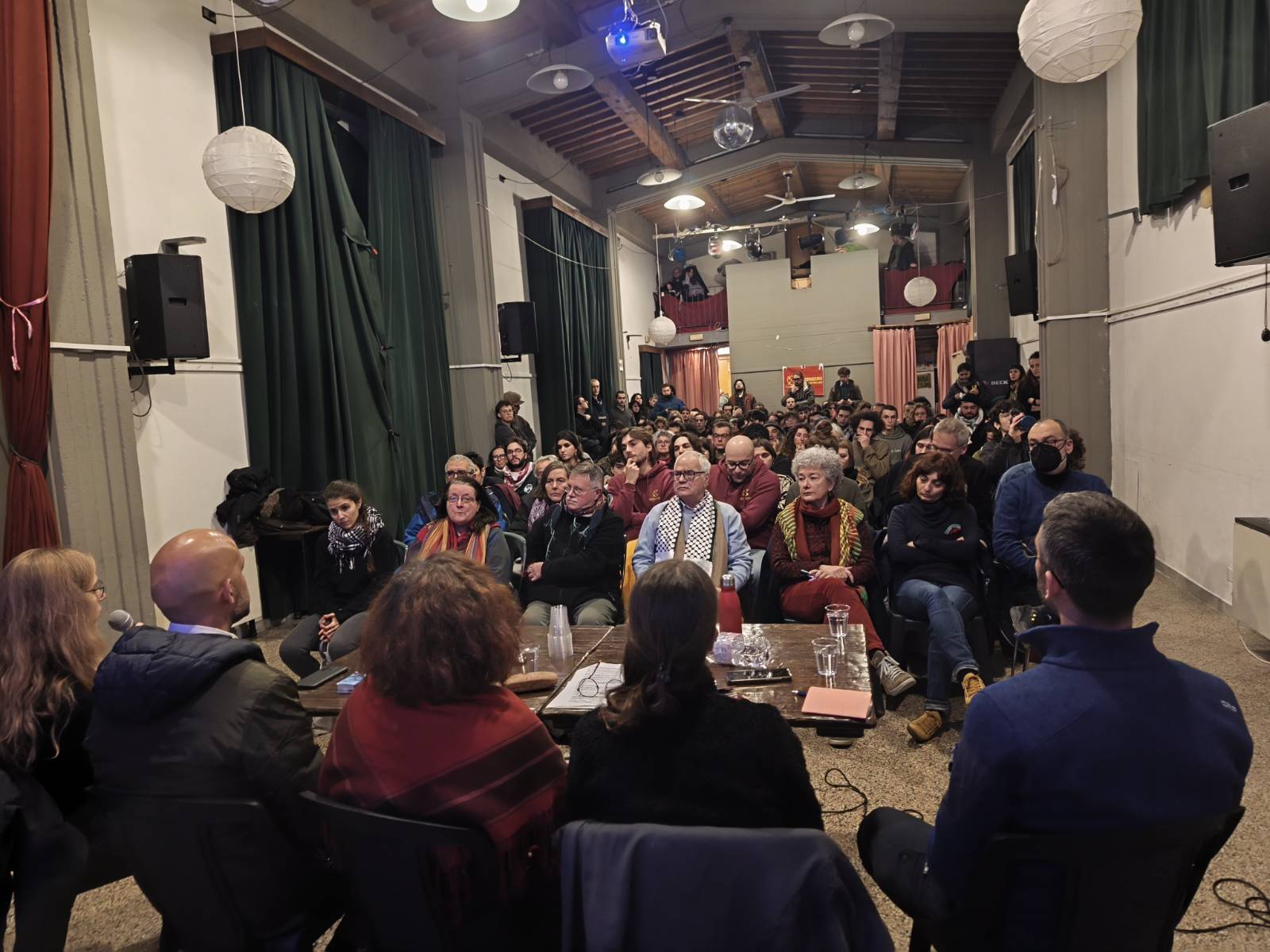
In January and April 2026, in Florence and Rome, two conferences were held, organised in collaboration with the Academy of Democratic Modernity, involving activists from Italy and from Kurdistan (Bakur and Rojhelat), Palestine and Iran. The primary aim of the events was to inform through the voices of those at the forefront of the struggles, to clarify the mosaic of identities in the Middle East, and to highlight the resistance movements of yesterday and today in order to build a vision of unity in diversity.
The two events were attended by several hundred people in total, as well as various media outlets. The various Italian democratic forces, in Florence and Rome respectively, reiterated that, in the context of a multipolar and fragmented Third World War, we must avoid falling into camp-based solidarity and instead build international convergence. During the speakers’ presentations, a desire emerged to develop a discourse that goes beyond mere solidarity with an oppressed, often victimised people, and to understand how a vision of a society based on solidarity and democracy can be promoted. The need to envisage continuity between struggles is glaringly apparent in the wake of the mass mobilisations, in solidarity with Palestine and against rearmament, which swept across Italy in 2025 and are re-emerging to coincide with the second mission of the Sumud Freedom Flotilla, yet which struggle to foster constructive collaboration among organisations and social movements.
These themes – solidarity and the unity of differences – have long been embraced by the Collettivo di Fabbrica Operai ex GKN in Florence, co-organiser of the first event. In an interview, one of the collective’s public figures stated clearly: ‘We started with the motto “Let’s rise up” and as we went along we realised we had to unite, to “converge”. Only the convergence of struggles can bring about real change; we need to bring together different experiences to shift the balance of power.’ The dispute at the former GKN began as a collective of workers fighting against the closure of their factory, but for four years now it has been waging a battle for ecological industrial reconversion, the revival of cooperative work, and the fight for fair and dignified work. GKN has broadened its horizons to become a point of reference for democratic and environmentalist forces, and more recently, for the opposition to the arms industry.
The Rete 25 Aprile Roma Est, co-organiser of the second event, is the network that brings together social and political groups in the eastern part of Rome, and for four years has been working to forge a common path between groups with very different histories and methods of struggle. Starting from a desire to bring the partisan struggle into the present day and move beyond a mere commemoration of 25 April, the Network has become a platform for organisation and a meeting point in the city. The revitalisation of the values of the resistance and of society’s self-defence, at the heart of the network’s initiatives, was also the main theme of the April event.
Luciana Romoli (partisan of the Garibaldi Brigade in Rome), Zylan Diyar (activist with Women Weaving the Future and TJK-E1), Sharif Hamad (Palestinian activist from Gaza), Maryam Fathi (activist with KJAR2 and TJK-E), and Neguin Bank (an activist with Donna Vita Libertà-Rome) were the speakers at the meetings, providing a historical overview of their respective peoples’ resistance. The talks demonstrated how the various resistance struggles have become intertwined, sometimes converging, sometimes less so, but sharing the oppression of the imperialist and colonial system, patriarchal domination and attempts to erase minorities.
During the meetings, the role that the formation of nation-states has played and continues to play in the implementation of an imperialist model in the Middle East emerged. In particular, the creation of the Turkish state and the State of Israel served as a springboard for British interests first and then US interests. The importation of the nation-state model exacerbated problems already present in a system based on tribal structures, authoritarianism and heavily influenced by religion. A monolithic model of a single state, a single flag and a single identity was imposed on a multicultural social fabric with multiple identities. This is how, on the one hand, divisions between peoples were fuelled, whilst on the other, economic agreements were forged to serve the hegemonic powers. If we look specifically at these two states, we can clearly see how, beyond the false propaganda of confrontation between the Turkish and Israeli governments, significant economic relations have been established away from the spotlight. Turkey, for example, was Israel’s fifth-largest economic partner, with substantial trade, including in the military sphere.
But, as Neguin Bank pointed out during the second event, solidarity and internationalist relations must be rebuilt on a different level, one that is not that of the state. Indeed, the Iranian regime’s economic support for certain Palestinian parties does not justify its cruelty and anti-democratic nature, nor does it automatically create an alliance between oppressed peoples.
History teaches us that relations have not been confined to governments, but have primarily existed between revolutionary movements; there is, for example, a historical solidarity between the Palestinian and Kurdish resistance movements. It was in the Palestinian camps of the Bekaa Valley that the PKK began organising its guerrillas, and it was in supporting the Palestinian struggle for self-defence against Israel that it lost twelve fighters.
The principles of internationalism have been the foundation of the historic relationship between the Palestinian resistance and the Kurdish guerrillas, our comrades told us. This solidarity and friendship means fighting to ensure that all peoples, identities, faiths and socio-political groups already living in the same territories are on an equal footing and enjoy democracy, prioritising the building of a democratic society rather than the creation of new nation-states or forms of separation, aware that, as emerged during the debate, the enemy is also internal: whilst fighting the imperialism that comes from outside, we must not forget to tackle internal reactionary and nationalist tendencies.
Sharif Hamad expressed this clearly in the two meetings: ‘We must be united, because we have a single future’ and, reflecting on his childhood, ‘I grew up with photos of Abdullah Öcalan, Che Guevara, George Habas, Yasser Arafat, and all the revolutionaries of the world in my home, because the struggle is one’.
Paving the way, as is already happening, to shape the future, is the struggle of women.
Women are the vanguard of every resistance, as the partisan Luciana Romoli noted; their perspective is fundamental to creating a just and free society. The establishment of autonomous struggle organisations, such as the Women’s Defence Groups, during the Italian Resistance against Nazi-Fascism, is certainly not a unique experience but the result of a desire for liberation that recurs many times and in different places throughout the history of humanity’s struggles. Whether in Kurdistan, Iran or Palestine, women have played a central role in the resistance and in the development of revolutionary thought; figures such as Sakine Cansiz, killed by the Turkish secret services in France in 2013, or Marzieh Ahmadi, killed by the secret services of the Shah’s regime in Tehran, were remembered during the events as martyrs of these historic struggles, united by the same desire for freedom. The slogan, born of 50 years of liberation struggle, “Jin Jiyan Azadi” (Woman, Life, Freedom) has spread widely, from the free mountains of Kurdistan to Iran and then across the world, because it represents a proposal for a paradigm of liberation for women who are oppressed in every part of the world.
At the Rome meeting, it emerged that the struggle of the mothers represents a continuum of social strength expressed among these oppressed peoples, and how, therefore, the Mothers of Khavaran in Iran, the Mothers of Saturday in Turkey, and Women Wage Peace in Palestine have been able to transform profound individual grief into the most genuine collective resistance.
Beyond the millions of people who have fallen in these struggles, the backbone of the internationalist struggle must be the demand for freedom for political prisoners. All the speakers called for the spotlight to be turned on the thousands of Palestinians, Kurds, Persians and people of all nationalities who remain in detention. In particular, it is urgent that attention be drawn to the political prisoners in Iran who, in the shadow of the conflict between the regime and the United States, continue to be executed weekly in silence.
International campaigns such as that for the release of the two Sumud Freedom Flotilla activists, Thiago Avila and Saif Abukeshek, abducted by the Israeli army during an operation against the humanitarian mission in international waters, demonstrate the strength of international solidarity and can serve as an opportunity to shed light on prisons and all political prisoners.
In short, these initiatives are attempts to rise to today’s challenge, which hinges primarily on seeking dialogue and points of convergence between struggles. We must overcome dogmatic approaches and recognise the contradictions faced by every people and every democratic force, avoiding simplistic homogenisation and acknowledging the infinite nuances that make up societies. Resistance is not organised through ideological homogeneity; rather, internationalist solidarity must also be understood as a process of mutual transformation. Questioning one’s own shortcomings and convictions, learning from and strengthening one another, involves relearning how to cooperate and engage in constructive discussion. These are issues that are increasingly coming to a head amongst democratic forces in Italy and Europe, capable of vibrant solidarity yet also unable to overcome hyper-fragmentation. The ‘sun of the future’ is not a given; it will not come if we merely wait for it. As the hotspots of war increase day by day, the planet is on the brink of an unprecedented ecological crisis and our social capacities are under constant attack, it is necessary to rediscover the ability to build together.
1 TJK-E, Kurdish Women’s Movement in Europe
2 KJAR, Organisation of Free Women of Rojhelat